
Northern Ireland Priority species (NIPS)
| CHROMOPHYTA : Sporochnales : Sporochnaceae | BROWN ALGAE |
Carpomitra costata (Stackhouse) Batters
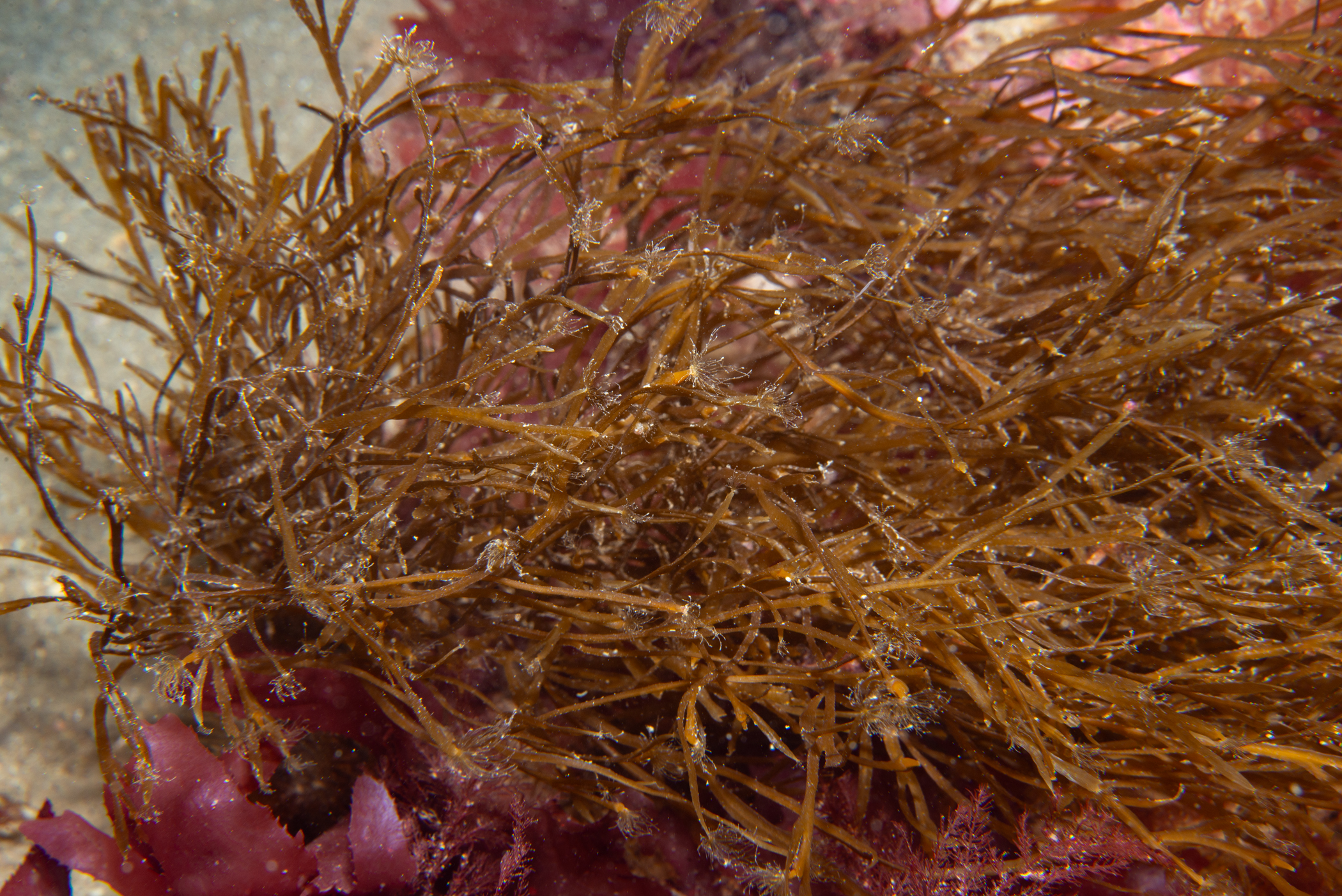 |
| Carpomitra costata |
This seaweed is rare and is only found in the sublittoral zone.
In brief
- Only found on the north and east coasts of County Antrim.
- Grows only in the sublittoral zone.
- Probably a summer annual.
- It is a rare sublittoral species.
- No main threats known except general threats to the coastline.
Species description: This seaweed forms erect, branching light brown fronds which grow to about 25 cm long, are about 2 mm wide with a distinct midrib. The tips of the fronds show tufts of hair-like filaments.
Life cycle: Unilocular sporangia are borne in sori (reproductive structures producing spores) terminal on the branches. It has been shown that in laboratory cultures an alternation of generations does exist. The spores from the unilocular sporangium form a microscopic gametophyte bearing antheridia (male) and oogonia (female) which produce a new plant.
Similar species: Dictyota dichotoma and Dictyopteris polypodioides are both flat and show slight similarity; however, Dictyota does not have a midrib while Dictyopteris is much broader, up to 15 mm. Neither have tufts of filaments at the tips of the fronds.
How to see this species: Carpomitra costata grows on rock in the sublittoral zone to 37 m deep and is tolerant of sand cover. It is probably a summer annual. In Northern Ireland it has been recorded from the north and east coasts of County Antrim. Elsewhere it has been recorded from the west of Ireland, west of Scotland, south-west of Wales, England and Atlantic Europe.
Current status: Rare. Nationally scarce. Potentially data deficient due to only being found in the sublittoral.
Why is this species a priority in Northern Ireland?
- Criterion 3: Rare or restricted range – rare breeding species confined to 5 hectads or less (based on expert judgement).
Threats:
- Generally vulnerable to changes in coastal habitat and the sublittoral.
Action: Records of new sites for this species, with details of habitat and population are always valuable. Observations with a photograph can be recorded using iNaturalist, find the MBDP-NI iNaturalist project here.
Alternatively, records can be sent to CEDaR, National Museums Northern Ireland, 153 Bangor Road, Cultra, Holywood, County Down, BT18 0EU. Tel 028 9039 5257, e-mail cedar.records@nationalmuseumsni.org, or via the online portal.
Objectives:
- Maintain the number of viable populations of the species.
- Maintain the range of the species.
Conservation:
- Rathlin Island is a Marine Protected Area with multiple designations.
Distribution Map from NBN: Carpomitra costata at National Biodiversity Network mapping facility, data for UK.
iNaturalist: Carpomitra costata at iNaturalist World Species Observations database.
WoRMS: Carpomitra costata at World Register of Marine Species. Accepted name: Carpomitra costata (Stackhouse) Batters, 1902. AphiaID: 145910.
Classification: Biota; Chromista; Harosa; Heterokonta; Ochrophyta; Phaeophyceae; Fucophycidae; Sporochnales; Sporochnaceae; Carpomitra
| Previous species | Next species |
| Adapted from text by Osborne Morton (2026). Carpomitra costata. (Stackhouse) Batters. [In] Priority species, Marine Biodiversity Portal NI. https://www2.habitas.org.uk/marbiop-ni/priorityaccounts.php?item=ZR4850. Accessed on 2026-09-13 |