
Northern Ireland Priority species (NIPS)
| RHODOPHYTA : Gigartinales : Calosiphoniaceae | RED ALGAE |
Schmitzia hiscockiana Maggs et Guiry
 |
| Schmitzia hiscockiana |
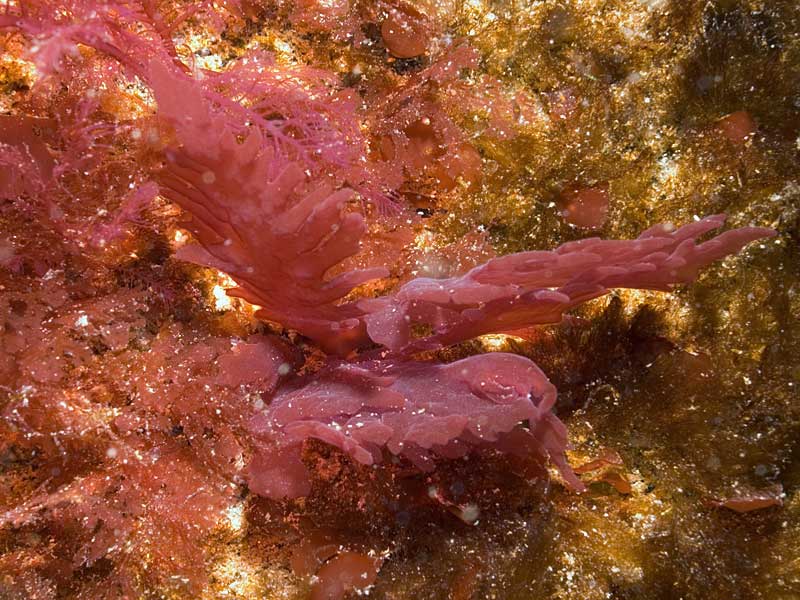
This is a small rare red seaweed discovered and named in 1985 for the first time in the world. It has no common name.
In brief
- Small red marine algae found at seven sites in Northern Ireland.
- It is scarce, with Northern Ireland being an Irish stronghold for this species.
- The only threat is to its habitat and thought to be sensitive to water quality.
- The most obvious stage of its life cycle is of a plant which is soft and mucilaginous growing in tufts, mature plants up to 8 cm long. The other stages are small or microscopic.
Species description: This alga has three stages (or phases) in its life cycle; each is different in appearance. The upright stage is soft, gelatinous and no more than 8 cm long, 6 cm wide and a few millimetres thick. It is flattened and divided in a leaf-like manner with marginal proliferations. Rose pink in colour. Under the microscope the blades can be seen to be composed of a filamentous axis bearing whorls branchlets. These whorls branchlets branch to form a cortex.
The second stage is microscopic and concerned with the fertilization and release of spores. The third stage (or phase) grows in a crust-like manner, is of firm texture, small, only 6mm in diameter and is bright red in colour. It also releases spores. The second and third stages are very small, one is microscopic.
Life cycle: The life cycle of the red algae is complex. The upright (gametophyte) stage of this species has male and female sex cells. After fertilization the second stage (or phase), which is microscopic, develops (the carposporophyte), it remains attached to the female plant and when mature it produces spores (carpospores). These spores, when released, grow and develop to form a crust-like alga quite different in appearance from the other stages and closely attached to a substrate. This crust-like stage (the tetrasporophyte) produces spores in fours which, when released, settle and grow to form the upright (gametophyte) stage, thus completing the cycle.
Similar species: This species is a flattened plant quite distinct from other species of Schmitzia.
How to see this species: Schmitzia hiscockiana has been recorded from seven sites in Northern Ireland: Rathlin Island, Murlough Bay, Torr Head, Loughan Bay and Ringfad Point in Co. Antrim and Lighthouse Island and near Rue Point in Strangford Lough, Co. Down. It occurs only where there is strong wave action or tides at depths of 4-17m on cobbles and pebbles. It is best searched for by scuba-diving.
Current status: Nationally scarce, data deficient.
Why is this species a priority in Northern Ireland?
- Criterion 3: Rare or restricted range – rare breeding species confined to 5 hectads or less (based on expert judgement).
Threats:
- Habitat degradation, through physical damage or loss of water quality.
Action: Records of new sites for this species, with details of habitat and population are always valuable. Observations with a photograph can be recorded using iNaturalist, find the MBDP-NI iNaturalist project here.
Alternatively, records can be sent to CEDaR, National Museums Northern Ireland, 153 Bangor Road, Cultra, Holywood, County Down, BT18 0EU. Tel 028 9039 5257, e-mail cedar.records@nationalmuseumsni.org, or via the online portal.
Objectives:
- The status of Schmitzia hiscockiana will be surveyed and monitored and appropriate conservation action undertaken if required.
Conservation:
- Rathlin Island is a Marine Protected Area with multiple designations.
- Strangford Lough is a Marine Protected Area with multiple designations.
Distribution Map from NBN: Schmitzia hiscockiana at National Biodiversity Network mapping facility, data for UK.
iNaturalist: Schmitzia hiscockiana at iNaturalist World Species Observations database.
WoRMS: Schmitzia hiscockiana at World Register of Marine Species. Accepted name: Schmitzia hiscockiana Maggs & Guiry, 1985. AphiaID: 145603.
Classification: Biota; Plantae; Biliphyta; Rhodophyta; Eurhodophytina; Florideophyceae; Rhodymeniophycidae; Gigartinales; Calosiphoniaceae; Schmitzia
| Previous species | Next species |
| Adapted from text by Osborne Morton (2026). Schmitzia hiscockiana. Maggs et Guiry. [In] Priority species, Marine Biodiversity Portal NI. https://www2.habitas.org.uk/marbiop-ni/priorityaccounts.php?item=ZM5590. Accessed on 2026-09-13 |