
Northern Ireland Priority species (NIPS)
| RHODOPHYTA : Hapalidiales : Hapalidiaceae | RED ALGAE |
Phymatolithon calcareum (Pallas) Adey et McKibbin
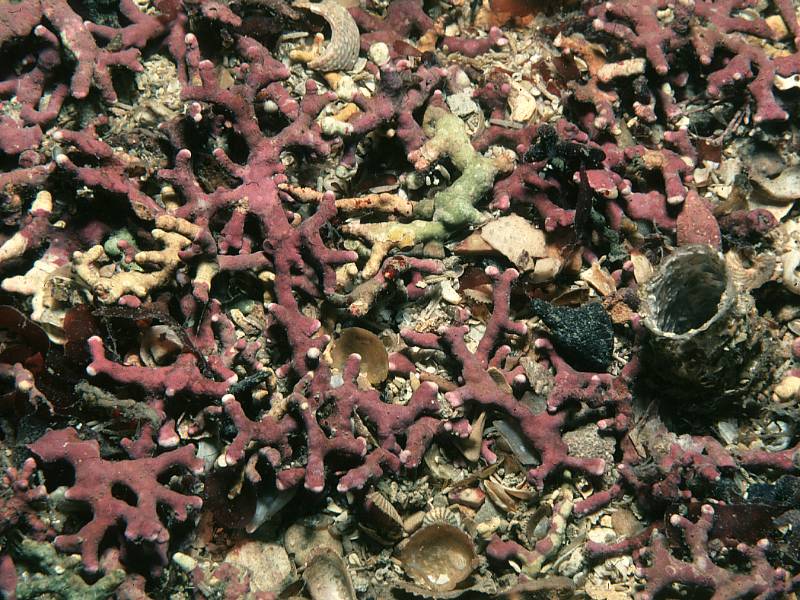 |
| Phymatolithon calcareum |
Phymatolithon calcareum is a red seaweed and a coralline alga, that is, an alga which is calcified and hard in texture.
In brief
- Phymatolithon calcareum has been recorded from several sites in Northern Ireland; in both Counties Antrim and Down.
- It is an unattached, branched, coralline alga.
- Living or dead it occurs in extensive deposits referred to as ‘maerl beds or banks’ below low-water mark.
- Phymatolithon calcareum is scarce in Northern Ireland.
- Threats include anchoring, harvesting, eutrophication and obstruction of water flow.
Species description: Phymatolithon calcareum is a small branched, unattached alga. It is hard in texture being encrusted or impregnated with calcium carbonate. It exists either as an unattached branching plant varying from a single branch to a subglobular or flattened branching system about 7 cm in diameter. The colour is mauvish-brown but changing somewhat when dry.
Life cycle: It is assumed that the unattached plants in Northern Ireland (in fact all of Britain and Ireland) propagate vegetatively, possibly by animal activity. In other countries other stages in the life cycle have been found.
Similar species: Unattached plants of other species contribute to the maerl beds. The differences between the species are microscopic.
How to see this species: Unattached plants occur in the sublittoral maerl beds, mostly in sheltered areas. It has been recorded from several sites in County Antrim including Rathlin Island, Garron Point, Red Bay, Ballygally Head and on the north side of Belfast Lough. In County Down it has been recorded in Strangford Lough and also near Stalka Rock and north of Greenore Point, both in Carlingford Lough. It is best looked for by SCUBA diving.
Current status: Nationally scarce. Phymatolithon calcareum has been recorded at several sites in Northern Ireland from 1985 to 1996. Sites in County Antrim include Rathlin Island, Garron Point, Ballygalley Head and on the north side of Belfast Lough. In County Down it has been recorded in Strangford Lough and also near Stalka Rock and north of Greenore Point, both in Carlingford Lough.
Why is this species a priority in Northern Ireland?
- Criterion 1: Internationally listed species.
Threats:
- Commercial extraction for use as a soil conditioner on acidic ground, as an animal food additive, for the filtration of acid drinking water and in pharmaceutical and cosmetic products.
- Scallop dredging has been identified as the biggest impact on maerl beds of both maerl, by breaking and burying the thin layer of living maerl, and the associated species. Other types of mobile fishing gear are also likely to damage the living layer of maerl on top of the bed.
- Heavy anchors and mooring chains could cause considerable damage to maerl beds.
- Eutrophication, which causes smothering of the maerl by excess growth of other seaweeds and increased sedimentation.
- Finfish farms nutrient and chemical discharges that can affect the fauna associated with maerl beds may be affected.
- Mussel aquaculture could cause damage to maerl beds as the production of pseudo-faeces could smother the live maerl.
- Obstruction to water flow building of barrages, causeways and bridges are potential blockages to water flow, causing fine sediment particles to accumulate between the maerl fragments and smother the bed.
Action: Records of new sites for this species, with details of habitat and population are always valuable. Observations with a photograph can be recorded using iNaturalist, find the MBDP-NI iNaturalist project here.
Alternatively, records can be sent to CEDaR, National Museums Northern Ireland, 153 Bangor Road, Cultra, Holywood, County Down, BT18 0EU. Tel 028 9039 5257, e-mail cedar.records@nationalmuseumsni.org, or via the online portal.
Objectives:
- The status of Phymatolithon calcareum will be surveyed and monitored and appropriate conservation action undertaken if required.
Conservation:
- Rathlin Island is a Marine Protected Area with multiple designations.
- Strangford Lough is a Marine Protected Area with multiple designations.
- Implementation of the Northern Ireland Habitat Action Plan for Maerl Beds.
- Red Bay was designated as a Special Area of conservation.
Distribution Map from NBN: Phymatolithon calcareum at National Biodiversity Network mapping facility, data for UK.
iNaturalist: Phymatolithon calcareum at iNaturalist World Species Observations database.
WoRMS: Phymatolithon calcareum at World Register of Marine Species. Accepted name: Phymatolithon calcareum (Pallas) W.H.Adey & D.L.McKibbin ex Woelkering & L.M.Irvine, 1986. AphiaID: 145199.
Classification: Biota; Plantae; Biliphyta; Rhodophyta; Eurhodophytina; Florideophyceae; Corallinophycidae; Hapalidiales; Hapalidiaceae; Phymatolithon
| Previous species | Next species |
| Adapted from text by Osborne Morton (2026). Phymatolithon calcareum. (Pallas) Adey et McKibbin. [In] Priority species, Marine Biodiversity Portal NI. https://www2.habitas.org.uk/marbiop-ni/priorityaccounts.php?item=ZM4910. Accessed on 2026-09-13 |