
Northern Ireland Priority species (NIPS)
| MAMMALIA : Cetartiodactyla : Balaenopteridae | MAMMALS |
Balaenoptera acutorostrata Lacépède, 1804
Minke whale
 |
| Balaenoptera acutorostrata |
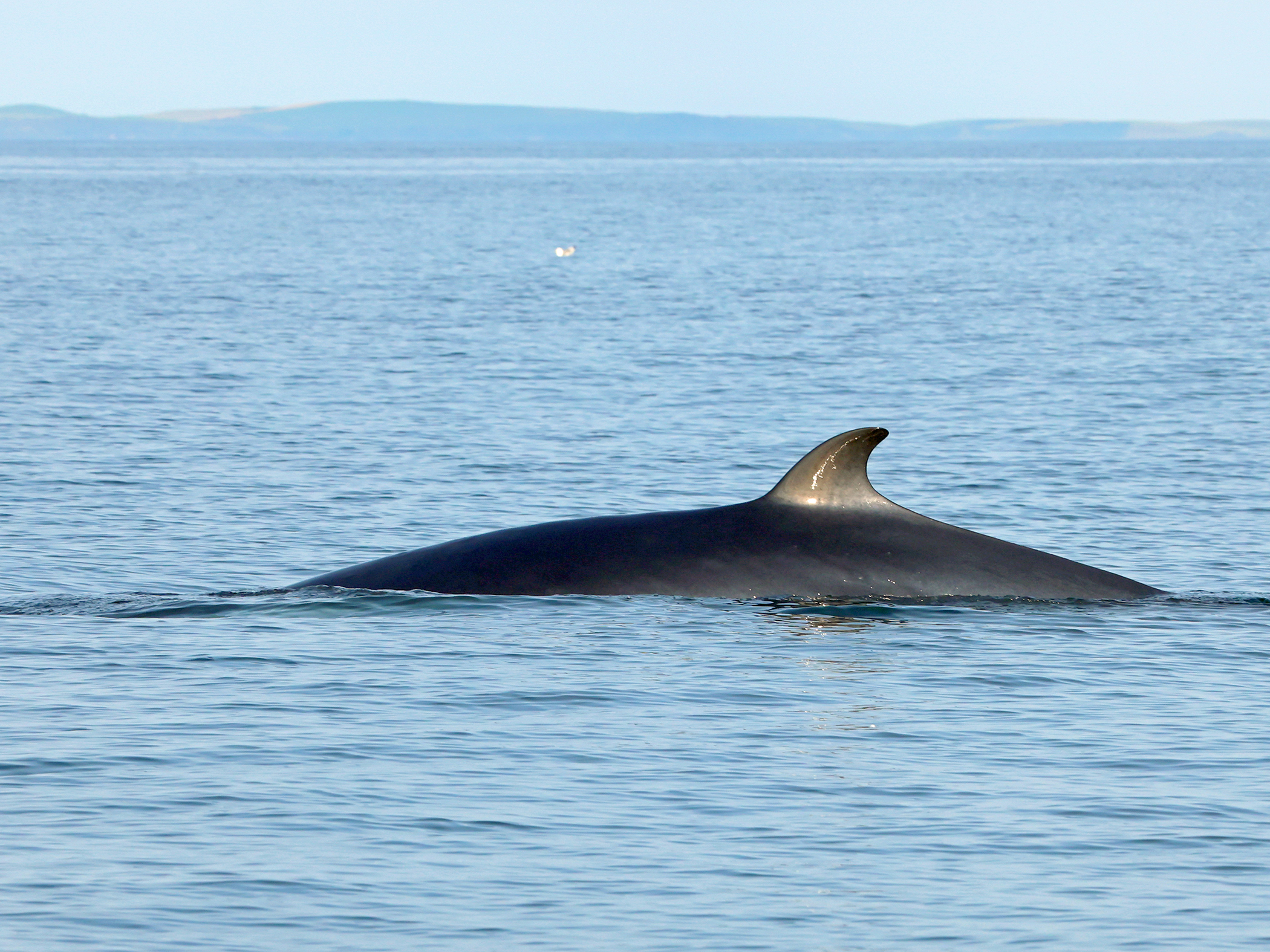
The Minke whale is the smallest and most common of the baleen whales found around the coast of Northern Ireland.
In brief
- Recorded from all around the Northern Ireland coast, especially the north coast.
- Most records are from May to October.
- Listed as a UK Priority species.
- The common minke whale is listed as Least Concern on the IUCN Red List.
- Although there has been a global moratorium on commercial whaling in place since 1986, in the North Atlantic minke whales are still killed each year through commercial hunts conducted by Norway, aboriginal subsistence hunts in Greenland, with occasional commercial hunts by Iceland.
Species description: The Minke whale is the smallest and most common of the baleen whales found around the coast of Northern Ireland. The head is flat, narrow and pointed with a sharp central ridge that runs from in front of the two blow holes to the edge of the upper lip. Numerous throat grooves (between 50 and 70) extend halfway along the body and allow the throat to expand when the whale is feeding. There are between 200 and 350 short (less than 20 cm long) cream/yellow baleen plates on each side of the upper jaw. They are dark grey dorsally with lighter grey or white markings ventrally. The have distinctive white bands on the upper side of their pectoral fins.
Life cycle: Minke whales are found throughout the world’s oceans. There are three geographically distinct populations – in the North Pacific, North Atlantic and Southern Hemisphere. They appear to be more common in cooler waters and are often seen inshore. Minke are fast swimmers and can reach speeds of up to 20 kilometres per hour. Some populations are thought to migrate, feeding in colder waters in summer, then moving to warmer waters in winter where breeding takes place and the young are born (December/ January). Minke whales are thought to become sexually mature at around six or seven years of age. Pregnancy lasts about 10 to 11 months and a single calf may be produced every two years. At birth, the calf weighs about 450 kg and measures 2 to 3 m. It is suckled for about seven months and grows rapidly. Minke whales may live for up to 50 years. Minke whales are usually seen singly but, where feeding is good, small groups of two or three may be seen. They generally feed on krill and small fish.
Similar species: May be confused with the Sei, Fin or Northern Bottlenose whale. The sight of the blow and the dorsal fin at the same time occurs only with Sei and Minke whales. Only Minke whales have white bands on their pectoral fins.
How to see this species: Sightings off the coast of Northern Ireland have increased over recent years as whale-watching becomes more popular. The best places for whale-watching are headlands, islands and bays when the sea is calm. They are most commonly seen off the north coast of Northern Ireland but can be seen all around the coastline.
Current status: Stable, with population thought to have partially recovered from historic whaling pressures, but still below historic levels. The total population of common minke whales in the North Atlantic is estimated to be over 170,000 to 220,000 individuals (International Whaling Commission, 2026).
Minke whales are regularly seen off the Northern Ireland coastline.
Why is this species a priority in Northern Ireland?
- Criterion 1: Internationally listed species.
Threats:
- Commercial hunting for Minke whales in the North Atlantic presents a major threat to the British and Irish population. Despite the introduction of a global moratorium in 1986, Norway, Greenland and occasionally Iceland still hunt minke whales. The most recent quota set by Norway was over 1100 whales, an increase on previous years, and they engage in commercial whaling. Greenland hunts under an exception granted for aboriginal subsistence and is limited to under 200 animals a year across both east and west territories. Iceland engages in commercial whaling but mostly targets fin whales.
- Entanglement in fishing gear, especially pot lines and creels. Once entangled it is extremely difficult and dangerous to free a trapped whale, although a specialist Large Whale Disentanglement Team does exist.
- Collisions with ships. This is an increasing problem as shipping traffic has hugely increased in number of vessels as well as speed of vessel.
- Attacks by killer whales.
- Ocean pollution (chemical and noise). Whales and dolphins communicate mainly by sound and they also use sound to navigate and find food. Many man-made sounds are introduced into the oceans and some of these, such as noise due to seismic exploration for oil and gas and disturbance from marine traffic, may pose a threat to whale and dolphin populations.
Action: Records of new sites for this species, with details of habitat and population are always valuable. Observations with a photograph can be recorded using iNaturalist, find the MBDP-NI iNaturalist project here.
Alternatively, records can be sent to CEDaR, National Museums Northern Ireland, 153 Bangor Road, Cultra, Holywood, County Down, BT18 0EU. Tel 028 9039 5257, e-mail cedar.records@nationalmuseumsni.org, or via the online portal.
Objectives:
- Maintain the current range and abundance of the Minke whale.
- Encourage water users to act appropriately where they may be cetaceans, e.g. maintain steady course and speed, do not approach the animal(s), slow down if animal(s) suspected ahead.
Conservation:
- They are protected under Schedule 5 of the Wildlife (Northern Ireland) Order 1985.
- Whale hunting and intentional killing, injury or disturbance is illegal in Northern Ireland waters.
- There is a global moratorium on commercial whaling, although there are some exceptions granted.
- Protected under Bern Convention (Convention on the Conservation of European Wildlife and Natural Habitats)Appendix III.
- Listed on Habitats Directive, Annex IV.
- Covered by Conservation Regulations (NI), Part III.
- Covered under CITES Annex A.
- Listed under The Conservation (Nature Habitats, etc.) Regulations (Northern Ireland) 1995, amended 2004 - Part 2 and Part 3.
- Listed under The Conservation of Habitats and Species Regulations 2010 - Part 2 and Part 3.
Distribution Map from NBN: Balaenoptera acutorostrata at National Biodiversity Network mapping facility, data for UK.
iNaturalist: Balaenoptera acutorostrata at iNaturalist World Species Observations database.
WoRMS: Balaenoptera acutorostrata at World Register of Marine Species. Accepted name: Balaenoptera acutorostrata Lacépède, 1804. AphiaID: 137087.
Classification: Biota; Animalia; Chordata; Vertebrata; Gnathostomata; Tetrapoda; Mammalia; Theria; Cetartiodactyla; Cetancodonta; Cetacea; Mysticeti; Balaenopteridae; Balaenoptera
| Previous species | Next species |
| Picton, B.E., Keatley, L. & Morrow, C.C. (2026). Balaenoptera acutorostrata. Lacépède, 1804. [In] Priority species, Marine Biodiversity Portal NI. https://www2.habitas.org.uk/marbiop-ni/priorityaccounts.php?item=ZK1320. Accessed on 2026-09-13 |