
Northern Ireland Priority species (NIPS)
| PISCES : Gadiformes : Gadidae | BONY FISH |
Gadus morhua Linnaeus, 1758
Cod
 |
| Gadus morhua |
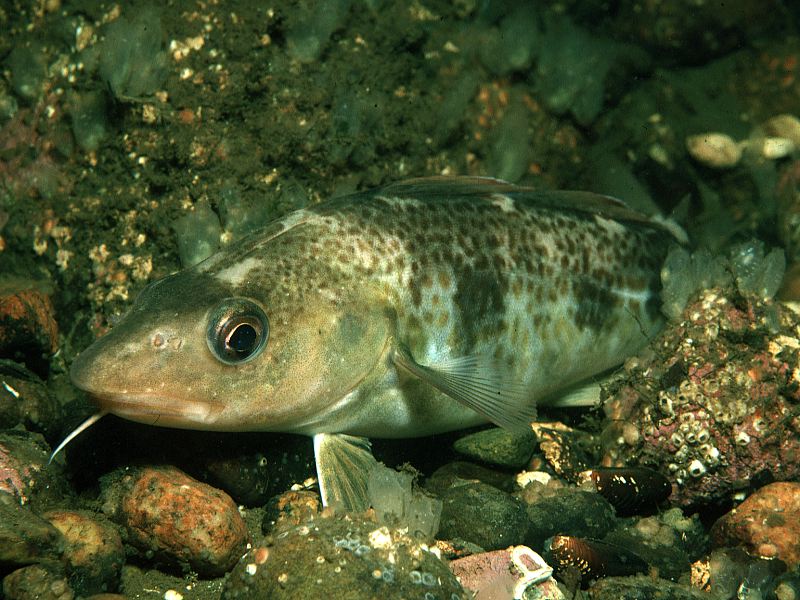
Cod belongs to a family of fish known as gadoids which includes species such as haddock, pollack, pouting and ling. It has a distinctive barbel below the lower jaw which it uses to search for food on the seabed. Cod is found all around the coasts of Britain and Ireland and is one of the UK’s most popular seafood’s. As a result it has been fished extensively in UK waters. Cod are often found in large dense shoals making them an easy target for fishermen.
In brief
- Widely distributed around the coast of Northern Ireland
- Found in a variety of habitats from the shoreline to >200 m
- Listed as vulnerable on the global/European IUCN Red List, its population is declining in the Irish Sea
- Commercially valued seafood; sport fish for anglers, the waste and offal are used in fish meal, and the liver oil is used as a by-product
- Main threat from overfishing, while climatic change is affecting recruitment
Species description: Cod is a stout bodied fish with a muscular head and a fairly long chin barbel. It has relatively small eyes, three dorsal fins which are all close together at the base and two anal fins. The upper jaw overhangs the lower and the lateral line is continuous with a smooth curve above the pectoral fin. The tail can be square or rounded. The background colour of cod can vary from greenish to sandy brown with dark or light mottling on its back and sides, the underneath is white. Average cod measure about 120 cm and weigh 11.3 kg, the maximum reported age is 25 years. Cod usually forms shoals during the day, while at dawn and dusk searches for food on the seabed and mid-water. Adults eat crustaceans, worms, brittle stars and fish. Juvenile cod feed on small crustaceans.
Life cycle: Cod in the Irish Sea spawn from late February to early April, with spawning areas situated in coastal areas. Adults can make considerable migrations to spawning grounds, although little is known on their exact movements. The eggs are transported by currents before hatching after approximately 12 to 24 days, dependent on seawater temperatures. Older and larger cod have been found to produce larger eggs with neutral buoyancy, which is important for egg and larval survival. The age of maturity varies regionally being 3 years in the Irish Sea. Juvenile cod remain in the water column feeding on plankton before settling onto the seabed at about 50 mm in length. Irish Sea cod are some of the fastest growing cod in the world, being close to the species southern range.
Similar species: Juvenile cod can look similar in shape and colouring to juvenile whiting Merlangius merlangus, however cod has a chin barbel where whiting does not.
How to see this species: Adult cod are a deepwater species so is rarely seen in its natural habitat, juvenile cod are sometimes seen in relatively shallow water by divers. Cod are targeted by sea anglers and codling (young cod) are often caught along our northern shore line.
Current status: Declining. The Irish Sea stock of cod has declined ten-fold since the late 1980’s and is well below safe biological limits as defined by fishery scientists.
Why is this species a priority in Northern Ireland?
- Criterion 1: Internationally listed species.
- Criterion 2: Decline based on available data and expert judgement.
Threats: The main threat to cod is overfishing. In previous years cod was significantly widespread and abundant. Since the 1980’s stocks of cod have been harvested unsustainably, as it is a long-lived species and currently has low recovery this makes it particularly vulnerable. Scientists advised in 2011 that if no action was taken cod was likely to become extinct in the next 10 years.
Due to the aggregating behaviour of cod it is still possible to find areas where there is a high density even at low abundance. This in turn can lead to high catches in specific areas and the possibility of low levels of fishing effort causing high numbers of cod being removed from the stock.
There is evidence that the reduction in the number of young cod produced by a specific stock per year could be due to a combination of reduced numbers of females old enough to reproduce and poor environmental conditions corresponding with above-average sea temperatures. The minimum landing size for cod in EU waters is 35 cm however the approximate size at which 50% of females first spawn is 60-70 cm. The removal of females before spawning reduces the ability of the stock to be replenished.
Action: Records of new sites for this species, with details of habitat and population are always valuable. Observations with a photograph can be recorded using iNaturalist, find the MBDP-NI iNaturalist project here.
Alternatively, records can be sent to CEDaR, National Museums Northern Ireland, 153 Bangor Road, Cultra, Holywood, County Down, BT18 0EU. Tel 028 9039 5257, e-mail cedar.records@nationalmuseumsni.org, or via the online portal.
Objectives:
- Undertake further research to understand climatic/recruitment processes
- Commerical fishing for this species should be significantly reduced or stopped as the stocks have crashed and not been allowed to adequately recover. Catches have been documented as steadily decreasing since 2000, despite the implementation of the measures listed below.
- Increase minimum landing size to more than 70 cm in order to allow females to reach sexual maturity and start to contribute to replenishing the population.
- In addition anglers should adopt the catch and release programme in particular with large female cod, or consider not targeting a declining species at all.
- Discourage consumption of cod in favour of more sustainable alternatives.
Conservation:
- The cod fishery is currently managed through a combination of closed spawning areas, TACs and measures associated with days at sea and gear restrictions.
- On OSPAR list of Threatened and/or Declining Species and Habitats.
- NERC Act 2006 Species of Principal Importance in England (section 41) and Wales (Section 42).
- Listed as Vulnerable on Global IUCN Red List.
- Included in the Grouped Species Action Plan for commercial marine fish.
Distribution Map from NBN: Gadus morhua at National Biodiversity Network mapping facility, data for UK.
iNaturalist: Gadus morhua at iNaturalist World Species Observations database.
WoRMS: Gadus morhua at World Register of Marine Species. Accepted name: Gadus morhua Linnaeus, 1758. AphiaID: 126436.
Classification: Biota; Animalia; Chordata; Vertebrata; Gnathostomata; Osteichthyes; Actinopterygii; Actinopteri; Teleostei; Gadiformes; Gadidae; Gadus
| Previous species | Next species |
| Adapted from text by Robert Rossell (2026). Gadus morhua. Linnaeus, 1758. [In] Priority species, Marine Biodiversity Portal NI. https://www2.habitas.org.uk/marbiop-ni/priorityaccounts.php?item=ZG1730. Accessed on 2026-09-13 |