
Northern Ireland Priority species (NIPS)
| PISCES : Anguilliformes : Anguillidae | BONY FISH |
Anguilla anguilla (Linnaeus, 1758)
European eel
 |
| Anguilla anguilla |
The only eel found in fresh water, this species is still of commercial importance to Northern Ireland despite major international decline.
In brief
- The European eel is found in most lowland rivers and lakes in Northern Ireland
- It prefers slow flowing or still water
- It is mainly nocturnal and is best seen in commercial fisheries, or when migrating between fresh and salt water
- Its NI priority status reflects its IUCN listing as critically endangered, while still relatively abundant in NI, and supporting a major fishery
- A pan-European decline in recruitment of juvenile glass eel from its oceanic breeding phase has not been attributed to a single cause and is probably multifactorial
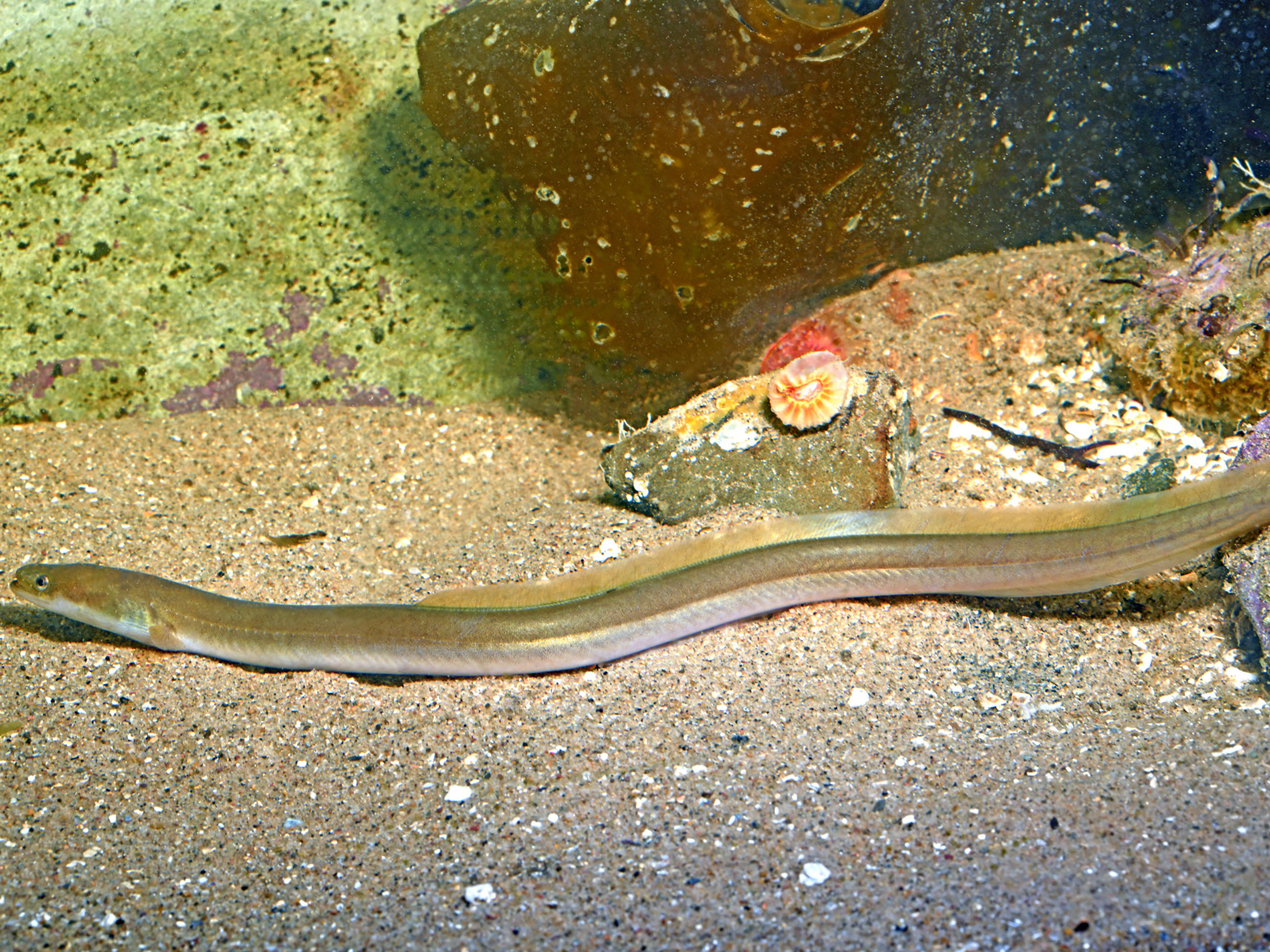
Species description: An elongated fish, growing to 0.5 metres (males) and 1 metre (females) in Irish waters. Un-mistakable in fresh water, it can be distinguished from juvenile lamprey, conger or moray eel by its protruding lower jaw, small blunt teeth, rounded pectoral fins, a long single dorsal fin starting closer to the vent than the gill openings, and minute scales embedded in the skin.
The European eel is of commercial importance as a high value food species, being harvested in the wild and also reared in aquaculture. The life cycle has never been completed in captivity. (adapted from Wheeler, 1978)
Life cycle: Spawning has never been definitively observed. The concensus is that there is effectively a single spawning stock or the breeding area in or near the Sargasso Sea, north of the Caribbean. Flattened “leptocephalus” (leaf-like) larvae drift or migrate using transatlantic currents to North Eastern Atlantic coasts, where they metamorphose to the familiar elongated form and move into fresh water and reduced salinity coastal waters as transparent “glass eel” and “elvers”. Maturing “yellow” or “brown” eels are found in fresh water from North Africa to Northern Norway. After 6 to 40 years in Irish waters yellow eels metamorphose to “silver” eels and make the return migration to their spawning grounds.
Similar species: The European eel is the only European representative of the genus Anguilla, family Anguillidae, found in Irish waters. The genus has about 12 species world-wide. The similar A. rostrata occurs in North America
How to see this species: Determined observers may still see the 7 cm long “Glass eel” entering estuaries at night on rising tides from January to March. From April to July these transparent glass eel become black or brown “elvers” and will enter rivers, climbing wet surfaces out of water where progress is impeded. The mass influxes of glass eel and elver once seen annually are much reduced since the 1980s. Despite declining recruitment, the “yellow” phase of the eel is still common in Irish lakes and rivers where they have access from the sea. Eels are commercially fished in Lough Neagh, county Antrim, the last remaining large single source eel fishery in Europe. Approximately 3 tonnes are exported daily from the Fishermens’ co-operative at Toomebridge, from May to September. Silver eels are fished at specialized weirs on the River Bann as they leave Lough Neagh. Silver eel are caught, transported and released live downstream of Hydroelectric turbines on the Erne and Shannon rivers. Eels are readily caught at night on hooks baited lines with fish or earth worm, but may now no longer be legally retained by rod and line anglers.
Current status: Declining. Considered critically endangered on IUCN Redlist, which is the closest level to extinct in the wild.
The eel is currently listed in the Ireland Red list as “Critically endangered”. This listing reflects its global IUCN status. Taken over Europe as a whole it has suffered recruitment decline, measured as numbers of glass eel entering coastal waters, of 95% to 99% over a period of 30 years since the 1980s. It has been listed as a CITES appendix 2 species since March 2009.
Commercial Eel fishing is still of commercial importance to Northern Ireland, The Lough Neagh fishery maintains 150 to 200 mixed seasonal and full time jobs and is the largest remaining single site fishery in Europe. Fishing is carried out under a management plan drawn up to meet the requirements of the 2009 EU eel regulation aimed at recovery of the internationally depleted stock. The regulation permits exploitation only where it can be shown that spawning emigration is maintained at 40% or more of pristine levels. The Lough Neagh fishery is maintained by importation of glass eel, also permitted under the regulation, from estuarine fisheries where these are still able to be fished.
Why is this species a priority in Northern Ireland?
- Criterion 1: Internationally listed species.
- Criterion 2: Decline based on available data and expert judgement.
Threats: The pan-European decline in recruitment of glass eel from the Atlantic ocean to estuaries and freshwater cannot be ascribed to any particular cause, and is probably multi-factorial. Possible contributing causes listed with some evidence in the literature are:
- Changes in Ocean Circulation and/or or temperature
- Overfishing
- Habitat loss in Fresh Water
- Damage to spawning migrants and restriction of upstream migration at hydropower dams
- Impact of Anguilliculoides crassus, an introduced nematode swim-bladder parasite of Anguilla japonica
- Increases in predators once persecuted by man
- Loss of spawner fitness through bio-contaminating chemicals
Action: Records of new sites for this species, with details of habitat and population are always valuable. Observations with a photograph can be recorded using iNaturalist, find the MBDP-NI iNaturalist project here.
Alternatively, records can be sent to CEDaR, National Museums Northern Ireland, 153 Bangor Road, Cultra, Holywood, County Down, BT18 0EU. Tel 028 9039 5257, e-mail cedar.records@nationalmuseumsni.org, or via the online portal.
Objectives: The current objectives in Northern Ireland are compliant with the EU eel regulation on stock recovery. Actions include fishery restrictions to ensure compliance with biomass escapement targets, and where fisheries have been closed, actions to allow recruits access to freshwater and ensure free passage to sea of silver eels.
Anglers and Commercial Fishermen should be aware of and comply with regulations. Riparian and waterway owners should be aware where eels are present and ensure free passage in and out of ponds, past weirs and abstractions.
Conservation:
- The Eel management plans drawn up under the EU Eel Regulation were incorporated into Northern Ireland law with the enactment of the Eel Fishing Regulations (Northern Ireland) 2010. (Statutory Rules of Northern Ireland 2010 no 166). Under these regulations, which came into operation on 1st June 2010, all commercial eel fishing is prohibited in Northern Ireland with the exception of Lough Neagh and the existing eel weirs on the Lower River Bann. Anglers may no longer retain eel caught on rod and line anywhere in Northern Ireland.
- Fishing for trap-and transport of silver eel past the River Erne hydro-electric stations is permitted under section 14 of the Fisheries Act (Northern Ireland) 1966, as can be any fishery activity for the purposes of research or monitoring of stocks.
- Legal provisions exist in the 1966 fisheries act to enforce fitting of eel passes to weirs or other man made barriers built after 1842. For weirs built before that date, construction of a pass can be legally enforced where the weir is modified, repaired or water abstracted for a changed use (e.g. hydropower generation).
- CITES Appendix II listing of the eel in 2009 requires any movement of glass eel to aquaculture outside Europe to be accompanied by a “non-detriment” finding.
- Trade within Europe is regulated by the EU Eel Regulation.
Distribution Map from NBN: Anguilla anguilla at National Biodiversity Network mapping facility, data for UK.
iNaturalist: Anguilla anguilla at iNaturalist World Species Observations database.
WoRMS: Anguilla anguilla at World Register of Marine Species. Accepted name: Anguilla anguilla (Linnaeus, 1758). AphiaID: 126281.
Classification: Biota; Animalia; Chordata; Vertebrata; Gnathostomata; Osteichthyes; Actinopterygii; Actinopteri; Teleostei; Anguilliformes; Anguillidae; Anguilla
| Previous species | Next species |
| Adapted from text by Robert Rossell (2026). Anguilla anguilla. (Linnaeus, 1758). [In] Priority species, Marine Biodiversity Portal NI. https://www2.habitas.org.uk/marbiop-ni/priorityaccounts.php?item=ZG120. Accessed on 2026-09-13 |