
Northern Ireland Priority species (NIPS)
| PISCES : Lamniformes : Cetorhinidae | CARTILAGINOUS FISH |
Cetorhinus maximus (Gunnerus, 1765)
Basking Shark
 |
| Cetorhinus maximus |
A large, long-lived shark which is unlikely to be confused with any other species. Populations are thought to be stable but depleted and therefore this species is internationally listed.
In brief
- Largest fish found around Britain and Ireland.
- Internationally listed species.
- Populations in this region are currently thought to be stable but well below historic levels.
- While this species is well protected by various legislations these require enforcement and monitoring.
- It remains at risk from various threats including climate change, fishing and future offshore development.
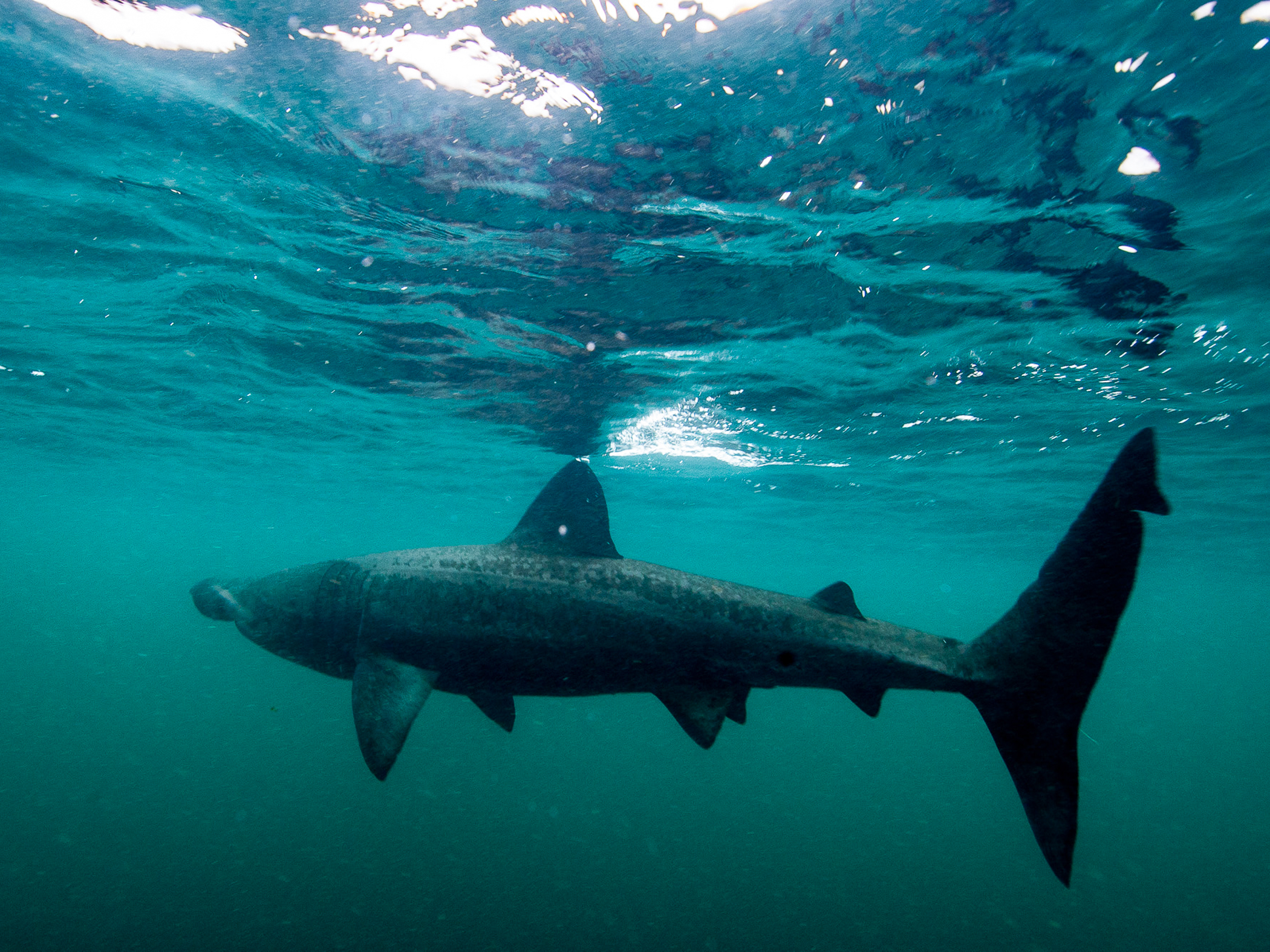
Species description: The basking shark is the largest fish that occurs in the waters around Britain and Ireland and the second largest fish in the world (the largest being the whale shark). It is easily recognised by its great size (usually around 7.5 m but may be up to 11 m), and five very large gill slits. It normally swims along close to the surface with its first dorsal fin, snout and tail fin breaking the surface. It feeds by filtering huge quantities of seawater through its gills and trapping planktonic organisms on its gill rakers. The coloration is greyish-brown to black with lighter mottling, the gills are bright red.
Life cycle: These are a relatively long-lived (around 50 years) and slow to mature species with males reaching sexual maturity between 12-16 years and females between 16-20 years. Mating occurs in the summer months (May-June) with the female giving birth to live young, after a long gestation period.
Similar species: There are no similar species found in this region.
How to see this species: The basking shark has been recorded from all around the coasts of Britain and Ireland, with some 'hotspots' off the west coast of Ireland in recent years.
The majority of sightings of basking sharks have been in the summer months and mainly on days when the sea is calm enough to distinguish the large fins and snout breaking the surface. Despite its enormous size it feeds on planktonic organisms such as tiny crustaceans, jelly-fish and comb-jellies.
Current status: Endangered. Populations are depleted but currently thought to be stable.
Why is this species a priority in Northern Ireland?
- Criterion 1: Internationally listed species.
Threats:
- Alteration of habitat due to climate change or developments such as offshore wind farms.
- Disturbance from humans whether accidental or deliberate, this can disrupt feeding patterns and courtship behaviours. Any tour or boat operators should always operate in such as way as to create no disturbance to these nature behaviours.
- Fishing - disturbance of natural behaviours and accidental bycatch are risks to this species.
- Collisions with ships - marine traffic has increased significantly and this species is especially at risk when feeding close to the surface.
- Pollution affecting water quality and availability of food.
Action: Records of new sites for this species, with details of habitat and population are always valuable. Observations with a photograph can be recorded using iNaturalist, find the MBDP-NI iNaturalist project here.
Alternatively, records can be sent to CEDaR, National Museums Northern Ireland, 153 Bangor Road, Cultra, Holywood, County Down, BT18 0EU. Tel 028 9039 5257, e-mail cedar.records@nationalmuseumsni.org, or via the online portal.
Objectives:
- Monitor and maintain current population levels.
- Identify any important areas for breeding, feeding or migration, and ensure these receive adequate protection.
- Enforce responsible boating/human encounters.
- Take movements and behaviour of this species into account when planning any future developments including wind farms.
Conservation:
- Listed as endangered on Irish and European Red List. Globally listed as vulnerable.
- On OSPAR List of Threatened and/or Declining Species and Habitats.
- Listed on Bern Convention on the conservation of European wildlife and natural habitats Annex II.
- Protected under Wildlife (NI) Order Part 1 Schedule 5, 6 and 7.
- Protected under the Wildlife and Natural Environment (WANE) Act (Northern Ireland) 2011.
Distribution Map from NBN: Cetorhinus maximus at National Biodiversity Network mapping facility, data for UK.
iNaturalist: Cetorhinus maximus at iNaturalist World Species Observations database.
WoRMS: Cetorhinus maximus at World Register of Marine Species. Accepted name: Cetorhinus maximus (Gunnerus, 1765). AphiaID: 105837.
Classification: Biota; Animalia; Chordata; Vertebrata; Gnathostomata; Chondrichthyes; Elasmobranchii; Neoselachii; Selachii; Galeomorphi; Lamniformes; Cetorhinidae; Cetorhinus
| Previous species | Next species |
| Picton, B.E., Keatley, L. & Morrow, C.C. (2026). Cetorhinus maximus. (Gunnerus, 1765). [In] Priority species, Marine Biodiversity Portal NI. https://www2.habitas.org.uk/marbiop-ni/priorityaccounts.php?item=ZF250. Accessed on 2026-09-13 |