
Northern Ireland Priority species (NIPS)
| PISCES : Rajiformes : Rajidae | CARTILAGINOUS FISH |
Raja montagui Fowler, 1910
Spotted Ray
 |
| Raja montagui |
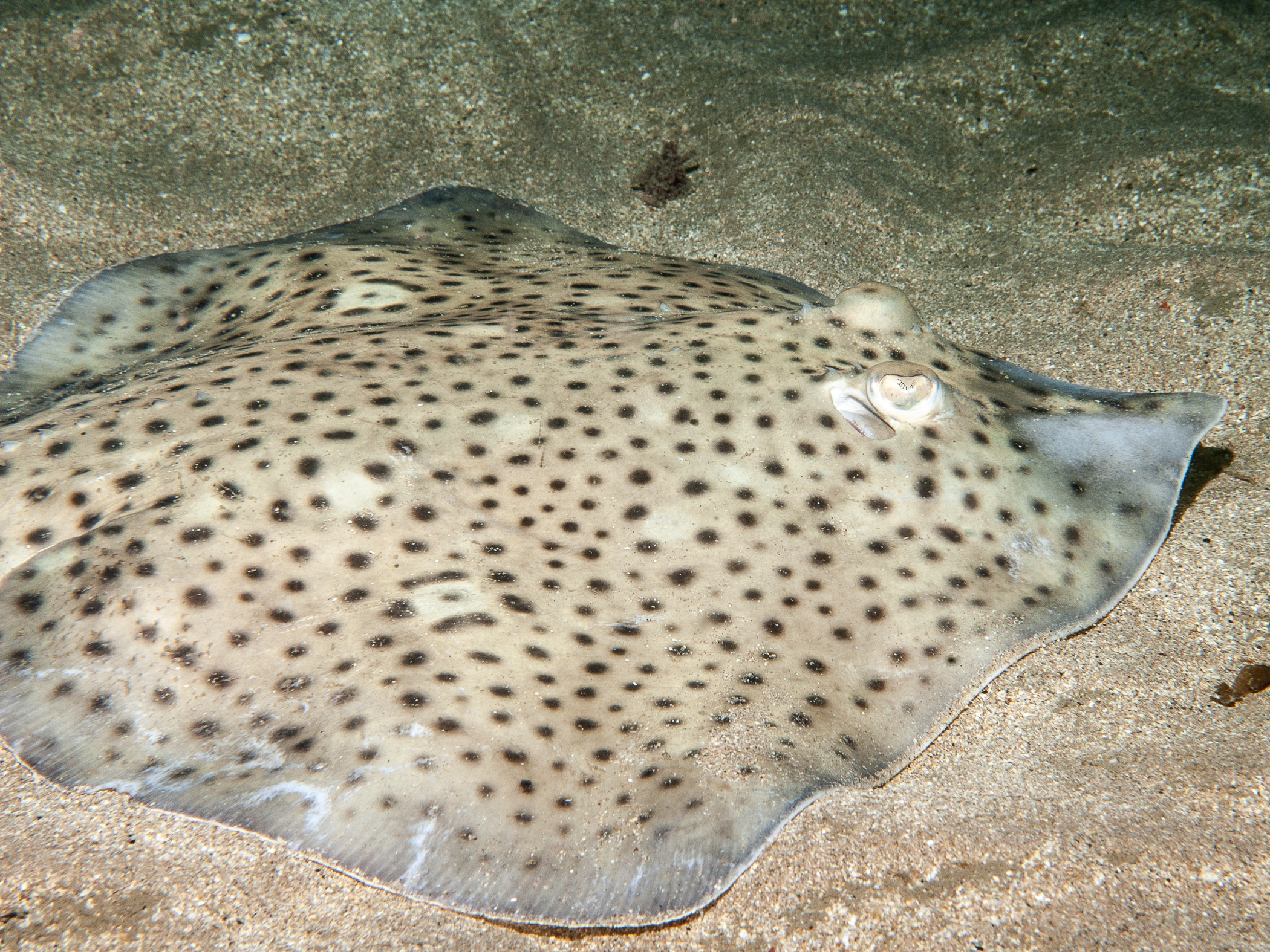
This skate is superficially similar to the thornback skate and reaches up to 75 cm. The upper surface is usually a pale yellow-brown with numerous dark brown to black spots and patches.
In brief
- Pale yellow to brown with dark brown to black spots on upper surface.
- Currently listed as Least Concern, but data deficient.
- Recreational records suggest a decline in numbers of mature adults.
- Main threats come from bycatch mortality and habitat damage.
Species description: The spotted skate has a flattened, diamond-shaped body with broad wing-like pectoral fins and a long tail. There are small spines on the front edge of the disc in young fish, in adults these spines extend to behind the eyes. The posterior part of the disc is free of spines, apart from one central row of large spines which runs from the centre of the disc, along the tail to the first dorsal fin. Young fish also have rows of spines along the sides of the tail. The upper surface of the ray is usually yellow to pale brown with numerous dark brown-black spots which do not extend to the edges of the disc. Often there is an ocellus (eye-spot) on each wing. Adult fish can grow to 75 cm in length.
Life cycle: This species can live for around 18 years, and matures around 3-4 years of age. Mating and egg-laying occurs during the summer months. Eggs take 4-5 months to hatch, and juveniles stay in relatively shallow water before heading to much deeper water as they mature.
Similar species: The spotted ray is similar in size and shape to the thornback ray (Raja clavata) however the latter has characteristic large spines with button-like bases scattered over its back.
How to see this species: The spotted ray lives in sandy or muddy areas at depths between 25-120 m. Juveniles feed on amphipods, isopods and shrimps, and are typically found further inshore, whilst adults feed mainly on crabs. This species is widespread all around the coasts of Britain and Ireland but appears to be absent from the east coast of England.
Current status: Data deficient. Currently listed as Least Concern and stable in a wider geographical context, but from recreational records it appears that the number of mature adults being landed or sighted around Northern Ireland has declined in recent years.
Why is this species a priority in Northern Ireland?
- Criterion 1: Internationally listed species.
- Criterion 2: Decline based on available data and expert judgement.
Threats: This main threat to this species is being caught as accidental bycatch during bottom fishing targeting other species. Bottom fishing, pollution and eutrophication also destroy their habitat.
Action: Records of new sites for this species, with details of habitat and population are always valuable. Observations with a photograph can be recorded using iNaturalist, find the MBDP-NI iNaturalist project here.
Alternatively, records can be sent to CEDaR, National Museums Northern Ireland, 153 Bangor Road, Cultra, Holywood, County Down, BT18 0EU. Tel 028 9039 5257, e-mail cedar.records@nationalmuseumsni.org, or via the online portal.
Objectives:
- Investigate and monitor local population trends
- Use data to inform fisheries management and conservation measures
- Ensure adequate protection from bottom fishing in some areas to allow population and habitat recovery.
Conservation:
- Listed as Least Concern on Irish, European and Global Red List.
- On OSPAR List of Threatened and/or Declining Species and Habitats.
Distribution Map from NBN: Raja montagui at National Biodiversity Network mapping facility, data for UK.
iNaturalist: Raja montagui at iNaturalist World Species Observations database.
WoRMS: Raja montagui at World Register of Marine Species. Accepted name: Raja montagui Fowler, 1910. AphiaID: 105887.
Classification: Biota; Animalia; Chordata; Vertebrata; Gnathostomata; Chondrichthyes; Elasmobranchii; Neoselachii; Batoidea; Rajiformes; Rajidae; Raja
| Previous species | Next species |
| Picton, B.E., Keatley, L. & Morrow, C.C. (2026). Raja montagui. Fowler, 1910. [In] Priority species, Marine Biodiversity Portal NI. https://www2.habitas.org.uk/marbiop-ni/priorityaccounts.php?item=ZF1420. Accessed on 2026-09-13 |