
Northern Ireland Priority species (NIPS)
| TUNICATA : Stolidobranchia : Pyuridae | SEA SQUIRTS |
Pyura microcosmus (Savigny, 1816)
 |
| Pyura microcosmus |
Sea squirts or tunicates are a group of animals which are entirely found in the sea. They are divided into three major groups: salps and appendicularians which are planktonic and spend their adult lives drifting in the sea and ascidians which are attached to or buried in the seabed as adults. The Tunicata are classified as a subphylum of the Chordata which includes fish and higher vertebrates and are thus of particular interest in the study of the origin of the vertebrates. Many ascidians are fast growing and fast reproducing and may be fouling organisms on artificial substrata such as boats or harbours. Some species are solitary whilst others are colonial, with many zooids being produced by budding from an initial settler. Pyura microcosmus is of interest in a Northern Ireland context in being a characteristic and moderately long-lived component of Modiolus modiolus beds in Strangford Lough.
In brief
- In Northern Ireland this species is most abundant in horse mussel beds in Strangford Lough which have decreased significantly in the last 30 years.
- Lives in the sea at depths of 10-280 m with populations most common in sheltered sea loughs.
- Individuals probably live for several years.
- Scarce in Northern Ireland but more common further south around SW Ireland and the SW of the UK and south to the Mediterranean Sea.
- Threatened primarily by bottom fishing with trawls or dredges which disrupt the biogenic reef habitat.
- Sensitive to climate change. As this species is more common farther south it may increase if water temperatures around Northern Ireland increase, or disappear if the water becomes colder.
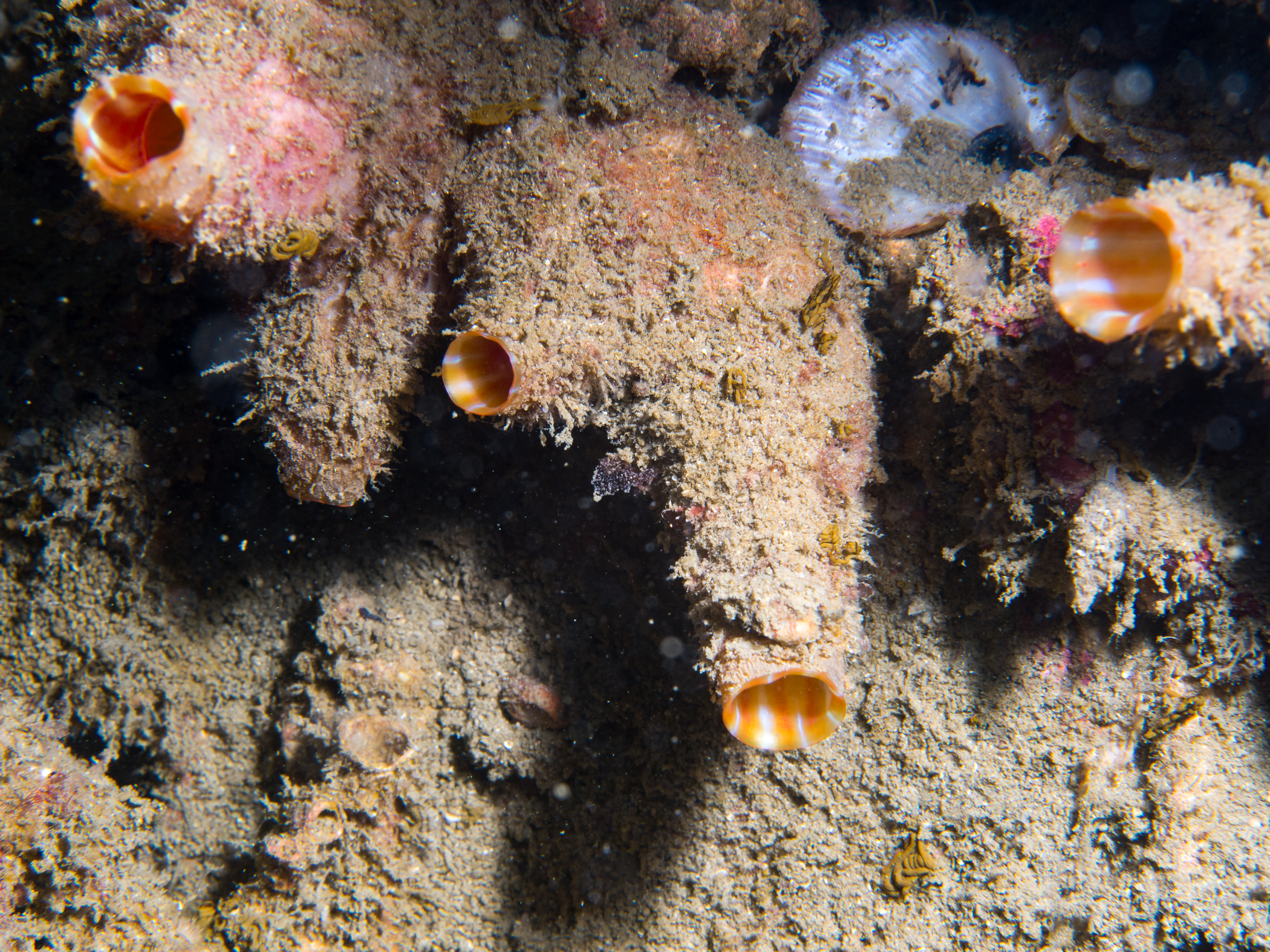
Species description: A dirty brown, wrinkled solitary ascidian recorded in the literature as growing to 3 cm in length, but up to 5 cm in local populations. The test is very thick and leathery and is wrinkled even when the animal is fully expanded. It is covered with detritus, algae and other attached plants and animals making it inconspicuous apart from the extended feeding siphons. These siphons are fairly long when fully expanded, but sensitive to light or disturbance so that they quickly contract on close inspection. They are longitudinally marked with red and white lines, most obvious on the inner surfaces. The openings become square and fluted in partial contraction.
Life cycle: Individuals are hermaphrodite with two gonads on one side of the body and one on the other. Eggs are released into the sea and fertilised there, developing into so-called tadpole larvae, which swim for a while before settling and attaching to the bottom. This is called oviparous development; many other tunicates are viviparous, brooding fertilised eggs within the tunic until they become tadpole larvae, which are then expelled into the water to swim and settle.
Similar species: This species belongs to the family Pyuridae which includes several smaller similar species. It can be distinguished from other species by the two gonads on the right-hand side of the body but must be dissected to confirm this. Similar looking species have only one gonad on each side.
How to see this species: This species could formerly be found amongst living horse mussels in Strangford Lough, where it was a common member of this community. These horse mussel beds have undergone significant decline. It is also found around Rathlin Island.
Current status: Declining. This is a species primarily confined to horse mussel beds in Northern Ireland where it used to be present in tens per square metre. Investigations in 2003 confirmed that the Strangford Lough horse mussel beds have declined considerably in the past 30 years and this species in particular seems to have become rare, with only a few small individuals present.
The current status of this species is somewhat unclear and it may also be undergoing a natural fluctuation in its populations. It is inconspicuous to any methods other than direct observation by experienced marine biologist divers or destructive quantitative sampling of the biogenic reefs where it lives. There are scattered records from the Copeland Islands, the Antrim coast and the Skerries at Portrush but no dense populations are known from the Northern Ireland open coast. Similar horse mussel beds in Loch Creran, Scotland have this species as a major component of the epifauna.
Why is this species a priority in Northern Ireland?
- Criterion 2: Decline based on available data and expert judgement.
Threats: In rapid decline due to physical impact of bottom fishing gear in its habitat. The target for the fishery is the queen scallop, Aequipecten opercularis, which lives in more open muddy patches between the horse mussel clumps, but requires stable biogenic reefs for successful recruitment. It is unclear whether direct impact from trawling has disrupted the mussel beds and encouraged predatory starfish or whether smothering by stirred up bottom sediments is more to blame for their decline.
Action: Records of new sites for this species, with details of habitat and population are always valuable. Observations with a photograph can be recorded using iNaturalist, find the MBDP-NI iNaturalist project here.
Alternatively, records can be sent to CEDaR, National Museums Northern Ireland, 153 Bangor Road, Cultra, Holywood, County Down, BT18 0EU. Tel 028 9039 5257, e-mail cedar.records@nationalmuseumsni.org, or via the online portal.
Objectives:
- Establish appropriate management on appropriate historic sites
- Monitor numbers present in Modiolus modiolus beds in Strangford Lough
- Investigate recruitment and predation of this species.
Conservation:
- Strangford Lough is a Marine Protected Area with multiple designations.
- Implementation of the Habitat Action Plan for Horse Mussel Beds.
- Rathlin Island is a Marine Protected Area with multiple designations.
Distribution Map from NBN: Pyura microcosmus at National Biodiversity Network mapping facility, data for UK.
iNaturalist: Pyura microcosmus at iNaturalist World Species Observations database.
WoRMS: Pyura microcosmus at World Register of Marine Species. Accepted name: Pyura microcosmus (Savigny, 1816). AphiaID: 103851.
Classification: Biota; Animalia; Chordata; Tunicata; Ascidiacea; Stolidobranchia; Pyuridae; Pyura
| Previous species | Next species |
| Picton, B.E., Keatley, L. & Morrow, C.C. (2026). Pyura microcosmus. (Savigny, 1816). [In] Priority species, Marine Biodiversity Portal NI. https://www2.habitas.org.uk/marbiop-ni/priorityaccounts.php?item=ZD2400. Accessed on 2026-09-13 |