
Northern Ireland Priority species (NIPS)
| TUNICATA : Stolidobranchia : Pyuridae | SEA SQUIRTS |
Boltenia echinata (Linnaeus, 1767)
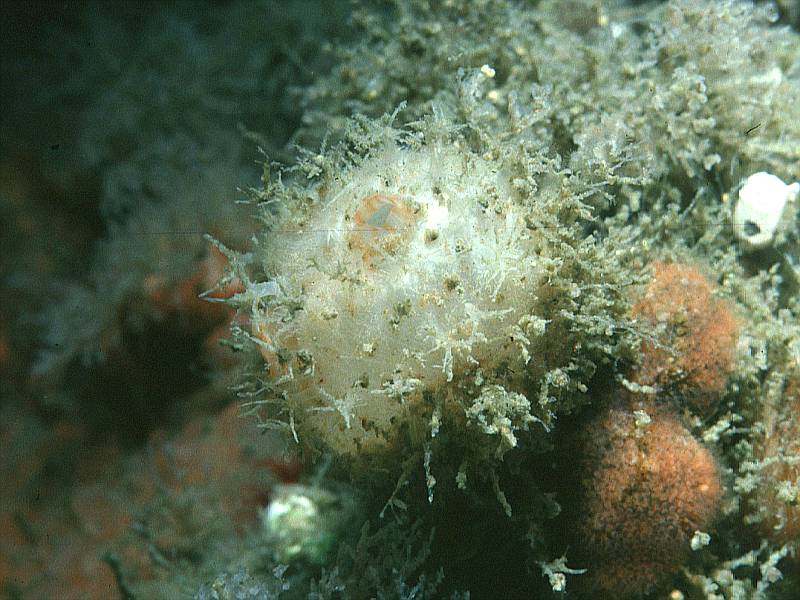 |
| Boltenia echinata |
Northern Ireland holds a large number of sites with this sea squirt, which otherwise is regarded as rare. It is threatened by bottom fishing operations, and may have declined as a result of this.
In brief
- Found at a number of sites from Rathlin Island through to St John’s Point, Dundrum Bay
- Habitat is silty areas with moderate shelter
- Can be found throughout the year
- Regarded as a NIPS because of likely decline in recent years
- Main threats are from use of mobile fishing gear.
Species description: This is a solitary and somewhat inconspicuous sea squirt; however, its distinctive form prevents confusion with other species. It is grey or grey-brown in colour, globule in shape, up to 4 cm height, and is covered with branched hairs or spine-like projections, each with its own array of four to eight secondary spinelets. These trap silt, partly causing the colour. The siphons (inhalant and exhalant openings for feeding and respiration) are short and sometimes fringed with a reddish colour.
Life cycle: Settlement and recruitment take place throughout the year.
Similar species: None.
How to see this species: This is a northern species, found from the Arctic through Norway and Sweden, around Scotland. The only sites in Ireland are in Northern Ireland, making it the stronghold for this species. It can be found at Rue Point on Rathlin, Murlough Bay, the Maidens, Muck Island, the Copeland Islands, the Long Sheelagh in Strangford Lough and off St John’s Point in Dundrum Bay. It may be found in silty areas of moderate shelter, though elsewhere in its range, more exposed sites have been reported.
Current status: Declining. Present at a range of sites around the Northern Ireland coast but thought to be in decline. The species has no legal protection.
Why is this species a priority in Northern Ireland?
- Criterion 5: Climate Change Sensitive.
Threats: The main threat is disruption of its seabed habitat by the use of mobile bottom fishing gear, trawling or dredging for scallops or Nephrops. The former is particularly known to be the case in Strangford Lough. It is also at risk of range reduction due to climate change, being a northern species.
Action: Records of new sites for this species, with details of habitat and population are always valuable. Observations with a photograph can be recorded using iNaturalist, find the MBDP-NI iNaturalist project here.
Alternatively, records can be sent to CEDaR, National Museums Northern Ireland, 153 Bangor Road, Cultra, Holywood, County Down, BT18 0EU. Tel 028 9039 5257, e-mail cedar.records@nationalmuseumsni.org, or via the online portal.
Objectives:
- Maintain the number of viable populations
- Maintain the range
- Establish appropriate management on key historical sites — notably Strangford Lough, but also investigate other locations where damage is likely to have occurred
- Monitor populations (or samples) at appropriate key locations.
Conservation:
- Rathlin Island is a Marine Protected Area with multiple designations.
- Strangford Lough is a Marine Protected Area with multiple designations.
- Strangford Lough was the subject of an attempted restoration project to restore the Modiolus modiolus community, however this was unsuccessful and the horse mussel beds are in unfavourable or poor condition.
- There is a Habitat Action Plan for Horse Mussel Beds applies.
Distribution Map from NBN: Boltenia echinata at National Biodiversity Network mapping facility, data for UK.
iNaturalist: Boltenia echinata at iNaturalist World Species Observations database.
WoRMS: Boltenia echinata at World Register of Marine Species. Accepted name: Boltenia echinata (Linnaeus, 1767). AphiaID: 103814.
Classification: Biota; Animalia; Chordata; Tunicata; Ascidiacea; Stolidobranchia; Pyuridae; Boltenia
| Previous species | Next species |
| Picton, B.E., Keatley, L. & Morrow, C.C. (2026). Boltenia echinata. (Linnaeus, 1767). [In] Priority species, Marine Biodiversity Portal NI. https://www2.habitas.org.uk/marbiop-ni/priorityaccounts.php?item=ZD2300. Accessed on 2026-09-13 |