
Northern Ireland Priority species (NIPS)
| MOLLUSCA : Pectinida : Pectinidae | SNAILS, SLUGS, ETC. |
Aequipecten opercularis (Linnaeus, 1758)
Queen scallop, Queenie
 |
| Aequipecten opercularis |
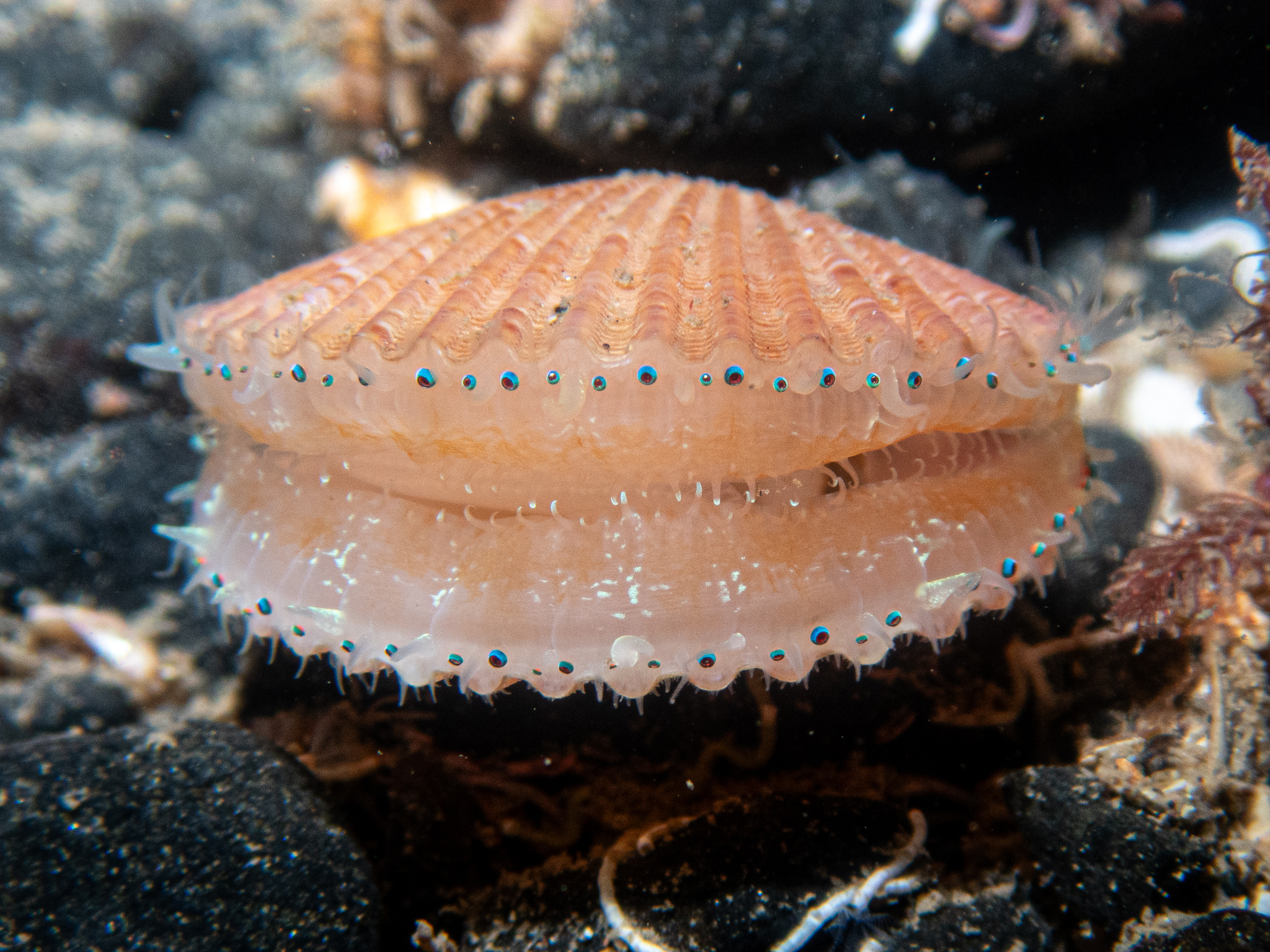
This scallop grows up to 9 cm, and the population is currently declining in Northern Ireland. It is closely associated with horse mussel (Modiolus modiolus) reefs which are important nursery grounds.
In brief
- Widespread records all around Northern Ireland, however the population has experienced rapid decline.
- Can live up to 10 years, and fecundity increases with age.
- At risk of overexploitation due to fishing.
- It is part of the horse mussel community in the sublittoral in Strangford Lough, which has been damaged.
- The main threat is the impact of commercial fishing gear.
Species description: This scallop comes in a variety of colours and can be light pink, brown, orange or yellow, and can often have either darker or lighter banding, zigzags or rays. It can grow up to 9 cm and has two convex shells, with the left slightly more convex then the right There are about 20 well defined ridges on each shell. The 'ears' are almost equal in size. In life it has distinctive bright blue eyes.
Life cycle: This species usually lives 6-10 years, reaching sexual maturity at around 1 year old. Although they can reproduce from around 1 year old, they do not make significant contributions to the population's total egg production until they mature further - with larger gonads- as fecundity of females increases with age. They spawn from March - May, sometimes there is a second spawning later in the year, or some sporadic spawning episodes throughout the summer months.
Similar species: Could potentially confused with some other scallops, but these are normally attached to rock by one shell, and Aequipecten opercularis has almost equal sized 'ears' while other species are distinctly unequal.
How to see this species: When very young they are usually attached by byssus, with older individuals free living. Very active swimmer. Can sometimes be completely covered by sponge. Prefers Sand or fine gravel, occasionally found on lower shore, but more common subtidally to depths of up to 100 m.
Current status: Declining. Aequipecten opercularis are closely associated with another priority species Modiolus modiolus, which can form biogenic reefs. The Modioulus reefs once present in Strangford Lough have been heavily damaged and are so far showing no signs of recovery, which is also affecting the Aequipecten opercularis population and recovery. This species has also been extensively fished in the past and populations are in decline.
Why is this species a priority in Northern Ireland?
- Criterion 2: Decline based on available data and expert judgement
Threats:
- Vulnerable to over exploitation through fishing.
- Habitat disturbance or loss through destructive bottom-fishing methods.
- Loss of important nursery grounds (e.g. Modiolus modiolus beds formerly found in Strangford Lough). This affects the ability of the population to recover.
- General decline in habitat due to pollution or eutrophication.
Action: Records of new sites for this species, with details of habitat and population are always valuable. Observations with a photograph can be recorded using iNaturalist, find the MBDP-NI iNaturalist project here.
Alternatively, records can be sent to CEDaR, National Museums Northern Ireland, 153 Bangor Road, Cultra, Holywood, County Down, BT18 0EU. Tel 028 9039 5257, e-mail cedar.records@nationalmuseumsni.org, or via the online portal.
Objectives:
- Monitor and assess current population levels.
- Promote population recovery by safeguarding any remaining nursery grounds and encouraging regeneration of any former grounds.
Conservation:
- Surveys are carried out by AFBI on behalf of DAERA to monitor and assess stocks.
- Rathlin Island is a Marine Protected Area with multiple designations.
- Strangford Lough is a Marine Protected Area with multiple designations.
- Implementation of the Habitat Action Plan for Horse Mussel Beds.
Distribution Map from NBN: Aequipecten opercularis at National Biodiversity Network mapping facility, data for UK.
iNaturalist: Aequipecten opercularis at iNaturalist World Species Observations database.
WoRMS: Aequipecten opercularis at World Register of Marine Species. Accepted name: Aequipecten opercularis (Linnaeus, 1758). AphiaID: 140687.
Classification: Biota; Animalia; Mollusca; Bivalvia; Autobranchia; Pteriomorphia; Pectinida; Pectinoidea; Pectinidae; Pectininae; Aequipectinini; Aequipecten
| Previous species | Next species |
| Picton, B.E., Keatley, L. & Morrow, C.C. (2026). Aequipecten opercularis. (Linnaeus, 1758). [In] Priority species, Marine Biodiversity Portal NI. https://www2.habitas.org.uk/marbiop-ni/priorityaccounts.php?item=W18050. Accessed on 2026-09-13 |