
Northern Ireland Priority species (NIPS)
| MOLLUSCA : Ostreida : Pinnidae | SNAILS, SLUGS, ETC. |
Atrina fragilis (Pennant, 1777)
Fan mussel
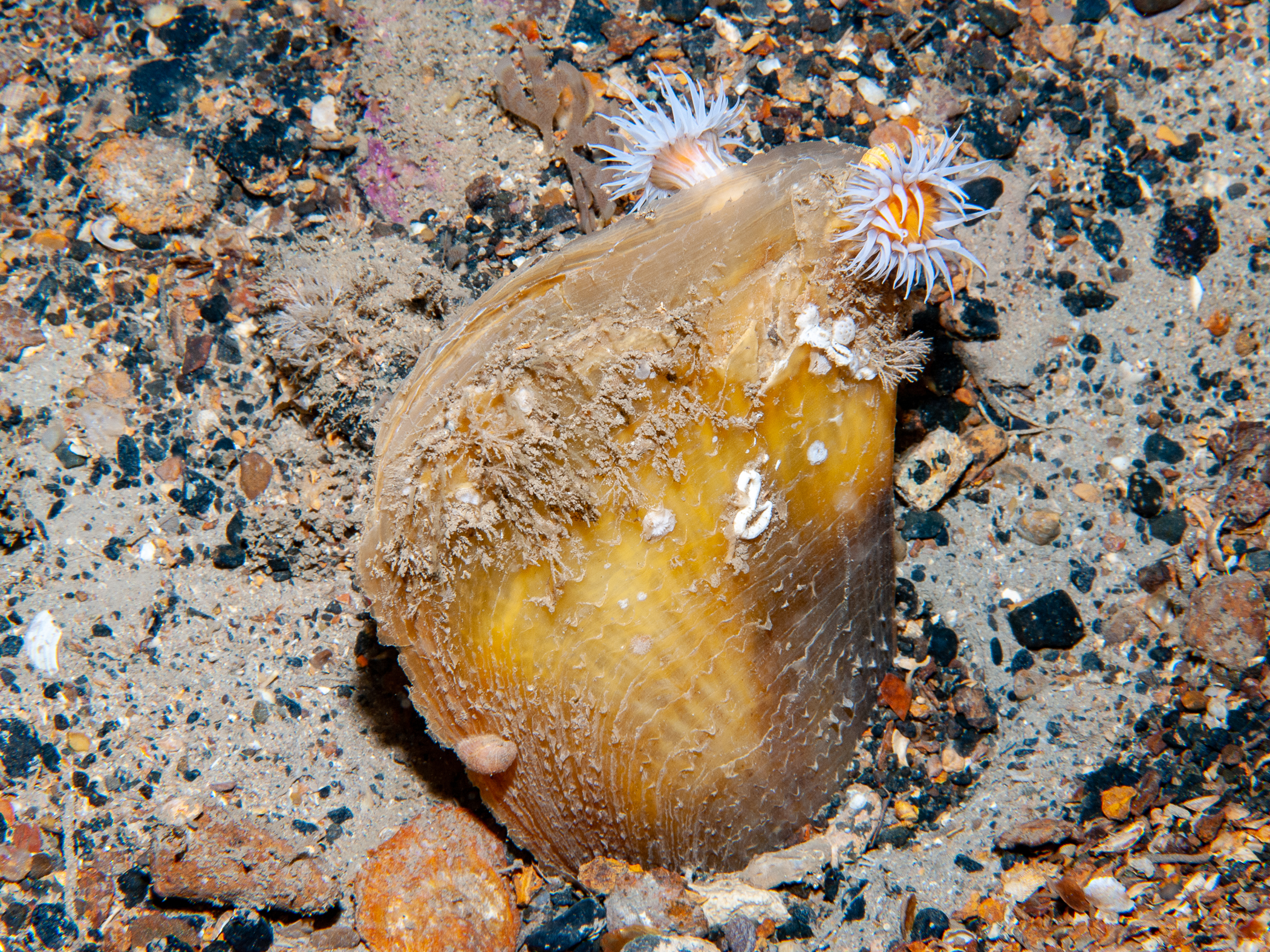 |
| Atrina fragilis |
In brief
- The fan mussel is found off the north coast of Northern Ireland.
- It can be seen only by diving or remote cameras, half-buried in mud, sandy mud or muddy gravel.
- The species has only been seen living in Northern Ireland waters once since 1989.
- The main threat is thought to be damage caused by commercial fishing gear.
Species description: The shell of the fan mussel is brittle, equivalve and triangular in outline with prominent gapes, tapering to a point. It is light yellowish-brown or dark brown in colour, occasionally with black patches, and a sculpture of concentric lines and 8 to 12 radiating ribs, sometimes with fluted spines. The colour inside is similar to the outside, but glossy. It is one of largest bivalve molluscs found in Europe, reaching up to 48cm in length, with the largest individuals being 10 to 12 years old.
Life cycle: The species breeds using external fertilization, where success is affected by the proximity of other individuals, as well as a range of environmental factors. The larvae undergo a planktonic phase that lasts 5 to 10 days.
Similar species: There are no similar species in Northern Ireland waters.
How to see this species: The only recent record is one individual recorded off Rathlin Island in 2007 in 33 m depth. Otherwise only known from off the north coast of Northern Ireland during a trawling survey for the queen scallop Aequipecten opercularis in 1971, close to and east of Rathlin Island to Magilligan, in depths to 64 m+, and at the entrance to Belfast Lough in 1989. Shells have been found on Portstewart, Downhill and Magilligan strands and on the seabed south of the Skerries, Portrush. It is normally present all year round. It lives with its pointed end buried vertically in bottoms of mud, sandy mud or muddy gravel, attached to small stones or pieces of shell by numerous fine strands of protein known as a byssus, which passes through the shell gape. Only the broad posterior portion of the valves is visible above the surface of the substrate, often fragmented or damaged. It occurs both as a solitary animal or in small groups, and feeds by filtering organic particles from the water.
Current status: Rare. This species has only apparently been recorded living in Northern Ireland once since 1989, when it was found off the north coast of Northern Ireland at Rathlin Island. In the Republic of Ireland, it is only known recently from Galway Bay (1962, 1970s) and Valentia 1975. Unlocalised animals have been seen in local public aquaria more recently than these dates. There are many old or shell records, particularly from the southern half of the island of Ireland. Whilst apparently recorded from all round Britain apart from the east coasts, there are few known recent populations. The fan mussel is distributed south from Britain on the continental shelf to the Iberian Peninsula and the Mediterranean down to 600 m.
Why is this species a priority in Northern Ireland?
- Criterion 1: Internationally listed species.
- Criterion 2: Decline based on available data and expert judgement.
- Criterion 3: Rare or restricted range – rare breeding species confined to 5 hectads or less (based on expert judgement).
Threats: The species is sensitive to substratum loss; smothering; changes in temperature, water flow, wave exposure; abrasion and physical disturbance; displacement and extraction of species – with a low recoverability to all these. For example, it is unable to burrow upwards or re-burrow following a disturbance incident. The main threat is thought to be the use of trawls and dredges in fishing, both of which disturb the seabed and damage fan mussels, often removing them from the sediment. Further threats include gravel and sand extraction.
Action: Records of new sites for this species, with details of habitat and population are always valuable. Observations with a photograph can be recorded using iNaturalist, find the MBDP-NI iNaturalist project here.
Alternatively, records can be sent to CEDaR, National Museums Northern Ireland, 153 Bangor Road, Cultra, Holywood, County Down, BT18 0EU. Tel 028 9039 5257, e-mail cedar.records@nationalmuseumsni.org, or via the online portal.
Objectives:
- Perform targeted surveys to ascertain the current status of the species in Northern Ireland.
- Establish appropriate management on appropriate historical sites.
- If refound, ensure that the population is maintained.
- If biologically feasible, enhance the distribution and population size in Northern Ireland.
Conservation:
- In Northern Ireland, it is legally protected from intentional killing, injuring or taking; possession or sale under the Wildlife Order (NI), 1985.
- Rathlin Island is a Marine Protected Area with multiple designations.
- Implementation of the Habitat Action Plan for Subtidal Sands and Gravel.
Distribution Map from NBN: Atrina fragilis at National Biodiversity Network mapping facility, data for UK.
iNaturalist: Atrina fragilis at iNaturalist World Species Observations database.
WoRMS: Atrina fragilis at World Register of Marine Species. Accepted name: Atrina fragilis (Pennant, 1777). AphiaID: 146524.
Classification: Biota; Animalia; Mollusca; Bivalvia; Autobranchia; Pteriomorphia; Ostreida; Pinnoidea; Pinnidae; Atrina
| Previous species | Next species |
| Adapted from text by Dr Julia Nunn (2026). Atrina fragilis. (Pennant, 1777). [In] Priority species, Marine Biodiversity Portal NI. https://www2.habitas.org.uk/marbiop-ni/priorityaccounts.php?item=W17250. Accessed on 2026-09-13 |