
Northern Ireland Priority species (NIPS)
| MOLLUSCA : Nudibranchia : Eubranchidae | SNAILS, SLUGS, ETC. |
Capellinia fustifera (Lovén, 1846)
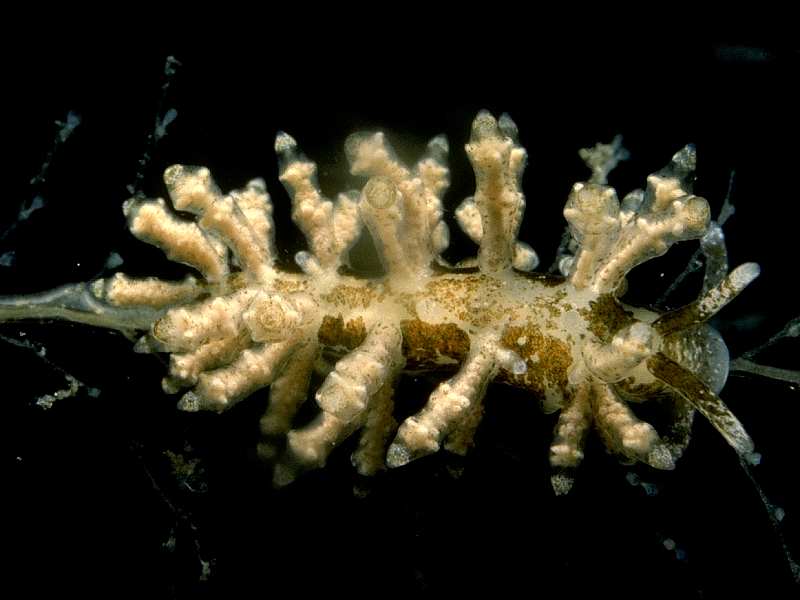 |
| Capellinia fustifera |
This cryptic sea slug is rare in Northern Ireland, and possibly under-recorded, being only found off the north coast.
In brief
- This species is rare in Northern Ireland, being found only off the north coast or in Strangford Lough.
- Northern Ireland is the stronghold for this species in Britain and Ireland.
- It can only be seen by diving.
- Threats to this species are unknown, as there is little knowledge of the current populations in Britain and Ireland.
Species description: This is a small nudibranch sea slug, with adults only growing to about 12 mm. The body is translucent white, with scattered brown or green pigment on the back and cerata. The cerata have two to three rows of tubercles giving an irregular knobbly appearance. The tip of each ceras is covered by a pale patch, and encircled by a brown-coloured ring. The rhinophoral and oral tentacles are smooth; the tips of these tentacles are white with a subterminal brown band.
Life cycle: As with all nudibranch sea slugs, Capellinia fustifera is a hermaphrodite. The spawn is a flared cup-like circle of white ribbon with a basal pad attaching it to the stem of its hydroid prey. Spawning normally takes place in November.
Similar species: There are two similar species: Nudibranchus exiguus and Capellinia vittatus. Capellinia fustifera may be easily distinguished from C. vittatus by the presence of tubercles on the cerata. N. exiguus has few cerata, which are urn-shaped, and is usually found on Obelia sp. attached to kelp.
How to see this species: This species has only been found off Rathlin Island, The Skerries (near Portrush) and Fair Head in Northern Ireland, in depths of 18-31 m in July and August. It has also been recorded in Strangford Lough. It lives on mixed substrates of bedrock, boulders and pebbles. It is carnivorous, feeding on the plumularian hydroid Kirchenpaueria similis.
Current status: Rare, only recorded from the few sites listed above in Northern Ireland. It has been located elsewhere around the island of Ireland from Mulroy Bay, County Donegal south down the west coast, to Lough Hyne, County Cork. It also occurs on the south and western coasts of Britain, although it has been found as far north as St. Kilda, and elsewhere the Atlantic coast of France and the Mediterranean. It is probably under-recorded.
Why is this species a priority in Northern Ireland?
- Criterion 3: Rare or restricted range – rare breeding species confined to 5 hectads or less (based on expert judgement).
- Criterion 4: NI stronghold or endemic – both stronghold range/population and designation as ‘endemic’ subject to expert judgement.
Threats: Threats to this species are unknown, as there is little knowledge of the current populations in Britain and Ireland.
Action: Records of new sites for this species, with details of habitat and population are always valuable. Observations with a photograph can be recorded using iNaturalist, find the MBDP-NI iNaturalist project here.
Alternatively, records can be sent to CEDaR, National Museums Northern Ireland, 153 Bangor Road, Cultra, Holywood, County Down, BT18 0EU. Tel 028 9039 5257, e-mail cedar.records@nationalmuseumsni.org, or via the online portal.
Objectives:
- Perform targeted surveys to ascertain the current status of the species in Northern Ireland.
- If refound, ensure that the population is maintained.
Conservation:
- Strangford Lough is a Marine Protected Area with multiple designations.
- Rathlin Island is a Marine Protected Area with multiple designations.
Distribution Map from NBN: Capellinia fustifera at National Biodiversity Network mapping facility, data for UK.
iNaturalist: Capellinia fustifera at iNaturalist World Species Observations database.
WoRMS: Capellinia fustifera at World Register of Marine Species. Accepted name: Capellinia fustifera (Lovén, 1846). AphiaID: 1339732.
Classification: Biota; Animalia; Mollusca; Gastropoda; Heterobranchia; Euthyneura; Ringipleura; Nudipleura; Nudibranchia; Cladobranchia; Fionoidea; Eubranchidae; Capellinia
| Previous species | Next species |
| Adapted from text by Dr Julia Nunn (2026). Capellinia fustifera. (Lovén, 1846). [In] Priority species, Marine Biodiversity Portal NI. https://www2.habitas.org.uk/marbiop-ni/priorityaccounts.php?item=W15110. Accessed on 2026-09-13 |