
Northern Ireland Priority species (NIPS)
| CRUSTACEA : Decapoda : Inachidae | CRABS, SHRIMPS AND LOBSTERS |
Inachus leptochirus Leach, 1817
Slender-legged spider crab
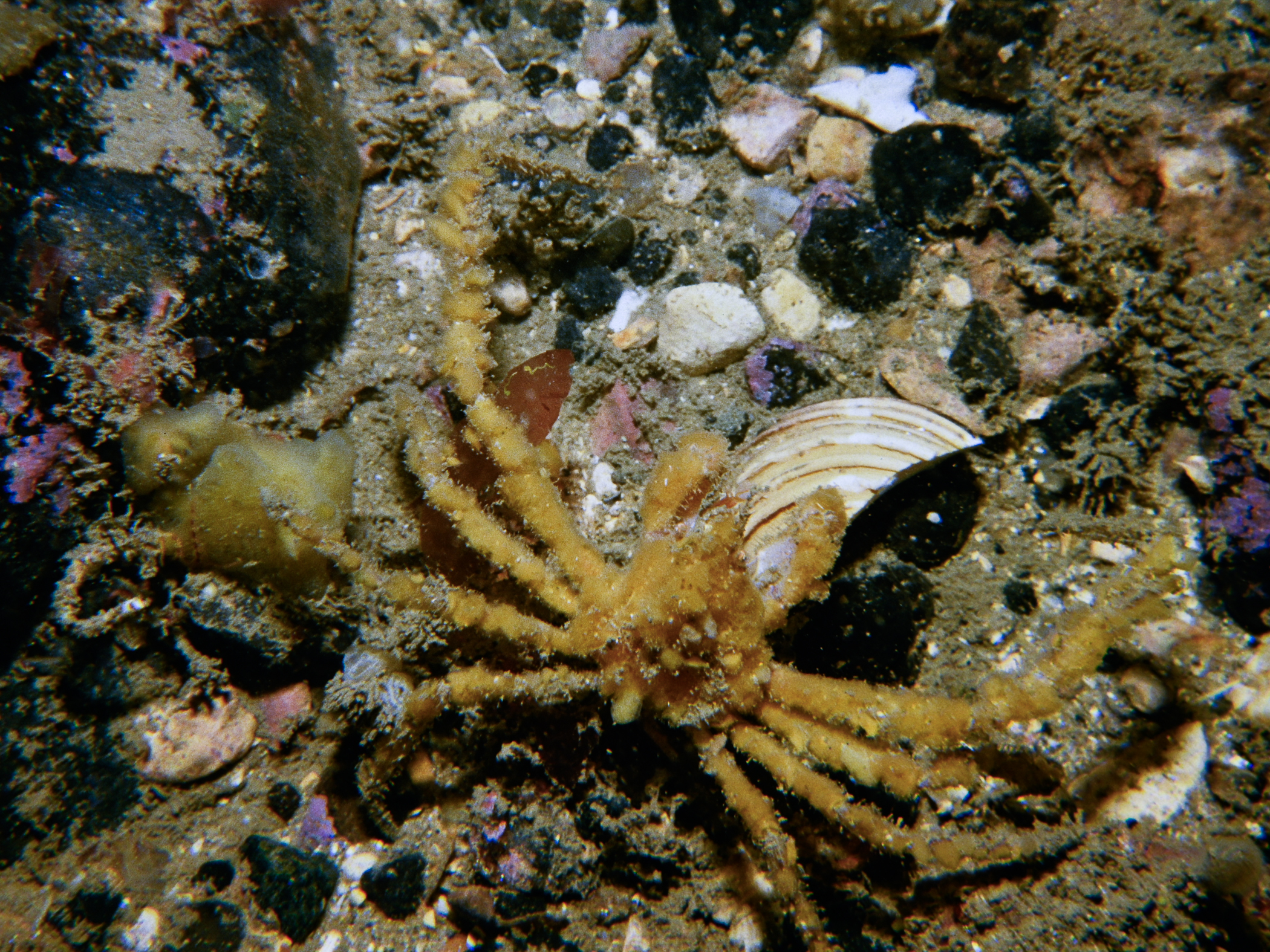 |
| Inachus leptochirus |
A small spider crab, quite widely found in sublittoral areas of the Northern Ireland coast, whose habitat of mud and muddy sands is strongly affected by fishing operations.
In brief
- Numerous sites along the north-eastern and eastern coast of Northern Ireland
- Habitat is sublittoral muds and muddy sands
- Can be found throughout the year
- Listed as a priority because of the importance of the population and the possibility of it declining
- Main threats / cause of decline are likely to be from fisheries using mobile bottom gear.
Species description: This is a small, slim spider crab, whose yellowish or greyish-brown upper shell, or carapace, is up to 28 mm length, 24 mm breadth. It has long slender legs, as suggested by the common name. The leading point of the carapace has a series of small ‘horns’ projecting forward on either side.
Life cycle: No information is available at present for reproduction in Northern Ireland waters. However, females of most of these species carry eggs on their underside, whereby after mating and fertilisation, planktonic larvae develop and disperse, with subsequent settlement of the larvae.
Similar species: Inachus phalangium and Inachus dorsettensis are similar, but I. leptochirus has a narrow u-shaped rostrum.
How to see this species: This crab can be found at numerous sites around the north-eastern and eastern coast of Northern Ireland, including Rathlin Island, Ballycastle, Garron Point, Red Bay, Larne, Donaghadee, and Strangford Lough, usually in mud or muddy sand, at depths recorded from elsewhere as ranging from 32-320 m. Further afield, NBN records it from County Cork and a small number of sites along Ireland’s south coast, whilst elsewhere it is found off western Scotland, the Irish Sea, Pembrokeshire, and south-west England.
Current status: Declining. Known from a large number of sites on the north-eastern and eastern coast of Northern Ireland. The species has no legal protection. There are relatively few recent records, possibly due to identification confusion, put Northern Ireland has previously been considered a stronghold for this species.
Why is this species a priority in Northern Ireland?
- Criterion 2: Decline based on available data and expert judgement
- Criterion 3: Rare or restricted range – rare breeding species confined to 5 hectads or less (based on expert judgement)
- Criterion 4: NI stronghold or endemic – both stronghold range/population and designation as ‘endemic’ subject to expert judgement.
Threats: Because the habitat of this crab is normally mud or muddy sands, and this occurs on relatively level seabed, the habitat is very subject to use of mobile fishing gear, particularly in relation to the Nephrops norvegicus (scampi) fishery; in areas of coarser sediments it may be vulnerable to trawling and dredging for scallops as well.
Action: Records of new sites for this species, with details of habitat and population are always valuable. Observations with a photograph can be recorded using iNaturalist, find the MBDP-NI iNaturalist project here.
Alternatively, records can be sent to CEDaR, National Museums Northern Ireland, 153 Bangor Road, Cultra, Holywood, County Down, BT18 0EU. Tel 028 9039 5257, e-mail cedar.records@nationalmuseumsni.org, or via the online portal.
Objectives:
- Establish true conservation status, and trends in number of sites and population sizes.
- Maintain the number of viable populations.
- Maintain the range.
- Protect sites of conservation importance from damage through contamination and physical disturbance or excessive use (for example, nutrient enrichment, dredging and development).
- Require EIAs for coastal developments to examine potential effects on nearshore areas.
- Monitor any impact of dump sites on inshore sublittoral sediment habitats, communities and wildlife, and take action as appropriate.
- Develop and implement strategies for the conservation and management of the wider marine environment at local, regional and national levels. For example, integrated Coastal Management Plans, water quality objectives, pollution control and avoidance measures. Species recovery and habitat restoration programmes should be included.
Conservation:
- Rathlin Island is a Marine Protected Area with multiple designations.
- Strangford Lough is a Marine Protected Area with multiple designations.
- There are Habitat Action Plans for Sublittoral Sands and Gravel and Mud Habitats in Deep Water.
Distribution Map from NBN: Inachus leptochirus at National Biodiversity Network mapping facility, data for UK.
iNaturalist: Inachus leptochirus at iNaturalist World Species Observations database.
WoRMS: Inachus leptochirus at World Register of Marine Species. Accepted name: Inachus leptochirus Leach, 1817. AphiaID: 107330.
Classification: Biota; Animalia; Arthropoda; Crustacea; Multicrustacea; Malacostraca; Eumalacostraca; Eucarida; Decapoda; Pleocyemata; Brachyura; Eubrachyura; Heterotremata; Majoidea; Inachidae; Inachinae; Inachus
| Previous species | Next species |
| Adapted from Allen & Mellon Environmental Ltd. (2026). Inachus leptochirus. Leach, 1817. [In] Priority species, Marine Biodiversity Portal NI. https://www2.habitas.org.uk/marbiop-ni/priorityaccounts.php?item=S25770. Accessed on 2026-09-13 |