
Northern Ireland Priority species (NIPS)
| CRUSTACEA : Decapoda : Paguridae | CRABS, SHRIMPS AND LOBSTERS |
Cestopagurus timidus (Roux, 1830)
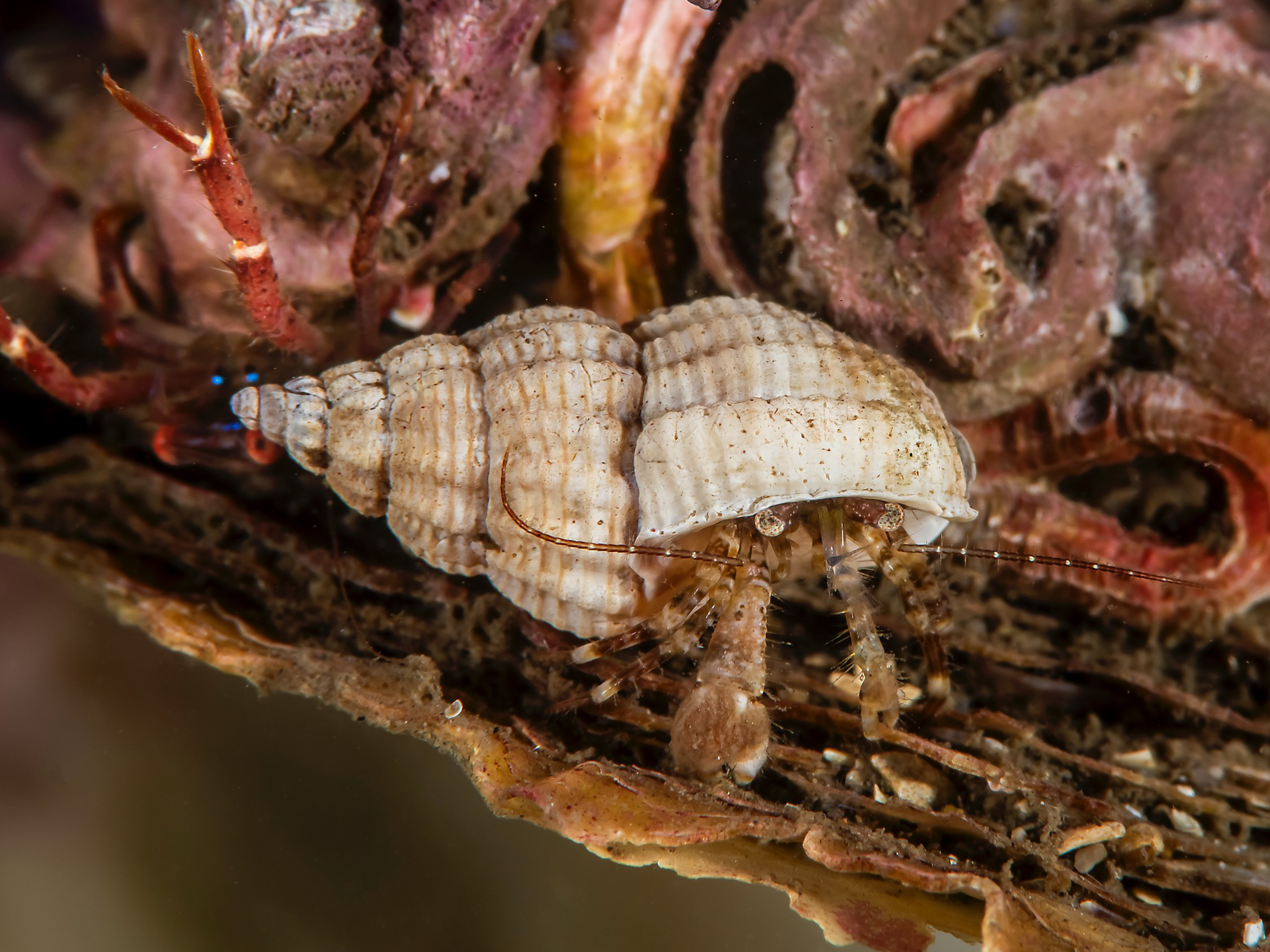 |
| Cestopagurus timidus |
A little-known hermit crab found only in a few scattered locations in the north of Ireland to date.
In brief
- Most records are from east of Doon Point and off Ushet Point, Rathlin Island, and around the Islandmagee peninsula.
- Habitat is intertidal and shallow subtidal muds and sands with eelgrasses.
- Can be found throughout the year.
- A priority species since Northern Ireland is a stronghold for the Irish population.
- Main threats likely to come from deteriorating water quality and shallow water dredging.
Species description: A small grey-brown hermit crab with a carapace (upper shell) of about 5 mm length. Its hairy claws are about the same length (not always the case with crabs) but the right claw is much thicker and more robust than the left. The eyestalks are long and quite thick, and between them the margin of the carapace is extended into a short point, or rostrum.
Life cycle: The life cycle is poorly known, but in the British Isles, planktonic larvae have been recorded from March to November. In Italy, females bearing eggs have been recorded between March and September.
Similar species: Could be confused with other species of hermit crab, especially juveniles. White and blue markings on pincers may help to distinguish this species. Eyestalks and eyes are distinctively coloured in Cestopagurus timidus.
How to see this species: Cestopagurus timidus can be found in intertidal and shallow sublittoral muds and soft sands, especially in or around eelgrass and algal beds. It Northern Ireland, it has been recorded on Rathlin Island to the east of Doon Point and off Ushet Point, and off the coast of Islandmagee, In Britain it is found in the Clyde and the Scilly Isles. Further afield, it has been recorded on the Atlantic coasts of mainland Europe, and in the Mediterranean.
Current status: Declining. This species is known from limited sites in Northern Ireland, mostly on Rathlin and Islandmagee. These represent the majority of the known Irish population. It has no legal protection.
Why is this species a priority in Northern Ireland?
- Criterion 2: Decline based on available data and expert judgement.
- Criterion 3: Rare or restricted range – rare breeding species confined to 5 hectads or less (based on expert judgement).
- Criterion 4: NI stronghold or endemic – both stronghold range/population and designation as ‘endemic’ subject to expert judgement.
Threats: The species and its habitat are vulnerable to shallow water dredging, and because of the relatively sheltered, sometimes partially enclosed nature of its sites, it would be vulnerable to deterioration of water quality and eutrophication.
Action: Records of new sites for this species, with details of habitat and population are always valuable. Observations with a photograph can be recorded using iNaturalist, find the MBDP-NI iNaturalist project here.
Alternatively, records can be sent to CEDaR, National Museums Northern Ireland, 153 Bangor Road, Cultra, Holywood, County Down, BT18 0EU. Tel 028 9039 5257, e-mail cedar.records@nationalmuseumsni.org, or via the online portal.
Objectives:
- Establish true status.
- Maintain the number of viable populations of the species.
- Maintain the range, and search for its presence in similar locations to those on Rathlin and near Islandmagee.
- Monitor known locations for water quality as appropriate.
Conservation:
- Rathlin Island is a Marine Protected Area with multiple designations.
- There is a Habitat Action Plan for Seagrass beds.
Distribution Map from NBN: Cestopagurus timidus at National Biodiversity Network mapping facility, data for UK.
iNaturalist: Cestopagurus timidus at iNaturalist World Species Observations database.
WoRMS: Cestopagurus timidus at World Register of Marine Species. Accepted name: Cestopagurus timidus (Roux, 1830). AphiaID: 107226.
Classification: Biota; Animalia; Arthropoda; Crustacea; Multicrustacea; Malacostraca; Eumalacostraca; Eucarida; Decapoda; Pleocyemata; Anomura; Paguroidea; Paguridae; Cestopagurus
| Previous species | Next species |
| Adapted from Allen & Mellon Environmental Ltd. (2026). Cestopagurus timidus. (Roux, 1830). [In] Priority species, Marine Biodiversity Portal NI. https://www2.habitas.org.uk/marbiop-ni/priorityaccounts.php?item=S24530. Accessed on 2026-09-13 |