
Northern Ireland Priority species (NIPS)
| CRUSTACEA : Decapoda : Palinuridae | CRABS, SHRIMPS AND LOBSTERS |
Palinurus elephas (Fabricius, 1787)
Crayfish, Spiny lobster
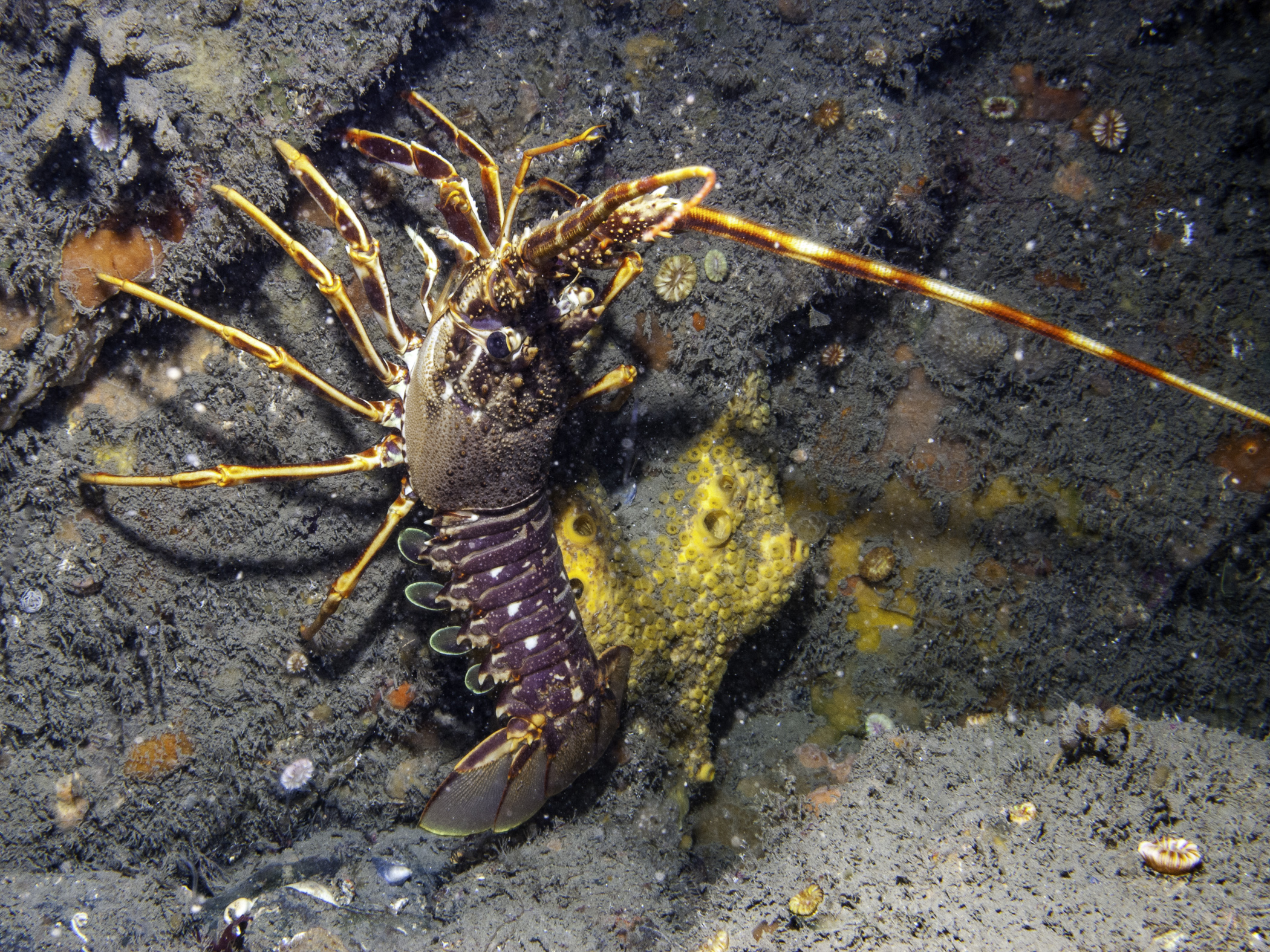 |
| Palinurus elephas |
A large westerly species of crustacean, in Northern Ireland mostly known only from the Rathlin Island area and limited sites on the north coast, although there are now a few records from The Maidens and east coast. It is vulnerable to fishing activities, especially tangle net fishing, and populations in Northern Ireland and western Scotland have been declining.
In brief
- Main population currently found on the western end of Rathlin Island, Shamrock Pinnacle, and off Kinbane Head
- Subtidal rock faces, rocky seabed, and sometimes on open terrain
- Can be seen the year round
- A priority species on account of its scarcity and decline
- Main threats come from fishing, especially tangle nets; the species has a poor recovery rate after exploitation.
Species description: A large crustacean, capable of growing to 600 mm in length, but more commonly to 400-500 mm. It has antennae that are longer than its body, and it is heavily built, with body armour bearing large spines; the claws are small and hook-like. Its tail is formed of a cluster of broad plates. Colour is orange, with whitish or yellow edging to legs and claws, but brown, purple and sandy-coloured morphs have also been found. The species can be gregarious where the population density allows, and whilst they are mostly crawlers around the seabed, they can also swim. They feed on echinoderms, small snails and bivalves, shrimp larvae and worms.
Life cycle: Females moult from July to September prior to mating, whilst the moulting period of the males is less defined, probably focusing more on the winter. Sexual maturity begins when the carapace (upper shell) is 76-77 mm in females, 82-83 mm in males, and sexes are separate. Egg-bearing females migrate to deeper water whilst the eggs are developing, and then return for mating, fertilisation of eggs and release. The eggs then develop into planktonic larvae which develop for about five months before settling on the seabed as young crawfish.
Similar species: Homarus gammarus — the lobster is the only species likely to cause confusion. However Palinurus is basically orange coloured, lacks the heavy claws, and is much spinier. It is also more likely than the lobster to be seen wandering over the open seabed.
How to see this species: Palinurus elephas has a primarily western distribution and in Northern Ireland can primarily be found at a number of sites around the western third of Rathlin Island, Shamrock Pinnacle, and near Kinbane head on the north coast. There are now records from other sites on the north and east coasts of Northern Ireland, although these are scarce. Elsewhere in Ireland it has been recorded on Tory Island, in Donegal Bay, Achill Island, and a number of locations in County Mayo, and generally around south-west Ireland. In Britain it is found around western Scotland although it is becoming scarcer there, and on the Pembrokeshire and Cornish coasts. Key areas to search are open exposed rock faces, rocky seabeds and locations with holes and crevices, although they may also be found in open terrain. They can be found throughout the year, but subject to migration of egg-bearing females (see above).
Current status: Scarce. In Northern Ireland it is known from a limited number of sites. It has no legal protection, but is covered by fisheries regulations administered by Fisheries Division of DAERA.
Why is this species a priority in Northern Ireland?
- Criterion 1: Internationally listed species.
- Criterion 2: Decline based on available data and expert judgement.
- Criterion 3: Rare or restricted range rare breeding species confined to 5 hectads or less (based on expert judgement).
Threats: The likely cause of the declines is fisheries, particularly with respect to tangle net fishing. Research has demonstrated that the species is sensitive to extraction, and shows a poor rate of recovery.
Action: Records of new sites for this species, with details of habitat and population are always valuable. Observations with a photograph can be recorded using iNaturalist, find the MBDP-NI iNaturalist project here.
Alternatively, records can be sent to CEDaR, National Museums Northern Ireland, 153 Bangor Road, Cultra, Holywood, County Down, BT18 0EU. Tel 028 9039 5257, e-mail cedar.records@nationalmuseumsni.org, or via the online portal.
Objectives:
- Maintain the number of viable populations of crawfish
- Maintain the range of the crawfish
- Establish appropriate management on appropriate historical sites.
- Protect sites of conservation importance from damage through contamination and physical disturbance (for example, turbidity and towed fishing gear).
- Require EIAs for coastal developments to examine potential effects on intertidal and nearshore areas.
- Monitor any impact of dump sites on inshore sublittoral rock habitats, communities and wildlife, and take action as appropriate.
- Implement strategies for managing the coastal zone at local, regional and national levels.
Conservation:
- The species is covered by similar regulations to the lobster. In the Republic of Ireland there is a minimum catch size of 50 mm shell length.
- Rathlin Island is a Marine Protected Area with multiple designations..
- There are Habitat Action Plans concerning sublittoral rock (Fragile Sponge & Anthozoan Communities on Rocky Habitats and Tide-Swept Channels).
Distribution Map from NBN: Palinurus elephas at National Biodiversity Network mapping facility, data for UK.
iNaturalist: Palinurus elephas at iNaturalist World Species Observations database.
WoRMS: Palinurus elephas at World Register of Marine Species. Accepted name: Palinurus elephas (Fabricius, 1787). AphiaID: 107703.
Classification: Biota; Animalia; Arthropoda; Crustacea; Multicrustacea; Malacostraca; Eumalacostraca; Eucarida; Decapoda; Pleocyemata; Achelata; Palinuridae; Palinurus
| Previous species | Next species |
| Adapted from Allen & Mellon Environmental Ltd. (2026). Palinurus elephas. (Fabricius, 1787). [In] Priority species, Marine Biodiversity Portal NI. https://www2.habitas.org.uk/marbiop-ni/priorityaccounts.php?item=S24140. Accessed on 2026-09-13 |