
Northern Ireland Priority species (NIPS)
| CNIDARIA : Leptothecata : Sertulariidae | SEA ANEMONES AND HYDROIDS |
Tamarisca tamarisca (Linnaeus, 1758)
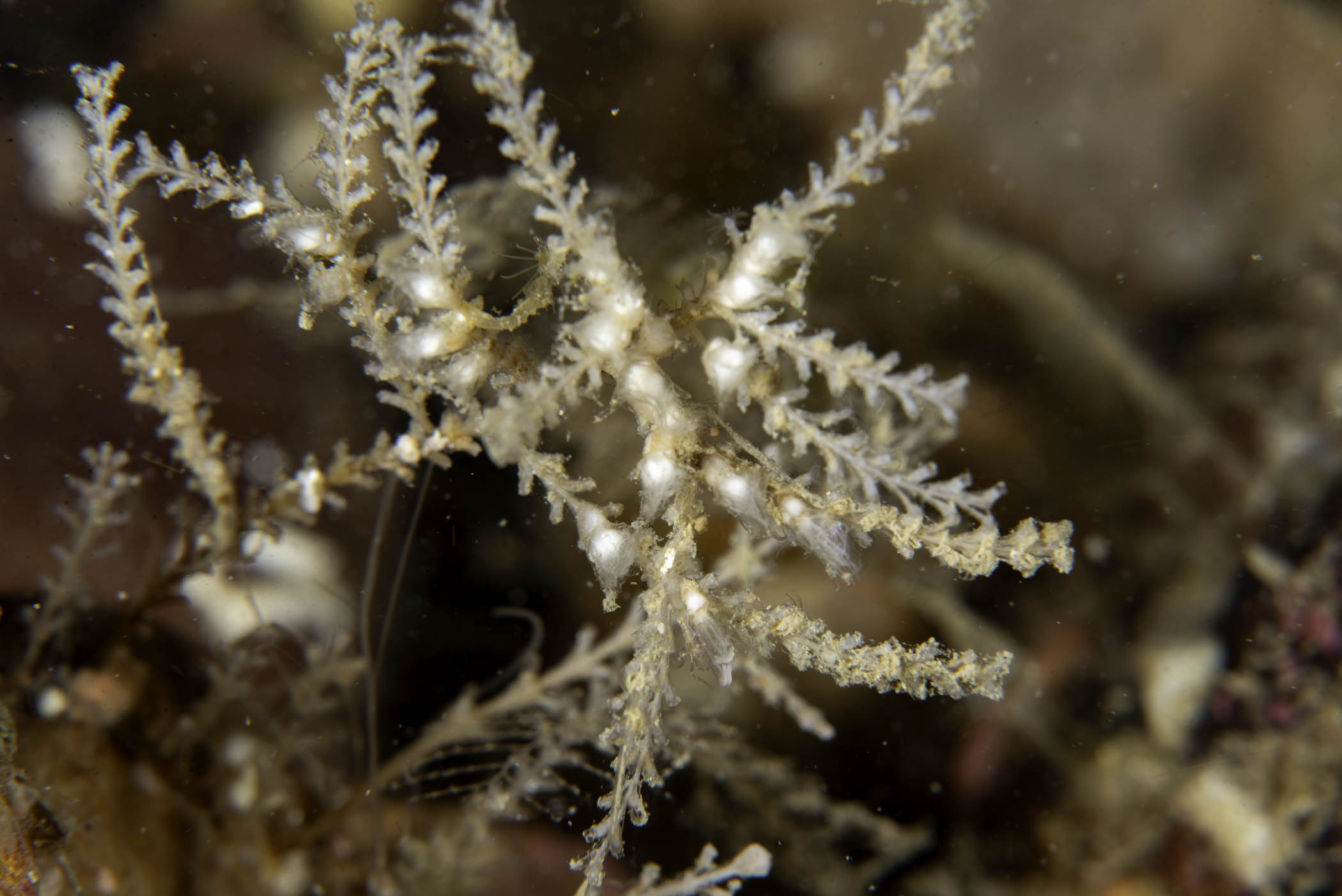 |
| Tamarisca tamarisca |
A colonial hydroid that has been recorded from only two locations in Northern Ireland, but is probably under-recorded. It is a species of shallow sublittoral bedrock, boulders, stones and shells, where there is a moderate to strong current.
In brief
- Found on Rathlin Island and the North Rocks off the outer Ards peninsula.
- Bedrock, boulders, large stones and shells, in areas of tidal current.
- Can be found throughout the year.
- It is listed as a priority species on account of its rarity.
- Main threats — none known to be active at present, but could be vulnerable to various types of coastal development.
Species description: A sparsely-branched colonial hydroid, whose branches emerge alternately up the stem from opposite sides. The colonies are typically from 60-150 mm in height and are colourless or a dull greyish-white. The hydrothecae (chambers containing the individual polyps, or colony inhabitants) are arranged in opposite pairs on the stem and branches, and these are tubular and attached for about half their length — an important feature when comparing with other species (see below).
Life cycle: Colonies have reproductive polyps, called gonozooids, which produce medusae (tiny jellyfish-like animals). However, reproduction within a colony may be achieved asexually by budding off new polyps from the main stem.
Similar species: Abietinaria abietina is similar but the hydrothecae are not opposite. It is also worth checking against the various Diaphasia species.
How to see this species: This is a circalittoral species, and can be found where moderate to strong tidal streams run over bedrock, boulders and large stones, and the larger shells. It is probably under-recorded, but has been recorded so far from Castle Head Rathlin Island, and east of the North Rocks, Cloghy, in County Down. Elsewhere in Ireland it has been sparsely recorded on all coasts, for example the Garvan Isles off Malin Head, Sheephaven, Donegal Bay and on the Cork coast. A similar sparse distribution has been recorded around Britain. It is present throughout the year.
Current status: Scarce. Recorded from two localities in Northern Ireland. The species has no legal protection. Nationally scarce. Northern Ireland is a stronghold for Britain and Ireland.
Why is this species a priority in Northern Ireland?
- Criterion 3: Rare or restricted range – rare breeding species confined to 5 hectads or less (based on expert judgement).
- Criterion 4: NI stronghold or endemic – both stronghold range/population and designation as ‘endemic’ subject to expert judgement.
Threats: There are no threats currently known to be affecting this species and its habitat, but it would be vulnerable to coastal developments and changes to the local current and sediment regimes at its sites.
Action: Records of new sites for this species, with details of habitat and population are always valuable. Observations with a photograph can be recorded using iNaturalist, find the MBDP-NI iNaturalist project here.
Alternatively, records can be sent to CEDaR, National Museums Northern Ireland, 153 Bangor Road, Cultra, Holywood, County Down, BT18 0EU. Tel 028 9039 5257, e-mail cedar.records@nationalmuseumsni.org, or via the online portal.
Objectives:
- Maintain the two viable populations of the species.
- Maintain the range of the species.
- Establish appropriate management of known sites.
- Monitor the population at the two sites.
Conservation:
- Rathlin Island is a Marine Protected Area with multiple designations.
Distribution Map from NBN: Tamarisca tamarisca at National Biodiversity Network mapping facility, data for UK.
iNaturalist: Tamarisca tamarisca at iNaturalist World Species Observations database.
WoRMS: Tamarisca tamarisca at World Register of Marine Species. Accepted name: Tamarisca tamarisca (Linnaeus, 1758). AphiaID: 117930.
Classification: Biota; Animalia; Cnidaria; Medusozoa; Hydrozoa; Hydroidolina; Leptothecata; Sertularioidea; Sertulariidae; Tamarisca
| Previous species | Next species |
| Adatped from text by Allen & Mellon Environmental Ltd. (2026). Tamarisca tamarisca. (Linnaeus, 1758). [In] Priority species, Marine Biodiversity Portal NI. https://www2.habitas.org.uk/marbiop-ni/priorityaccounts.php?item=D6890. Accessed on 2026-09-13 |