
Northern Ireland Priority species (NIPS)
| CNIDARIA : Scleractinia : Caryophylliidae | SEA ANEMONES AND HYDROIDS |
Caryophyllia inornata Duncan, 1878
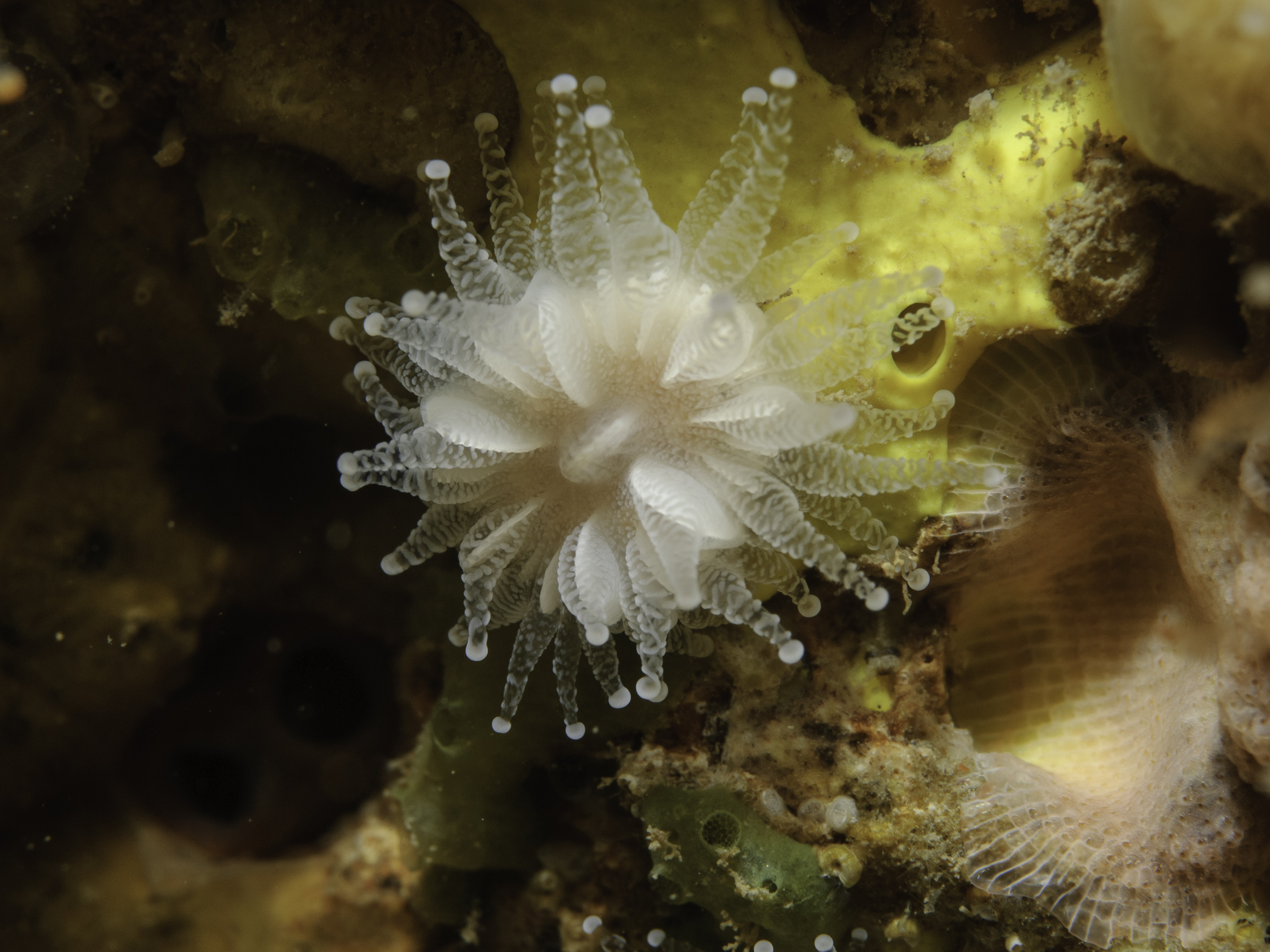 |
| Caryophyllia inornata |
A rare species of cup coral, found on bedrock gullies and caves; known from one site only in Northern Ireland.
In brief
- Found only on Rathlin Island.
- Habitat is bedrock, vertical faces, overhangs and caves, frequently in poorly lit locations.
- Can be found throughout the year.
- It is an extremely rare species, exploiting a specialised habitat.
- Trends in its conservation status are not known.
Species description: This is a relatively inconspicuous cup coral, up to 12 mm across and up to 18 mm tall — its height is typically greater than its diameter. It has a robust calcareous skeleton for its size, characterised by protruding septa or divisions which extend outside the top of the skeleton. The polyps are translucent white with short knobbed tentacles, although some writers also report colours ranging to pale reddish-brown.
Life cycle: The species is dioecious, that is, there are two distinct sexes, and after spawning and fertilisation, there is a relatively long planktonic stage, thus allowing quite wide dispersal of larvae. This has not, however, prevented it from being extremely localised.
Similar species: Corynactis viridis, the jewelled anemone is superficially similar, but has a much wider range of colours. Caryophyllia smithii, the Devonshire cup coral is also similar, but C. inornata is smaller, and septa are in six-rayed formation.
How to see this species: Caryophyllia inornata may be found on sublittoral (down to about 30 m depth) vertical or overhanging rock faces, and even small caves — notably locations with greatly reduced light, and often in small groups. The only known Northern Ireland site is off Ruecallan, Rathlin Island. There are several erroneous records from other locations (Strangford Lough and Ardglass) currently showing on NBN mapping. The species has also been recorded in Lough Hyne, Cork, and in western Scotland and south-west Wales and England. Further afield, it is commonly recorded from Azores and along the Atlantic coasts of Spain, Portugal and France. It can be found throughout the year.
Current status: Rare and thought to be declining. Known only from Ruecallan, on Rathlin Island, and this is one of only two localities in Ireland.
Why is this species a priority in Northern Ireland?
- Criterion 3: Rare or restricted range – rare breeding species confined to 5 hectads or less (based on expert judgement).
Threats: There are no known threats, and its habitat may be regarded as being fairly immune to human disturbance or damage. However, despite this it may be vulnerable to ecosystem changes brought about by changes in water quality, and by climate change, although it is equally possible that its range may increase with warming sea temperatures.
Action: Records of new sites for this species, with details of habitat and population are always valuable. Observations with a photograph can be recorded using iNaturalist, find the MBDP-NI iNaturalist project here.
Alternatively, records can be sent to CEDaR, National Museums Northern Ireland, 153 Bangor Road, Cultra, Holywood, County Down, BT18 0EU. Tel 028 9039 5257, e-mail cedar.records@nationalmuseumsni.org, or via the online portal.
Objectives:
- Maintain the only known viable population of the species in Northern Ireland.
- Maintain the range of the species.
- Establish appropriate management of its only known site.
- Monitor population (or a sample) at its Rathlin site.
- Protect sites of conservation importance from damage through contamination and physical disturbance (for example, turbidity and towed fishing gear).
- Require EIAs for coastal developments to examine potential effects on intertidal and nearshore areas.
- Monitor any impact of dump sites on inshore sublittoral rock habitats, communities and wildlife, and taking action as appropriate.
- Implement strategies for managing the coastal zone at local, regional and national levels.
Conservation:
- The Habitat Action Plan for Subtidal Chalk has the following objective - maintain the extent, variety and quality of marine subtidal chalk communities based on best available information.
- Rathlin Island is a Marine Protected Area with multiple designations.
Distribution Map from NBN: Caryophyllia inornata at National Biodiversity Network mapping facility, data for UK.
iNaturalist: Caryophyllia inornata at iNaturalist World Species Observations database.
WoRMS: Caryophyllia inornata at World Register of Marine Species. Accepted name: Caryophyllia (Caryophyllia) inornata (Duncan, 1878). AphiaID: 135141.
Classification: Biota; Animalia; Cnidaria; Anthozoa; Hexacorallia; Scleractinia; Vacatina; Caryophylliidae; Caryophyllia
| Previous species | Next species |
| Adapted from text by Allen & Mellon Environmental Ltd. (2026). Caryophyllia inornata. Duncan, 1878. [In] Priority species, Marine Biodiversity Portal NI. https://www2.habitas.org.uk/marbiop-ni/priorityaccounts.php?item=D13710. Accessed on 2026-09-13 |