
Northern Ireland Priority species (NIPS)
| PORIFERA : Poecilosclerida : Hymedesmiidae | SPONGES |
Hymedesmia stellifera Goodwin & Picton, 2009
 |
| Hymedesmia stellifera |
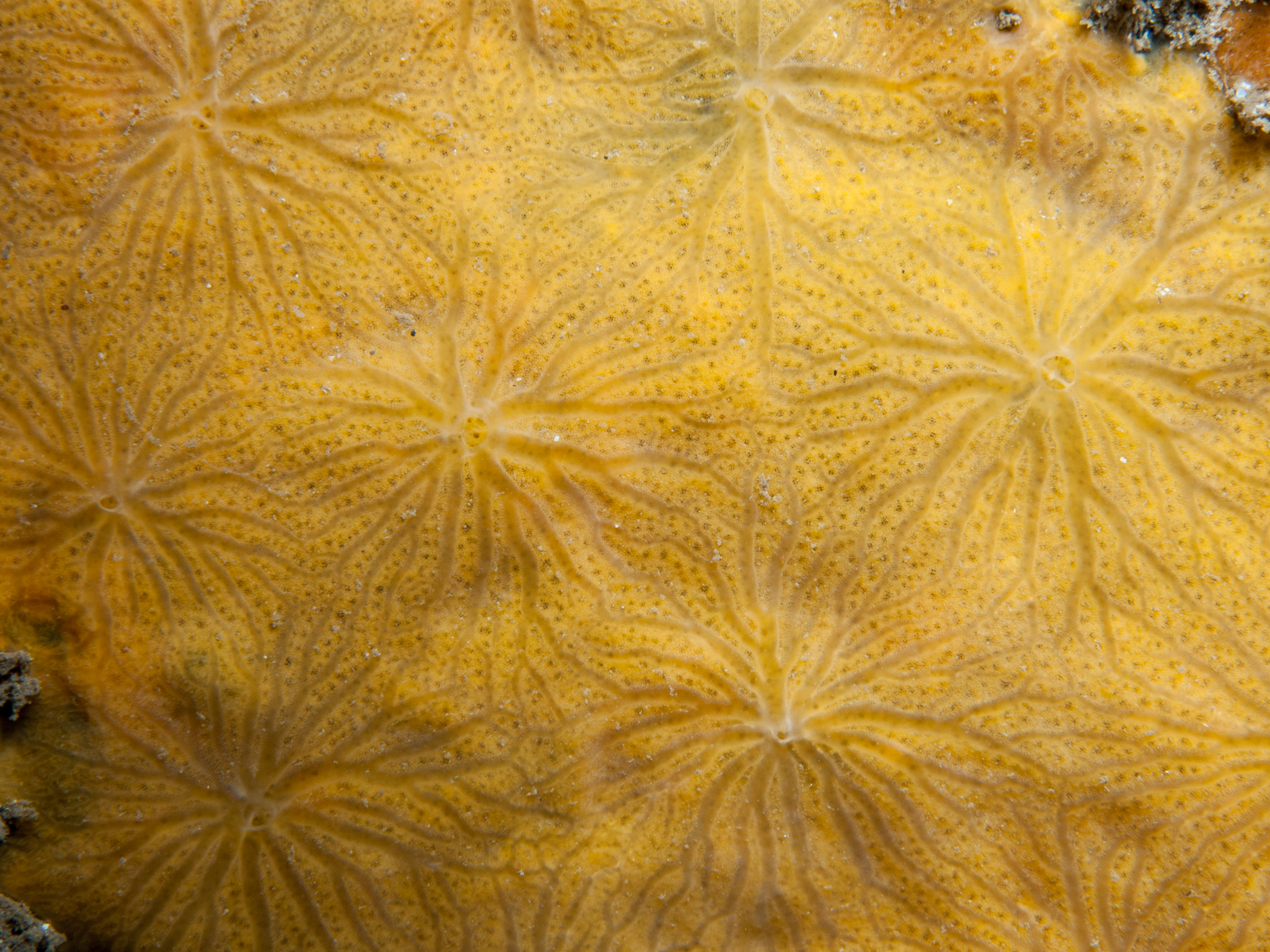
Hymedesmia stellifera is a yellow encrusting sponge which is a member of the Rathlin Island circalittoral sponge communities. It is a frequent species in the right habitats in the Firth of Lorne, Scotland.
In brief
- In Northern Ireland this species is found on Rathlin Island and the Maidens, off Larne.
- Lives on steep or vertical rock faces in water of 25 m or greater depth in moderate to strong tidal streams.
- Not seasonal, this sponge probably remains in one place for many years.
- Northern Ireland is a stronghold for this species.
- Requires rock reef or stable boulder habitats in clean water with a minimum of turbidity.
Species description: This species forms extensive, very thin patches, up to 20 cm in diameter but only 1 mm or less in thickness. It is dull yellow or cream to bright yellow in colour. The surface has regularly placed oscules surrounded by conspicuous exhalent channels in a star pattern.
Life cycle: Reproduction is by swimming larvae which must find suitable substratum to settle on. Settlement in suitable water conditions and initial growth are probably when most mortality occurs due both to chance and to competition for space.
Similar species: There are a number of yellow encrusting sponges in our area and this species is not identifiable with certainty in situ.
How to see this species: Found on steep rock faces in the circalittoral zone usually in places where there are many other encrusting sponges. Its bright yellow coloration makes this species conspicuous but it has no clear features which can be used to identify it in situ and requires microscopic examination of its spicules for confirmation.
Current status: Rare. This species has been found regularly at Rathlin Island and the Maidens, off Larne. All records are from 2005 onwards as this species was discovered on Rathlin Island by the Rathlin Island sponge project in 2005. Elsewhere it has been found in SW Scotland. Northern Ireland is considered to be a stronghold for this species as it has more than 50% of the records worldwide. Like many encrusting sponges this is partly due to the lack of sampling but the North Channel and Irish Sea do have sponge-rich habitats which are rare and not found elsewhere.
Why is this species a priority in Northern Ireland?
- Criterion 3: Rare or restricted range – rare breeding species confined to 5 hectads or less (based on expert judgement).
- Criterion 4: NI stronghold or endemic – both stronghold range/population and designation as ‘endemic’ subject to expert judgement.
Threats:
- The main threat to this species is degradation of water quality due to increased turbidity, pollution or nutrient enrichment.
- Inorganic silt clogs sponges making them unable to filter feed and such silt is artificially suspended into the water column by bottom-fishing activities.
- Some species of sponge can actively clean their surfaces to some extent and may become competitively able to displace other species if there is a shift in water quality.
- Polluted water may cause sponges to become diseased and may benefit some species at the expense of others by providing more bacteria and less plankton as food.
- Nutrient enrichment may have similar effects by changing the amounts of different types of plankton on which the sponges feed.
Action: Records of new sites for this species, with details of habitat and population are always valuable. Observations with a photograph can be recorded using iNaturalist, find the MBDP-NI iNaturalist project here.
Alternatively, records can be sent to CEDaR, National Museums Northern Ireland, 153 Bangor Road, Cultra, Holywood, County Down, BT18 0EU. Tel 028 9039 5257, e-mail cedar.records@nationalmuseumsni.org, or via the online portal.
Objectives:
- Maintain the number of viable populations of the species
- Maintain the range of the species.
- Establish appropriate management on appropriate historic sites.
- Encourage sustainable use of the seas by avoiding consumption of fish and shellfish captured by bottom dredging and bottom trawling.
Conservation:
- Rathlin Island is a Marine Protected Area with multiple designations.
- The Maidens are a Marine Protected Area with multiple designations.
- There is Habitat Action Plan for Fragile Sponge and Anthozoan Communities on Rocky Habitats.
iNaturalist: Hymedesmia stellifera at iNaturalist World Species Observations database.
WoRMS: Hymedesmia stellifera at World Register of Marine Species. Accepted name: Hymedesmia (Hymedesmia) stellifera Goodwin & Picton, 2009. AphiaID: 416424.
Literature:
Goodwin, C.E., Picton, B.E. (2009). Demosponges of the genus Hymedesmia (Poecilosclerida: Hymedesmidae) from Rathlin Island, Northern Ireland, with a description of six new species. Zoological Journal of the Linnean Society. 156: 896–912. doi: 10.1111/j.1096-3642.2008.00498.x.
Classification: Biota; Animalia; Porifera; Demospongiae; Heteroscleromorpha; Poecilosclerida; Hymedesmiidae; Hymedesmia
| Previous species | Next species |
| Picton, B.E., Keatley, L. & Morrow, C.C. (2026). Hymedesmia stellifera. Goodwin & Picton, 2009. [In] Priority species, Marine Biodiversity Portal NI. https://www2.habitas.org.uk/marbiop-ni/priorityaccounts.php?item=C6630. Accessed on 2026-09-13 |