
Northern Ireland Priority species (NIPS)
| PORIFERA : Poecilosclerida : Mycalidae | SPONGES |
Mycale subclavata (Bowerbank, 1866)
 |
| Mycale subclavata |
This sponge was described from specimens collected in Strangford Lough by Professor Dickie of Queen's College, Belfast (now Queen's University Belfast). It was a characteristic and moderately long-lived component of horse mussel beds in Strangford Lough until 20 years ago, but unlike other sponges from this habitat it appears to have increased in recent years. It is now common throughout the lough in a variety of habitats and has been found on the shore at Ballyhenry Island.
In brief
- In Northern Ireland this species was most abundant in horse mussel beds in Strangford Lough which have decreased significantly.
- Lives in the sea at depths of 20-40 m with populations only known in sheltered sea loughs.
- Individuals probably live for several years.
- Scarce in Northern Ireland but most sponges are poorly known and potentially under-recorded, although it appears to be having a population increase in Strangford Lough.
- Threatened primarily by bottom fishing with trawls or dredges which disrupt the biogenic reef habitat.
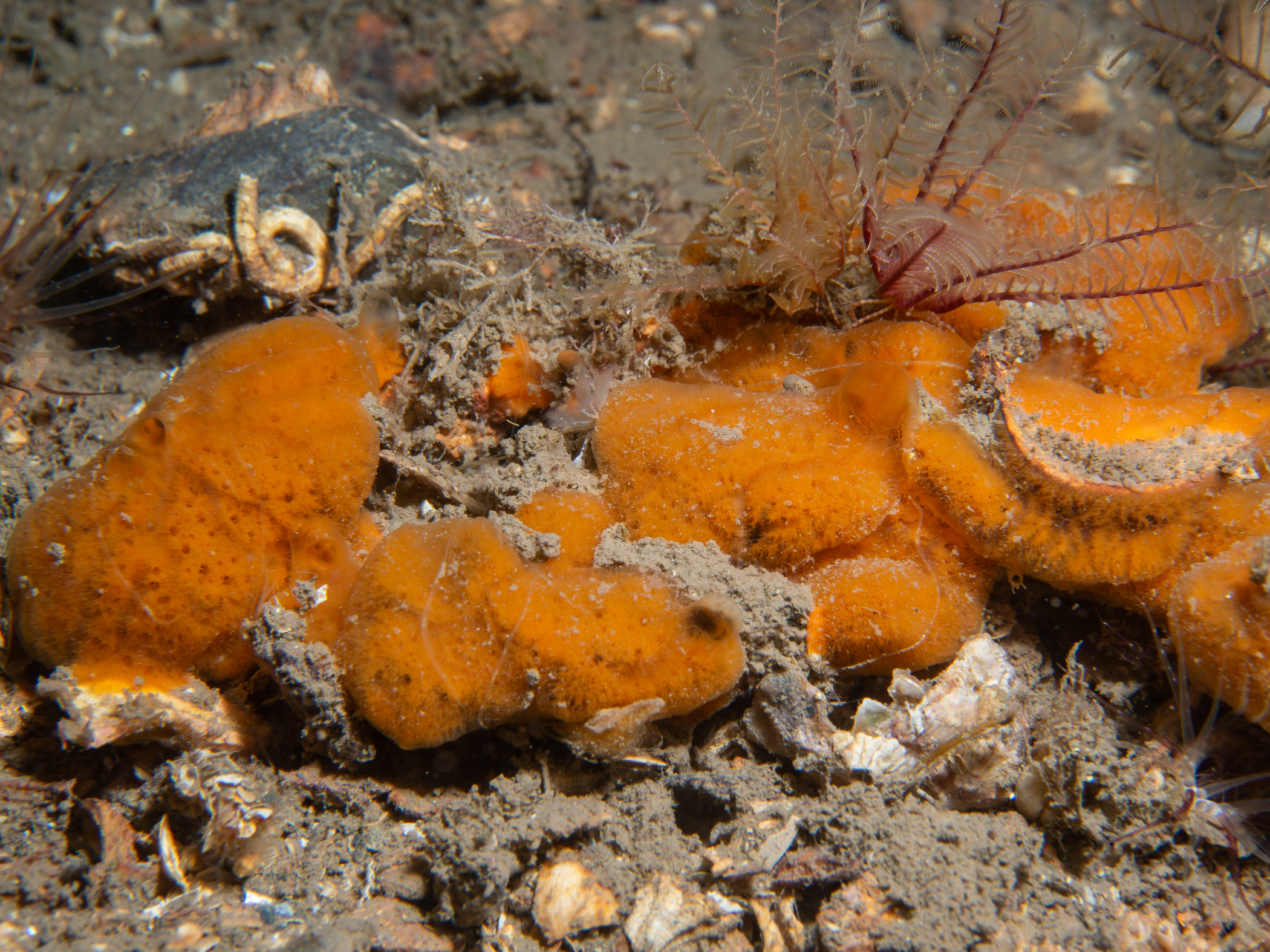
Species description: This sponge forms substantial cushions or sheets on hard substrata. It is orange in colour with large exhalent canals leading to several large osculae. It is soft in consistency with a transparent membrane at the surface and around the osculae. Internally there is a silica spicule skeleton consisting of subtylostyles with small and large anisochelae, toxa, trichodragmata and sigma spicules. The size and shape of the trichodragmata can be used to positively identify this species.
Life cycle: Probably with planktonic larvae which could disperse long distances and enable quick recovery of populations. A nudibranch seaslug, Geitodoris planata, was recently discovered for the first time in Strangford Lough, feeding on this sponge. This sea slug has recently undergone huge population increases in the Netherlands after suddenly appearing in a similar, sheltered, enclosed body of water and it is possible that it interacts with its sponge prey in a long-term cyclical fashion, so monitoring of the situation in Strangford over the next few years could be interesting.
Similar species: Similar in appearance to several other Mycale species but the colour is quite distinctive and appears to be quite consistent between individuals. Several Mycale species are rare on the open coast, apparently being more common in sheltered locations.
How to see this species: This species can be found from the lower shore to 30 m attached to rocks, stones, shells and other hard substrata in areas of slight to moderate current.
Current status: The current status of this species is not clear but it would be a useful indicator to monitor health of the horse mussel beds. It needs investigation to elucidate details of its biology. Investigations in 2003 confirmed that the horse mussel beds have declined considerably in the past 30 years but this species seems to have increased. There are no other recent records from Northern Ireland and few records of this species from Britain and Ireland. Northern Ireland is a stronghold for this species.
Why is this species a priority in Northern Ireland?
- Criterion 3: Rare or restricted range – rare breeding species confined to 5 hectads or less (based on expert judgement).
- Criterion 4: NI stronghold or endemic – both stronghold range/population and designation as ‘endemic’ subject to expert judgement.
Threats:
- This species seems to be undergoing population fluctuations possibly due to physical impact of bottom fishing gear in its habitat. The target for the fishery is the queen scallop, Aequipecten opercularis, which lives in more open muddy patches between the horse mussel clumps, but requires stable biogenic reefs for successful recruitment. Queen scallop numbers are now very low compared with the situation 30 years ago and sponges have been particularly affected by the changes.
- Sponges may be very vulnerable to increased siltation which clogs their feeding mechanisms and may in turn protect the bivalves from starfish predation, so healthy sponge populations may be an important indicator of health of these communities.
- It is unclear whether direct impact from trawling has disrupted the mussel beds and encouraged predatory starfish or whether smothering by stirred up bottom sediments is more to blame for their decline.
Action: Records of new sites for this species, with details of habitat and population are always valuable. Observations with a photograph can be recorded using iNaturalist, find the MBDP-NI iNaturalist project here.
Alternatively, records can be sent to CEDaR, National Museums Northern Ireland, 153 Bangor Road, Cultra, Holywood, County Down, BT18 0EU. Tel 028 9039 5257, e-mail cedar.records@nationalmuseumsni.org, or via the online portal.
Objectives:
- Establish appropriate management on suitable historical sites.
- Monitor numbers present in horse mussel beds in Strangford Lough.
- Investigate biology of this species.
Conservation:
- Strangford Lough is a Marine Protected Area with multiple designations.
- There is a Habitat Action Plan for Horse Mussel Beds.
Distribution Map from NBN: Mycale subclavata at National Biodiversity Network mapping facility, data for UK.
iNaturalist: Mycale subclavata at iNaturalist World Species Observations database.
WoRMS: Mycale subclavata at World Register of Marine Species. Accepted name: Mycale (Carmia) subclavata (Bowerbank, 1866). AphiaID: 168605.
Classification: Biota; Animalia; Porifera; Demospongiae; Heteroscleromorpha; Poecilosclerida; Mycalidae; Mycale
| Previous species | Next species |
| Picton, B.E., Keatley, L. & Morrow, C.C. (2026). Mycale subclavata. (Bowerbank, 1866). [In] Priority species, Marine Biodiversity Portal NI. https://www2.habitas.org.uk/marbiop-ni/priorityaccounts.php?item=C5540. Accessed on 2026-09-13 |