
Northern Ireland Priority species (NIPS)
| PORIFERA : Poecilosclerida : Esperiopsidae | SPONGES |
Amphilectus ovulum (Schmidt, 1870)
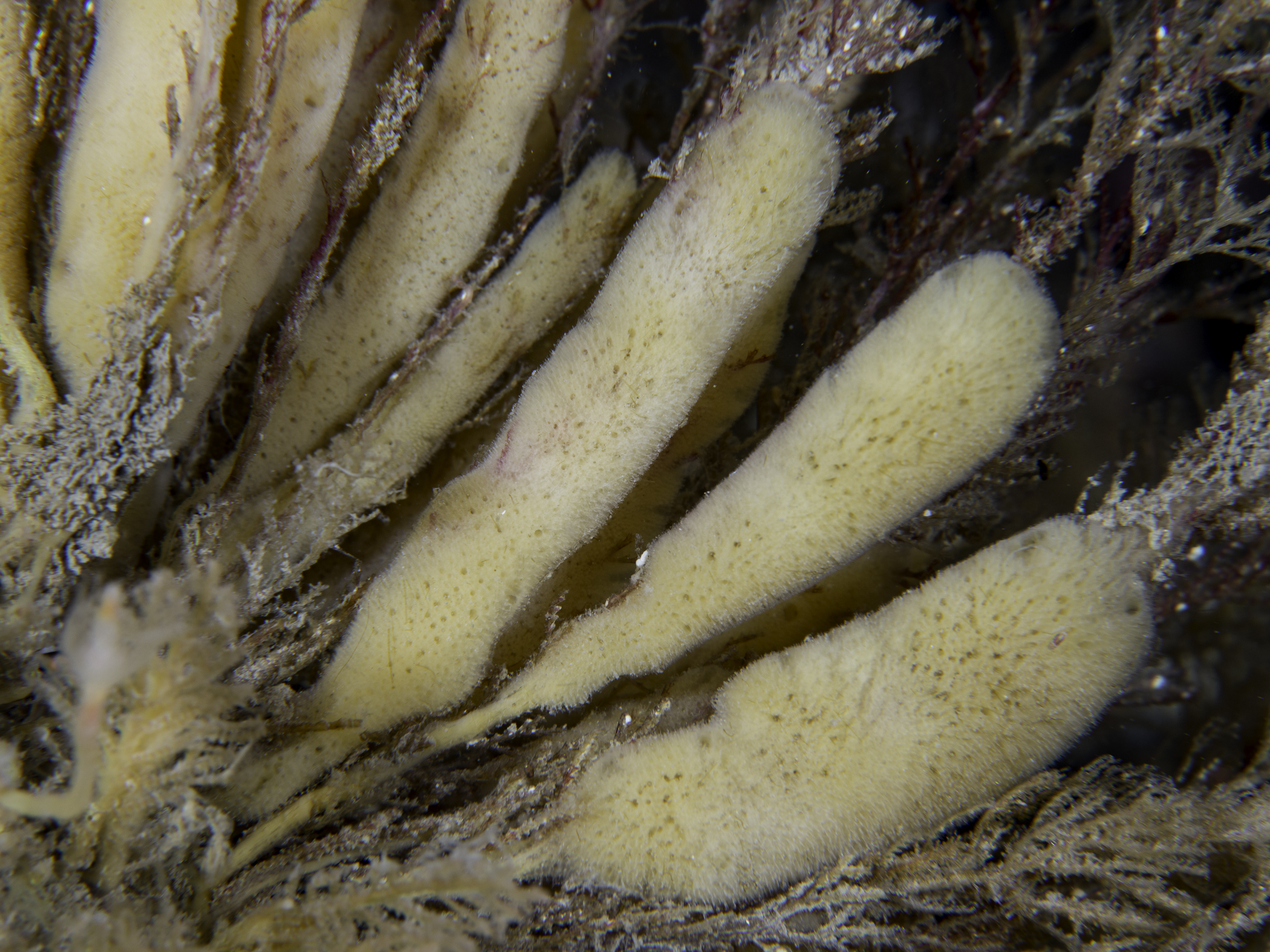 |
| Amphilectus ovulum |
A small yellowish or beige cushion-like sponge growing over algae and epifauna on rocks from the intertidal to deep waters. It is found at only three locations in Northern Ireland and is regarded everywhere as scarce.
In brief
- Found at the entrances to Strangford Lough, Carlingford Lough and The Gobbins, Islandmagee.
- Habitat is areas of strong tidal flow, rocks overgrown with hydroids and weeds.
- Found throughout the year.
- Regarded as a species of conservation concern because of its scarcity.
- Main threats are from fishing and coastal development.
Species description: This is a rounded or flattened pale yellow/beige cushion-like sponge that is usually found growing over other species like brown algae, hydroids or bryozoans that have an erect form, allowing the sponge access to the strong currents it favours. Where there is upright growth, the sponge generally takes on a cylindrical shape. Small specimens have a noticeable single respiratory pore, but larger ones may have several, scattered more or less randomly. Size may vary from 4-15mm diameter, depending also upon shape. The skeletal structures or spicules are long, slightly curved and needle-shaped.
Life cycle: Poecilosclerid sponges primarily reproduce sexually as simultaneous hermaphrodites with internal fertilization and viviparity (brooding embryos), though asexual processes like fragmentation also occurs.
Similar species: Could potentially be confused with many other sponge species and requires examination of the spicules to confirm its identity.
How to see this species: This species is found at only three locations in Northern Ireland - Strangford Lough and Carlingford Lough, and off the Gobbins. In the former it is recorded at several sites in the Narrows, in Carlingford off Blockhouse Island. All these are waters with strong tidal flows. It may be found growing on weeds, hydroids, bryozoans from the low levels of the intertidal to 200 m depth in some areas. Elsewhere in Ireland it has been found in Clifden Bay, County Galway. It has also been recorded from Skye, Loch Etive, Devon, near Milford Haven, and having a predominantly northern distribution, in Scandinavia, Faroes, Iceland and Greenland.
Current status: Rare in Britain and Ireland. In Northern Ireland, it is known from several sites in only three locations. It is likely that Northern Ireland is a stronghold and holds the majority of sites for this species. It may be under-recorded. The species has no legal protection.
Why is this species a priority in Northern Ireland?
- Criterion 3: Rare or restricted range – rare breeding species confined to 5 hectads or less (based on expert judgement).
- Criterion 4: NI stronghold or endemic – both stronghold range/population and designation as ‘endemic’ subject to expert judgement.
Threats: There is no information about the trends for population or range of this species. However, in some areas it is likely to be vulnerable to disruption of its habitat through the use of mobile bottom fishing gear. In more enclosed, shallow sites it is likely to be vulnerable to the effects of deteriorating water quality.
Action: Records of new sites for this species, with details of habitat and population are always valuable. Observations with a photograph can be recorded using iNaturalist, find the MBDP-NI iNaturalist project here.
Alternatively, records can be sent to CEDaR, National Museums Northern Ireland, 153 Bangor Road, Cultra, Holywood, County Down, BT18 0EU. Tel 028 9039 5257, e-mail cedar.records@nationalmuseumsni.org, or via the online portal.
Objectives:
- Maintain the number of viable populations in Strangford and Carlingford Loughs and the Gobbins.
- Maintain the range of this species.
- Monitor known populations, or a sample of these.
- Protect sites of conservation importance from damage through contamination and physical disturbance (for example, turbidity and towed fishing gear).
- Require EIAs for coastal developments to examine potential effects on intertidal and nearshore areas.
- Monitor any impact of dump sites on inshore sublittoral rock habitats, communities and wildlife, and taking action as appropriate.
- Iplement strategies for managing the coastal zone at local, regional and national levels.
Conservation:
- Strangford Lough is a Marine Protected Area with multiple designations.
- The Habitat Action Plan for Tide-Swept Channels is relevant.
Distribution Map from NBN: Amphilectus ovulum at National Biodiversity Network mapping facility, data for UK.
iNaturalist: Amphilectus ovulum at iNaturalist World Species Observations database.
WoRMS: Amphilectus ovulum at World Register of Marine Species. Accepted name: Amphilectus ovulum (Schmidt, 1870). AphiaID: 1424119.
Classification: Biota; Animalia; Porifera; Demospongiae; Heteroscleromorpha; Poecilosclerida; Esperiopsidae; Amphilectus
| Previous species | Next species |
| Adapted from text by Allen & Mellon Environmental Ltd. (2026). Amphilectus ovulum. (Schmidt, 1870). [In] Priority species, Marine Biodiversity Portal NI. https://www2.habitas.org.uk/marbiop-ni/priorityaccounts.php?item=C5450. Accessed on 2026-09-13 |