
Northern Ireland Priority species (NIPS)
| PORIFERA : Poecilosclerida : Mycalidae | SPONGES |
Mycale lingua (Bowerbank, 1866)
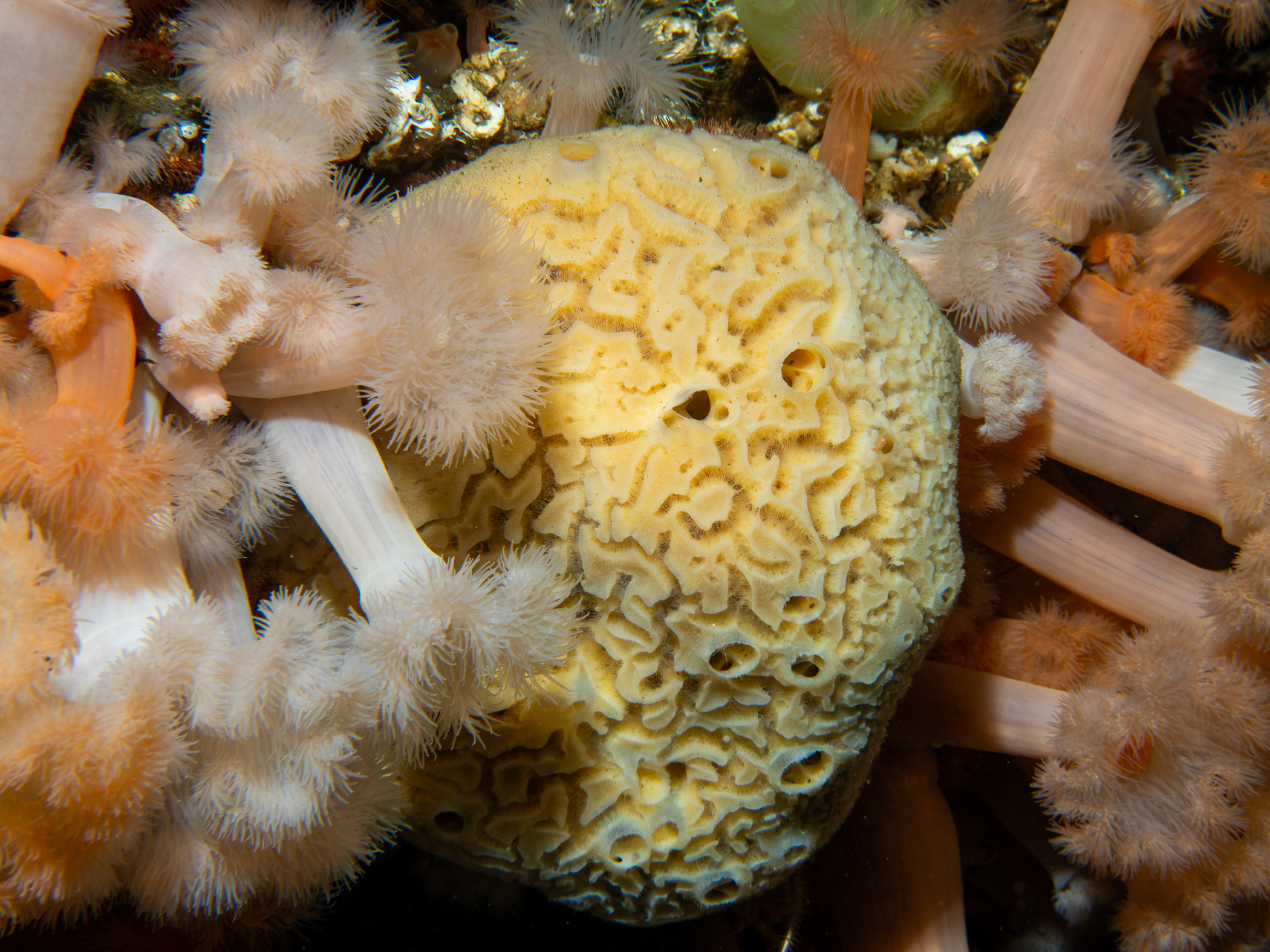 |
| Mycale lingua |
A large deep-water sponge that has been found only on Rathlin Island within depths normally accessible to divers. It is not known whether there are any threats to the population.
In brief
- Found off Farganlack Point, Rathlin Island.
- Habitat is boulders and bedrock, usually in deep water.
- Can be found throughout the year.
- Listed as a NIPS on account of its extreme rarity.
- Main threats and cause of decline, if there are any specific to this species, are not known.
Species description: This is a very large sponge, growing up to 30 cm in height, a dull grey or pale buff colour. On occasion, it assumes an erect form whereby it broadens out from a narrower base. It is irregular but rounded and often a roughly triangular shape. To the touch it is compressible, but tough and fibrous and has grooves running irregularly over the surface. The pores (oscules) of diameter about 5mm are located on low transparent cones on the surface. Spicules (skeletal structures) are long and needle-shaped - others seen by microscope somewhat resemble the mouthpiece of a telephone.
Life cycle: Sponges have either separate sexes or are hermaphrodite. In the case of the latter, self-fertilisation is avoided by eggs and sperms maturing at different rates within the same individual, so when spawning takes place and sperms are released through exhalent openings, it is unlikely that the eggs will be fertilised. Alternatively the eggs are retained within the sponge, and sperms drawn in from surrounding water. Fertilised eggs are released and develop into planktonic larvae. Asexual reproduction may also be achieved by budding, whereby a small unit of the sponge separates and develops as an independent entity.
Similar species: This is a distinctive sponge, but it has two synonyms: Esperia placoides, and Esperella murrayi.
How to see this species: The species has a worldwide distribution, occurring in deep waters round to Australia; in the north Atlantic it is found from the Azores to Spitzbergen, and into the Mediterranean. The only Northern Ireland location with divable depths is off Farganlack Point on the north coast of Rathlin Island, but it is also found at a number of locations off western Scotland, as well as Brittany, and the Faeroes. It occurs on bedrock and boulders in depths from 30-2460 m.
Current status: Rare in Northern Ireland, and the Rathlin site is the only one recorded in all Ireland. The species has no legal protection. It is a northern species, so could be at risk from climate change and reduction of range. Possibly declining, however it is data deficient so exact distribution and population sizes are unknown.
Why is this species a priority in Northern Ireland?
- Criterion 3: Rare or restricted range – rare breeding species confined to 5 hectads or less (based on expert judgement).
Threats:
- There is insufficient information to determine if the species is declining, and if so, what the likely causes might be. It is unknown if there are any threats specific to this species.
- It is of course at risk from general threats such as degradation of water quality due to increased turbidity, pollution or nutrient enrichment.
- Inorganic silt clogs sponges making them unable to filter feed and such silt is artificially suspended into the water column by bottom-fishing activities.
- Some species of sponge can actively clean their surfaces to some extent and may become competitively able to displace other species if there is a shift in water quality.
- Polluted water may cause sponges to become diseased and may benefit some species at the expense of others by providing more bacteria and less plankton as food.
- Nutrient enrichment may have similar effects by changing the amounts of different types of plankton on which the sponges feed.
Action: Records of new sites for this species, with details of habitat and population are always valuable. Observations with a photograph can be recorded using iNaturalist, find the MBDP-NI iNaturalist project here.
Alternatively, records can be sent to CEDaR, National Museums Northern Ireland, 153 Bangor Road, Cultra, Holywood, County Down, BT18 0EU. Tel 028 9039 5257, e-mail cedar.records@nationalmuseumsni.org, or via the online portal.
Objectives:
- Maintain the only known site of the species on Rathlin Island and monitor its population.
- Maintain the range of the species.
- Document and appropriately manage any new locations.
Conservation:
- Rathlin Island is a Marine Protected Area with multiple designations.
- There is Habitat Action Plan for Fragile Sponge and Anthozoan Communities on Rocky Habitats.
Distribution Map from NBN: Mycale lingua at National Biodiversity Network mapping facility, data for UK.
iNaturalist: Mycale lingua at iNaturalist World Species Observations database.
WoRMS: Mycale lingua at World Register of Marine Species. Accepted name: Mycale (Mycale) lingua (Bowerbank, 1866). AphiaID: 168640.
Literature:
Picton, B.E., Morrow, C.C. and van Soest, R.W.B. (2007). [In] Sponges of Britain and Ireland. http://www.habitas.org.uk/marinelife/sponges.asp?item=C5440.
Classification: Biota; Animalia; Porifera; Demospongiae; Heteroscleromorpha; Poecilosclerida; Mycalidae; Mycale
| Previous species | Next species |
| Adapted from text by Allen & Mellon Environmental Ltd. (2026). Mycale lingua. (Bowerbank, 1866). [In] Priority species, Marine Biodiversity Portal NI. https://www2.habitas.org.uk/marbiop-ni/priorityaccounts.php?item=C5440. Accessed on 2026-09-13 |