
Northern Ireland Priority species (NIPS)
| PORIFERA : Agelasida : Hymerhabdiidae | SPONGES |
Hymerhabdia typica Topsent, 1892
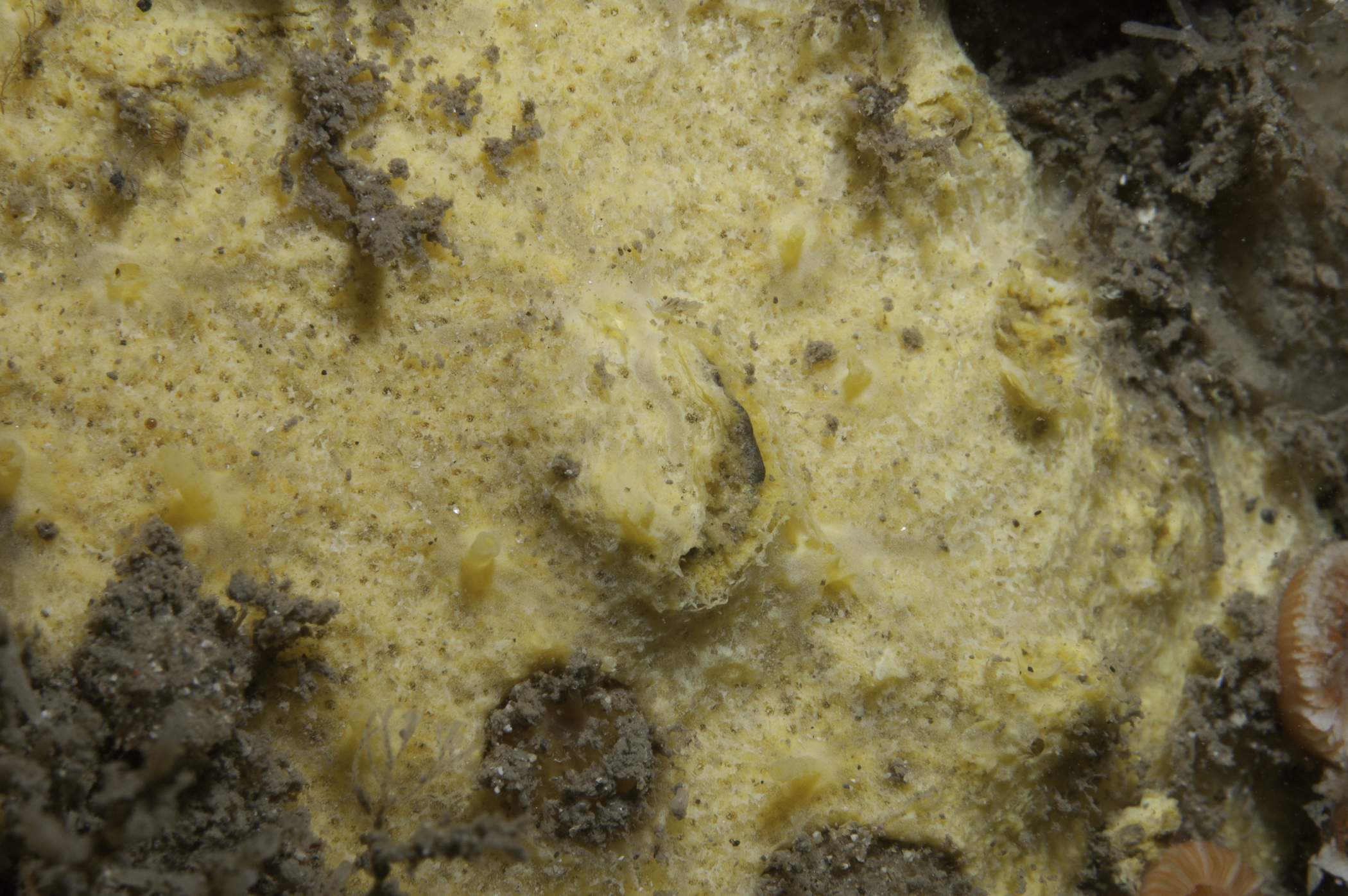 |
| Hymerhabdia typica |
This is a fragile encrusting sponge, known from a small number of sites, all on The Maidens or Rathlin Island and possibly well established there. These are the only known locations in Ireland. Whilst it appears not to have been strongly affected by bottom fisheries so far, it would be highly vulnerable if this occurred.
In brief
- Can be found on both north and south coasts of Rathlin Island, and The Maidens.
- Its habitat is bedrock, boulders grading down to gravel beds, in areas of strong current.
- It can be found throughout the year.
- This species is listed as a NIPS on account of the Rathlin sites being the only sites in an Irish context.
- Although not currently adversely affected by bottom fishing, the species would be threatened by disruption to its habitat from this activity.
Species description: This is a thinly-formed, quite fragile encrusting sponge that grows up to about 20 cm in extent. Its colour is generally yellow, sometimes quite bright, but some sources have reported a dark orange form. It has a somewhat granular appearance, with small respiratory openings and the respiratory/feeding channels are visible below its surface. The spicules (skeletal structures) are smooth, straight and have well-developed heads at one end.
Life cycle: Sponges have either separate sexes or are hermaphrodite. In the case of the latter, self-fertilisation is avoided by eggs and sperms maturing at different rates within the same individual, so when spawning takes place and sperms are released through exhalent openings, it is unlikely that the eggs will be fertilised. In the case of this species it is thought that it probably releases eggs which are fertilised externally and develop into planktonic larvae (B. Picton, pers. comm.). Asexual reproduction may also be achieved by budding, whereby a small unit of the sponge separates and develops as an independent entity.
Similar species: Hymerhabdia intermedia is similar, but can be separated by examination of the spicules.
How to see this species: The only Northern Ireland sites where this species has been found are on Rathlin Island; Black Head, West of Derginan Point, to east of Sroanderrig (recorded as Damicornis Bay by researchers), and below the White Cliffs; it currently appears to be well established. It may be found on boulders and bedrock, particularly where boulders run on to more open gravel, on open sections of coast where there are strong currents. There are no other Irish records. Further afield it has been recorded as having a mainly southern distribution from Brittany, Azores and the Mediterranean.
Current status: Rare. Known only from sites on both north and south coasts of Rathlin Island, although it looks to be well established in one location where it is found. Northern Ireland holds all the Irish sites for this species. The species has no legal protection.
Why is this species a priority in Northern Ireland?
- Criterion 3: Rare or restricted range – rare breeding species confined to 5 hectads or less (based on expert judgement).
- Criterion 4: NI stronghold or endemic – both stronghold range/population and designation as ‘endemic’ subject to expert judgement.
Threats: It is considered that probably the species has not been affected by bottom fisheries so far. However, where it is found amongst boulders grading into more level gravel seabed, disruption by mobile fishing gear could threaten its survival, as like many sponges, it requires stable conditions.
Action: Records of new sites for this species, with details of habitat and population are always valuable. Observations with a photograph can be recorded using iNaturalist, find the MBDP-NI iNaturalist project here.
Alternatively, records can be sent to CEDaR, National Museums Northern Ireland, 153 Bangor Road, Cultra, Holywood, County Down, BT18 0EU. Tel 028 9039 5257, e-mail cedar.records@nationalmuseumsni.org, or via the online portal.
Objectives:
- Maintain the number of viable populations of the species.
- Maintain the range of the species.
- Establish appropriate management of known sites.
- Monitor population at a sample of Rathlin sites.
Conservation:
- Rathlin Island is a Marine Protected Area with multiple designations.
- There is Habitat Action Plan for Fragile Sponge and Anthozoan Communities on Rocky Habitats.
- The Maidens are a Marine Protected Area with multiple designations.
Distribution Map from NBN: Hymerhabdia typica at National Biodiversity Network mapping facility, data for UK.
iNaturalist: Hymerhabdia typica at iNaturalist World Species Observations database.
WoRMS: Hymerhabdia typica at World Register of Marine Species. Accepted name: Hymerhabdia typica Topsent, 1892. AphiaID: 132527.
Literature:
Picton, B.E. and Goodwin, C.E. (2007). Sponge biodiversity of Rathlin Island, Northern Ireland. Jour. Mar. biol. Ass. UK 87: 1441-1458.
Picton, B.E. and Morrow, C.C. (2007). [In] Encyclopedia of Marine Life of Britain and Ireland. http://www.habitas.org.uk/marinelife/species.asp?item=C3840.
Classification: Biota; Animalia; Porifera; Demospongiae; Heteroscleromorpha; Agelasida; Hymerhabdiidae; Hymerhabdia
| Previous species | Next species |
| Adapted from text by Allen & Mellon Environmental Ltd. (2026). Hymerhabdia typica. Topsent, 1892. [In] Priority species, Marine Biodiversity Portal NI. https://www2.habitas.org.uk/marbiop-ni/priorityaccounts.php?item=C3840. Accessed on 2026-09-13 |