
| PORIFERA : Haplosclerida : Chalinidae | SPONGES |
Haliclona rosea (Bowerbank, 1866)
 |
| Haliclona rosea |
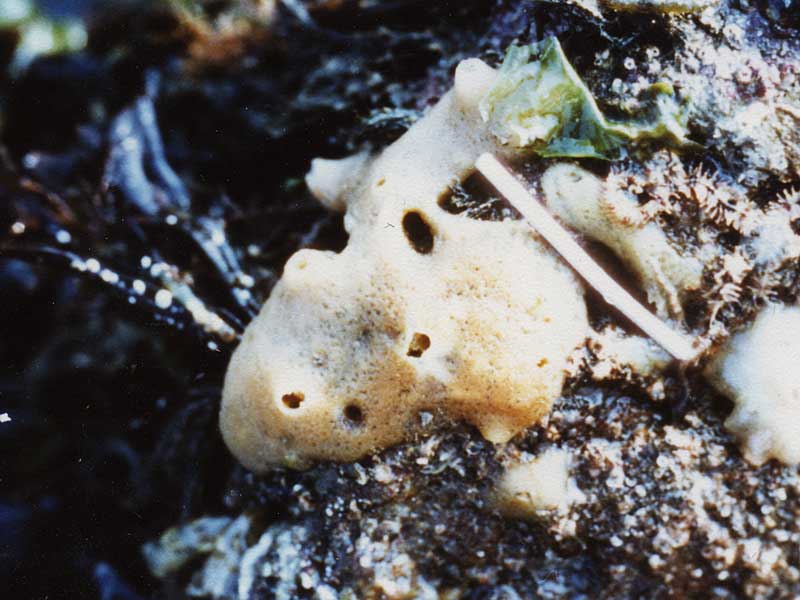
Form: The form varies from thin sheets, not exceeding 3cm across, to cushions up to 15cm across. In the larger specimens there are commonly a few thin, solid digitate processes branching from the main body.
Colour: Varies from light brown to lavender purple. The colour vanishes entirely in spirit.
Consistency: Soft and fragile.
Surface: Even, irregularly punctate; slightly hispid from the presence of projecting spicules.
Apertures:
- The oscules vary from 0.5-2mm diameter in the thinly encrusting growth forms to 0.5 to 1cm in the larger and more massive forms. They may be flush with the surface, or be situated at the summits of chimney-shaped elevations.
Contraction:
- Not noticeable.
| [ More images ] |
Synonyms: This species has had a complex taxonomic history, with many synonyms; see de Weerdt, 1986, p.122.
Internal characters
Skeleton: There is no ectosome. The skeleton consists of pauci- to multispicular (2-5 spicules wide) primary lines, connected by irregularly scattered, single, secondary spicules. The primary lines are often somewhat wavy. Spongin is scarce or absent; if present it is confined to the nodes of the spicule net.
Spicules: The megascleres are rather long oxea, with long points, 120-175 x 4-11 .
Habitat: Under intertidal boulders, and in the sublittoral to about 100m.
Distribution: Probably widely distributed all around the British Isles, except possibly the east coast of England. Known recently from Anglesey and Sherkin Island.
Distribution Map from NBN: Haliclona rosea at National Biodiversity Network mapping facility, data for UK.
iNaturalist: Haliclona rosea at iNaturalist World Species Observations database.
WoRMS: Haliclona rosea at World Register of Marine Species. Accepted name: Haliclona (Rhizoniera) rosea (Bowerbank, 1866). AphiaID: 166637.
Classification: Biota; Animalia; Porifera; Demospongiae; Heteroscleromorpha; Haplosclerida; Chalinidae; Haliclona
Editors: D. Moss, B.E. Picton.
| Previous species | Next species |
| Picton, B.E. & Morrow, C.C. (2023). Haliclona rosea. (Bowerbank, 1866). [In] Sponges of Britain and Ireland. https://www2.habitas.org.uk/marbiop-ni/sponges.php?item=C8620. Accessed on 2026-10-17 |