
| PORIFERA : Poecilosclerida : Microcionidae | SPONGES |
Microciona armata Bowerbank, 1866
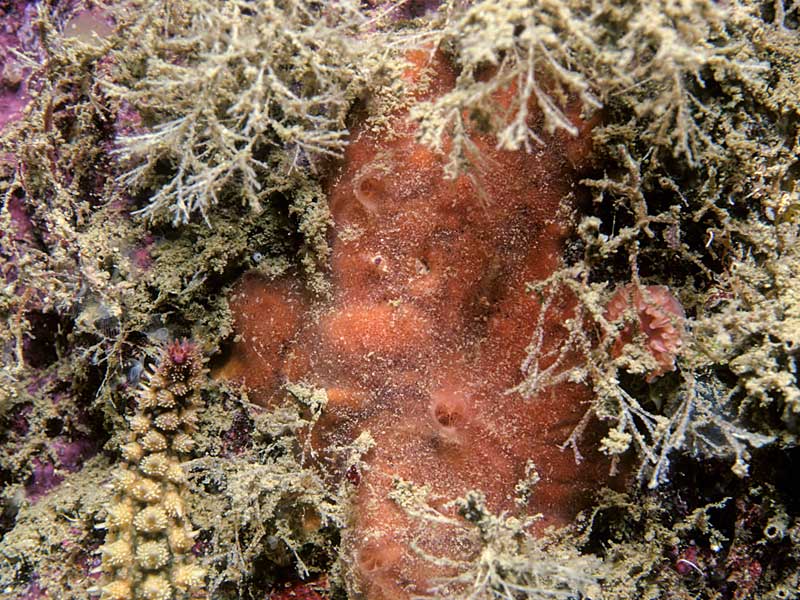 |
| Microciona armata |
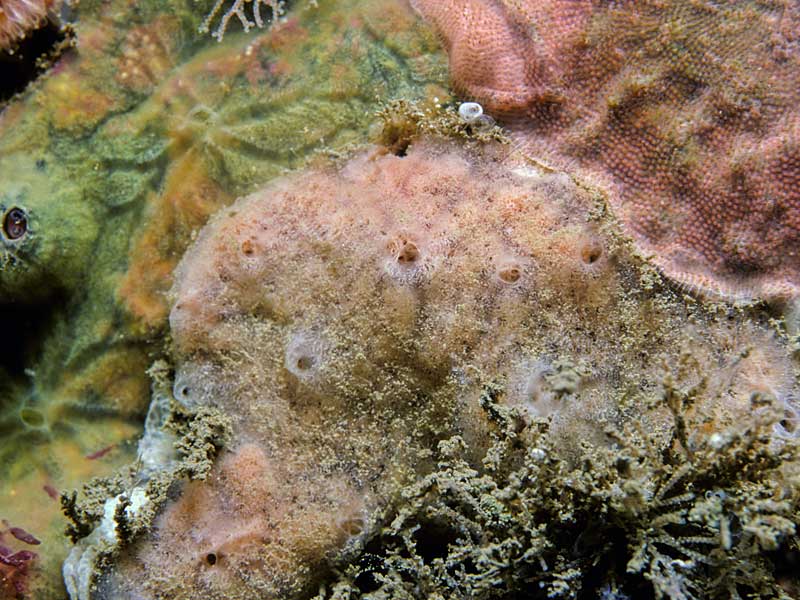
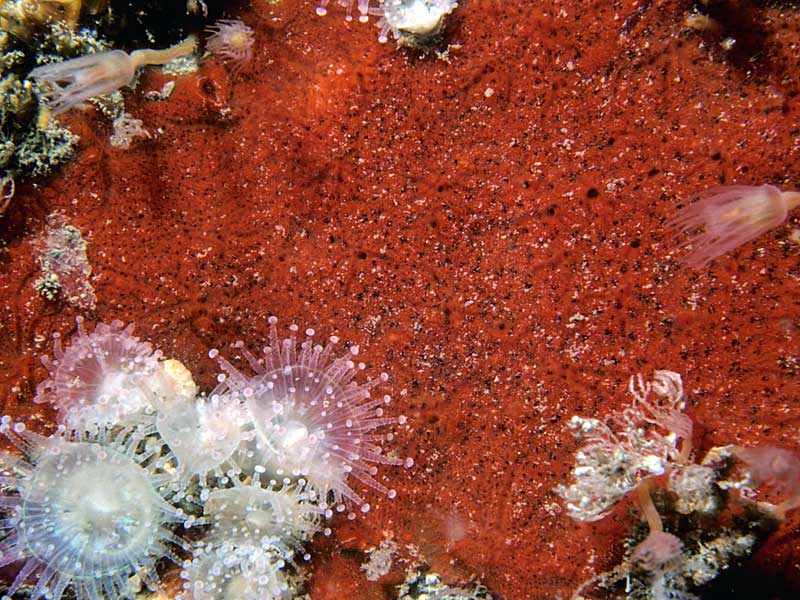
Form: Thin sheet covering rock or bivalve shells, to thin crust 1-5mm thick.
Colour: Light red, reddish-orange, "blood-red". Brown when dried.
Smell: None
Consistency: Difficult to determine in thin specimens, but rather brittle in thicker ones.
Surface: Smooth to casual inspection, but very finely hispid.
Apertures:
- Oscules have transparent converging excurrent channels.
Contraction:
- None
 |
 |
[ More images ] |
Internal characters
 |
Skeleton: Typically microcionid with ascending plumose bundles of large, sparsely spined acanthostyles, echinated by smaller acanthostyles. (See diagram on page 36). These bundles rarely branch, so thicker specimens tend to break with a right-angled edge, and bundles separate easily. There is a surface layer of subtylostyles. Toxa and palmate isochelae are frequent throughout the skeleton.
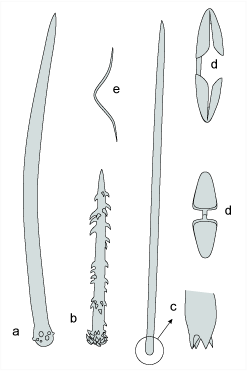
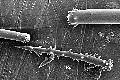
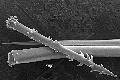
Spicules: The principal megascleres are almost smooth acanthostyles (a), slightly spined around the head, ca. 200-780 x 8-15 μm. Secondary echinating acanthostyles (b), ca. 100-200 μm, are entirely and heavily spined, with larger, recurved, spines towards the tips. Slender (sub)tylostyles (c), ca. 150-350 μm (300-450 μm according to van Soest and Stone), with microspined heads, are present in the surface. (It may be difficult to see these spines). Microscleres include palmate isochelae (d), ca. 7-23 μm and toxa (e), ca. 45-250 μm.
 |  |
Habitat: On bivalve shells on muddy sediments, rocks and boulders in sheltered sites, and also on bedrock in strong tidal streams. Intertidal to 180 m.
Distribution: "N. Atlantic": White Sea to Mediterranean. Coasts of Ireland, southern and western Britain, Channel Isles. Recently known from Calf of Man, Strangford Lough, Lough Hyne, Skomer Is.
Identity: The validity of the large range in spicule sizes given above is uncertain (but see Levi, 1960, p.73, from where it is apparent that spicule sizes tend to vary considerably in this species). In any given specimen such wide variation is unlikely to occur. Separation of the various microcionid 'red crusts' is difficult and needs careful microscopic examination. Lévi (1960, p.66) gives a key to the genus Microciona. This species does have extremely large, recurved spines on the smaller acanthostyles, which are quite distinctive. A distinct species has recently been discovered near Skomer Island which appears to be undescribed. It forms thick, bright red sheets, and has a spicule compliment similar to Microciona armata but with smaller spines on the secondary acanthostyles.
Distribution Map from NBN: Microciona armata at National Biodiversity Network mapping facility, data for UK.
iNaturalist: Microciona armata at iNaturalist World Species Observations database.
WoRMS: Microciona armata at World Register of Marine Species. Accepted name: Clathria (Microciona) armata (Bowerbank, 1862). AphiaID: 167614.
Classification: Biota; Animalia; Porifera; Demospongiae; Heteroscleromorpha; Poecilosclerida; Microcionidae; Microcioninae; Microciona
Voucher: BELUM : Mc1643. Strangford Lough, Down.
Editors: D. Moss, B.E. Picton.
| Previous species | Next species |
| Picton, B.E. & Morrow, C.C. (2023). Microciona armata. Bowerbank, 1866. [In] Sponges of Britain and Ireland. https://www2.habitas.org.uk/marbiop-ni/sponges.php?item=C8110. Accessed on 2026-10-15 |