
| PORIFERA : Poecilosclerida : Microcionidae | SPONGES |
Ophlitaspongia papilla Bowerbank, 1866
 |
| Ophlitaspongia papilla |
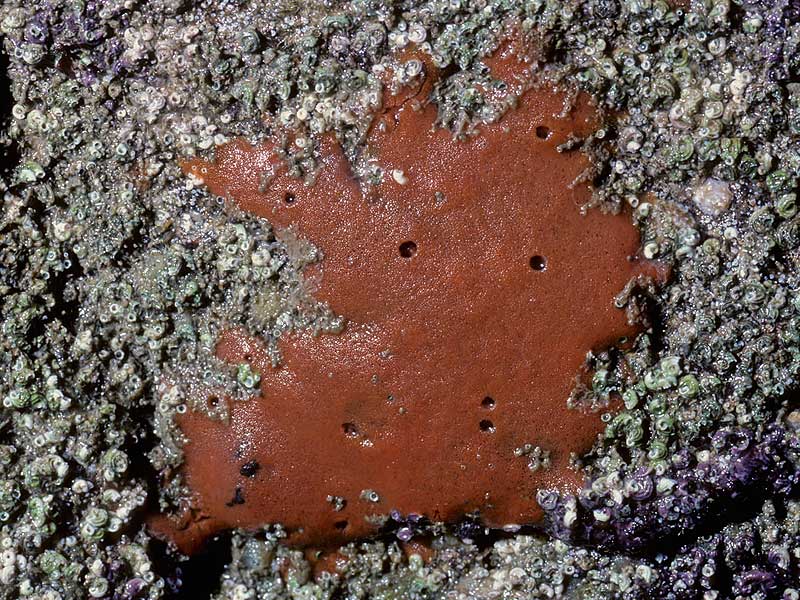
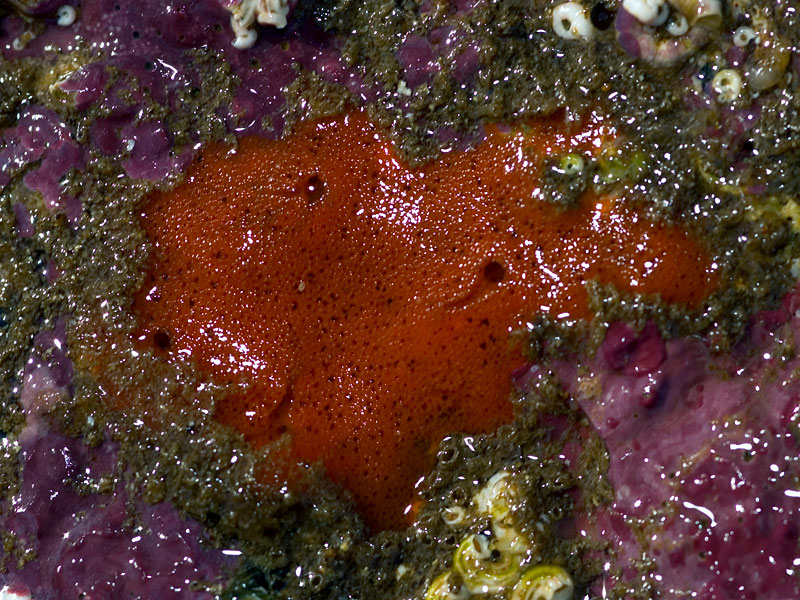
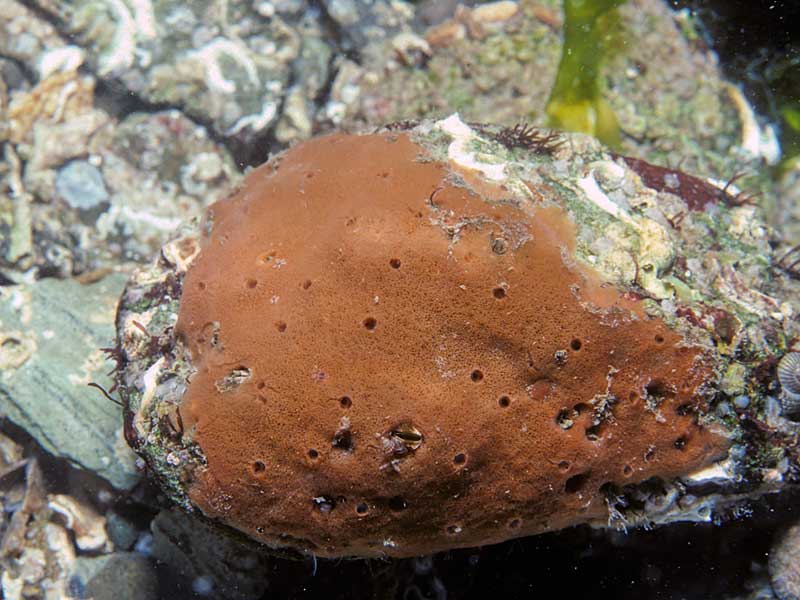
Form: Thin sheets, usually 2 - 3mm thick, but can develop into cushions of uniform thickness up to 10mm thick. Diameter of the animal may be up to 10cm.
Colour: Deep orange - red. The pigment squeezes out readily.
Smell: "Not strong" - "none" (?).
Consistency: Moderately firm and elastic. "Compressible, resilient. Breaks somewhat in the manner of a soft biscuit."
Surface: Very finely granular, "even, hispid", "minutely wrinkled". The surface has a smooth dense appearance which is quite distinctive.
Apertures:
- The oscules are conspicuous and evenly distributed in a regular fashion between 5 and 10mm apart over the surface. Neat, round and mostly flush with the surface, but the margins can be raised slightly above the surface. "Occasionally sub-fistular."
Contraction:
- None.
|
|
|
 |
 |
 |
[ More images ] |
Synonyms: Ophlitaspongia seriata sensu Johnston, 1842, auctt. nec Grant 1826.
Internal characters
 |
Skeleton: Very characteristic. In cross-section a ladder-like skeleton of spongin can be seen, which forms an anisotropic reticulation of well developed fibres. The primary ascending fibres are semi-cored by plumosely arranged megascleres, which often quasi-echinate the fibres. The secondary connecting fibres usually do not contain spicules. Accessory spicules are usually interstitial, rather than at the surface.
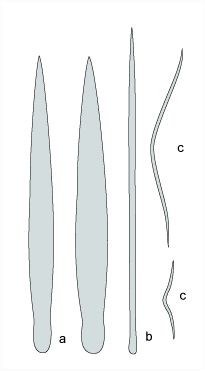
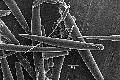
Spicules: The principal megascleres of the main skeleton are short fat styles or subtylostyles (a) 110-(117)-130 μm. The accessory spicules are thin subtylostyles (b) 105-(118)-130 μm. The microscleres are toxa (c) with smooth tips 50-(55)-60 μm. Chelae are absent.
 |
Habitat: On rock, commonly under boulders on the lower shore and also in the shallow sublittoral (to 5m CD). "On clean rock, shells, Fucus," and Laminaria stipes in areas of strong water movement (either tidal or wave action).
Distribution: "British Isles; France and Spain." A common shore species with recent records from south-west England, western Ireland, Strangford Lough and Tiree. Fry (1971) did research on this species from the Menai Straits and Anglesey.
Identity: Superficially Ophlitaspongia papilla could be confused with several other species. However the spiculation is distinctive and the form, colour and habitat make it readily identifiable. It could be confused with Amphilectus fucorum (q.v.) but when alive the strong smell of Amphilectus can be used as an initial indication; Amphilectus has a much softer consistency. It could also be confused with Microciona atrasanguinea (q.v., a shallow sublittoral species which also forms thin sheets), but whereas Ophlitaspongia can be peeled off the rock, Microciona usually crumbles and tears and is much thinner. The spiculation is also very different.
Distribution Map from NBN: Ophlitaspongia papilla at National Biodiversity Network mapping facility, data for UK.
iNaturalist: Ophlitaspongia papilla at iNaturalist World Species Observations database.
WoRMS: Ophlitaspongia papilla at World Register of Marine Species. Accepted name: Ophlitaspongia papilla Bowerbank, 1866. AphiaID: 184428.
Classification: Biota; Animalia; Porifera; Demospongiae; Heteroscleromorpha; Poecilosclerida; Microcionidae; Ophlitaspongiinae; Ophlitaspongia
Voucher: BELUM : Mc588. Rutland Harbour, Donegal.
Editors: R. Earll, D. Moss, B.E. Picton.
| Previous species | Next species |
| Picton, B.E. & Morrow, C.C. (2023). Ophlitaspongia papilla. Bowerbank, 1866. [In] Sponges of Britain and Ireland. https://www2.habitas.org.uk/marbiop-ni/sponges.php?item=C8050. Accessed on 2026-10-15 |