
| PORIFERA : Clathrinida : Clathrinidae | SPONGES |
Clathrina coriacea (Montagu, 1818)
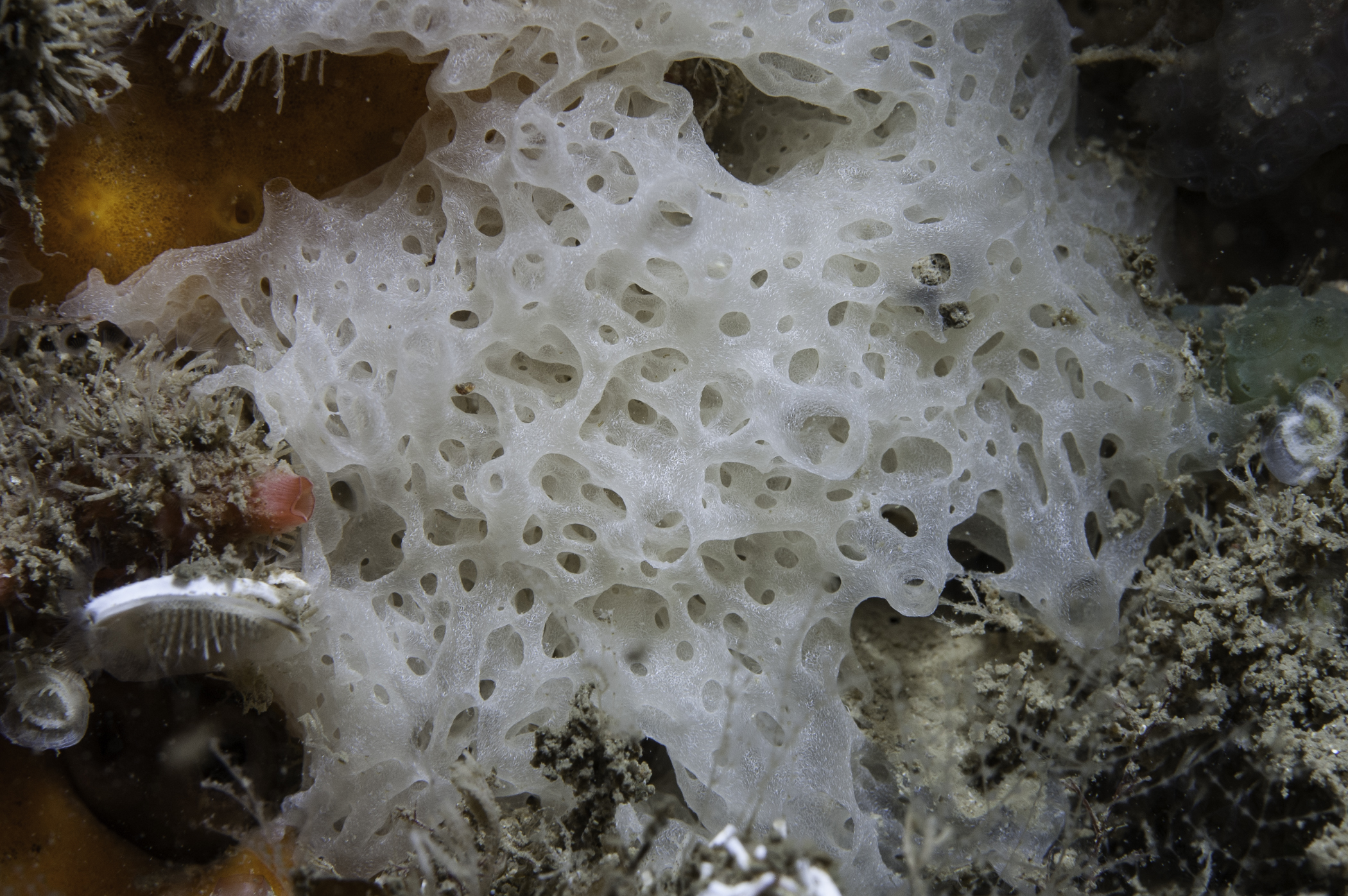 |
| Clathrina coriacea |
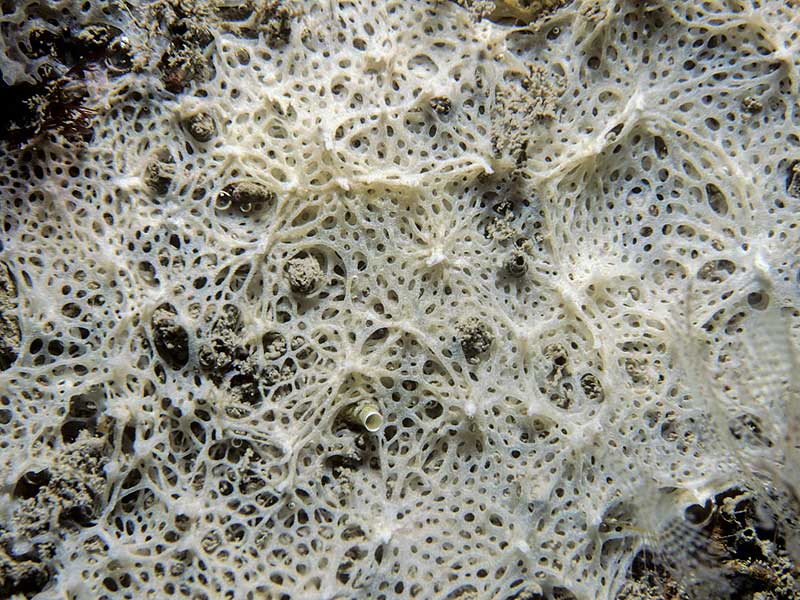
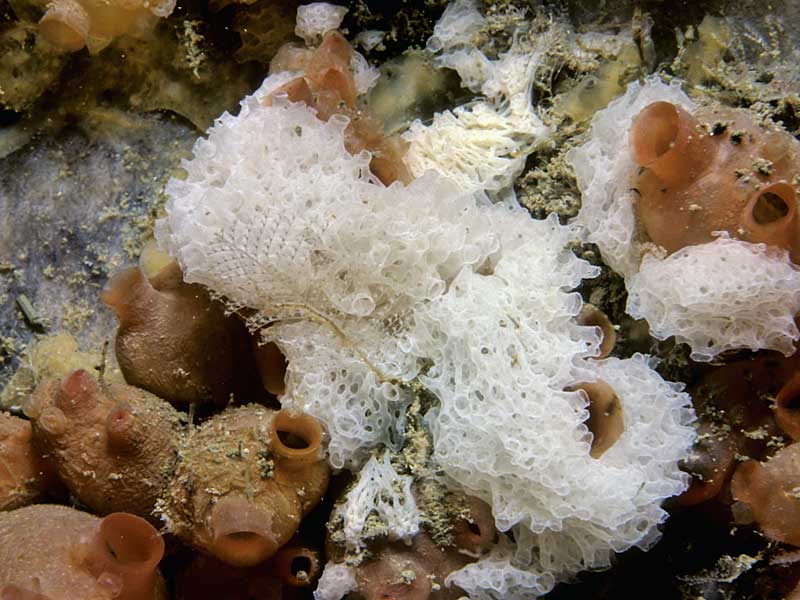
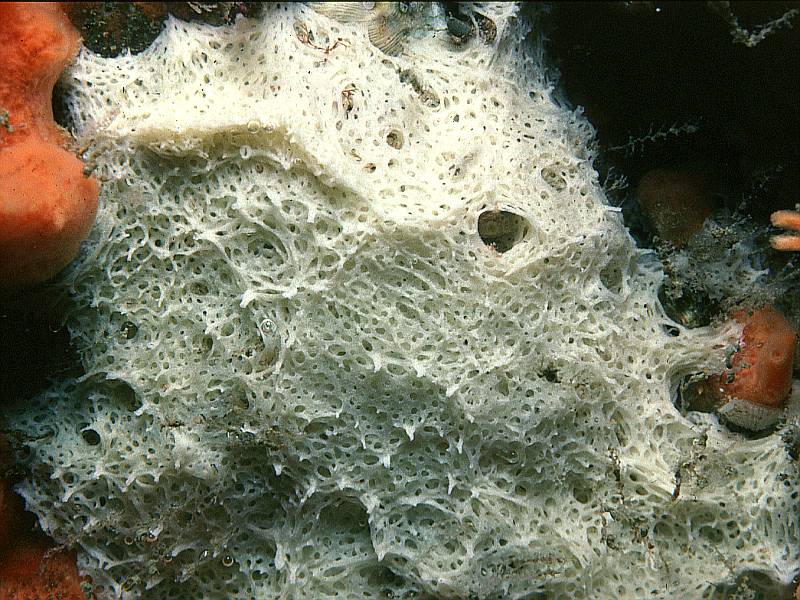
Form: Consists of three dimensional network of anastomosing thin walled tubes, which form a compact, low-lying anastomosing mass attached directly to the substrate. There are no erect free branches.
Colour: Usually white, but can be grey, pale rose, orange or sulphur yellow.
Smell: None.
Consistency: Soft, delicate.
Surface: Of tubes, smooth and soft.
Apertures:
- Several tubes join to share one common oscule, slightly raised above the surface, "but never marked tubular".
Contraction:
- Not noticeable (?).
 |
 |
 |
| [ More images ] |
Synonyms: Leucosolenia coriacea (Montagu, 1818:116) Bowerbank, 1866:34. This species was regarded by Burton (1963:183) to be one of several 'Named Forms' comprising Clathrina coriacea (Montagu, 1818), the name he accepted as valid for the whole complex. Most authors now consider other entities in this complex to be valid species. These include Clathrina contorta, Clathrina cerebrum and Clathrina clathrus, all of which may occur in the British Isles.The description given here may apply to an aggregate of several species.
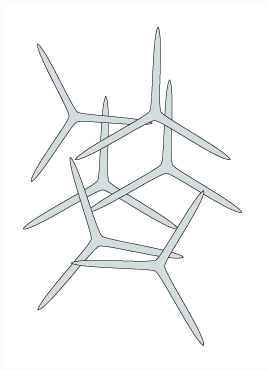 |
Spicules: Spicules are triradiates only (60-120 μm long x 6-12 μm wide) (cf. L. botryoides which usually has oxea and quadriradiates in addition), with rays which meet at equal angles.
Habitat: Found on clean rock surfaces, also under overhangs and boulders on the shore. Primarily a shallow water species. Often found associated with Dendrodoa, in surge gullies etc. but also found in sheltered situations (caves, overhangs). Further research may reveal this to be a complex of species.
Distribution: In the east Atlantic it is found from "the Arctic to S. Africa". "Littoral to 650m." A common species in the British Isles on all coasts.
Identity: Once the sponge is well known, it can usually be identified by sight, but beware L. botryoides (q.v.) which also consists of thin-walled tubes. If the specimen is intermediate between the two species, a microscopic section needs to be examined to ensure only triradiates are present. Some bryozoa have a superficially similar form but are hard. One species of colonial tunicate at a superficial glance looks a little like C. coriacea but on closer inspection can be seen not to consist of tubes.
Distribution Map from NBN: Clathrina coriacea at National Biodiversity Network mapping facility, data for UK.
iNaturalist: Clathrina coriacea at iNaturalist World Species Observations database.
WoRMS: Clathrina coriacea at World Register of Marine Species. Accepted name: Clathrina coriacea (Montagu, 1814). AphiaID: 132277.
Classification: Biota; Animalia; Porifera; Calcarea; Calcinea; Clathrinida; Clathrinidae; Clathrina
Voucher: BELUM : Mc5. Strangford Lough, Down.
Editors: J.D. Guiterman, D. Moss, B.E. Picton.
| Next species |
| Picton, B.E. & Morrow, C.C. (2023). Clathrina coriacea. (Montagu, 1818). [In] Sponges of Britain and Ireland. https://www2.habitas.org.uk/marbiop-ni/sponges.php?item=C80. Accessed on 2026-06-14 |