
| PORIFERA : Poecilosclerida : Esperiopsidae | SPONGES |
Amphilectus ovulum (Schmidt, 1870)
 |
| Amphilectus ovulum |
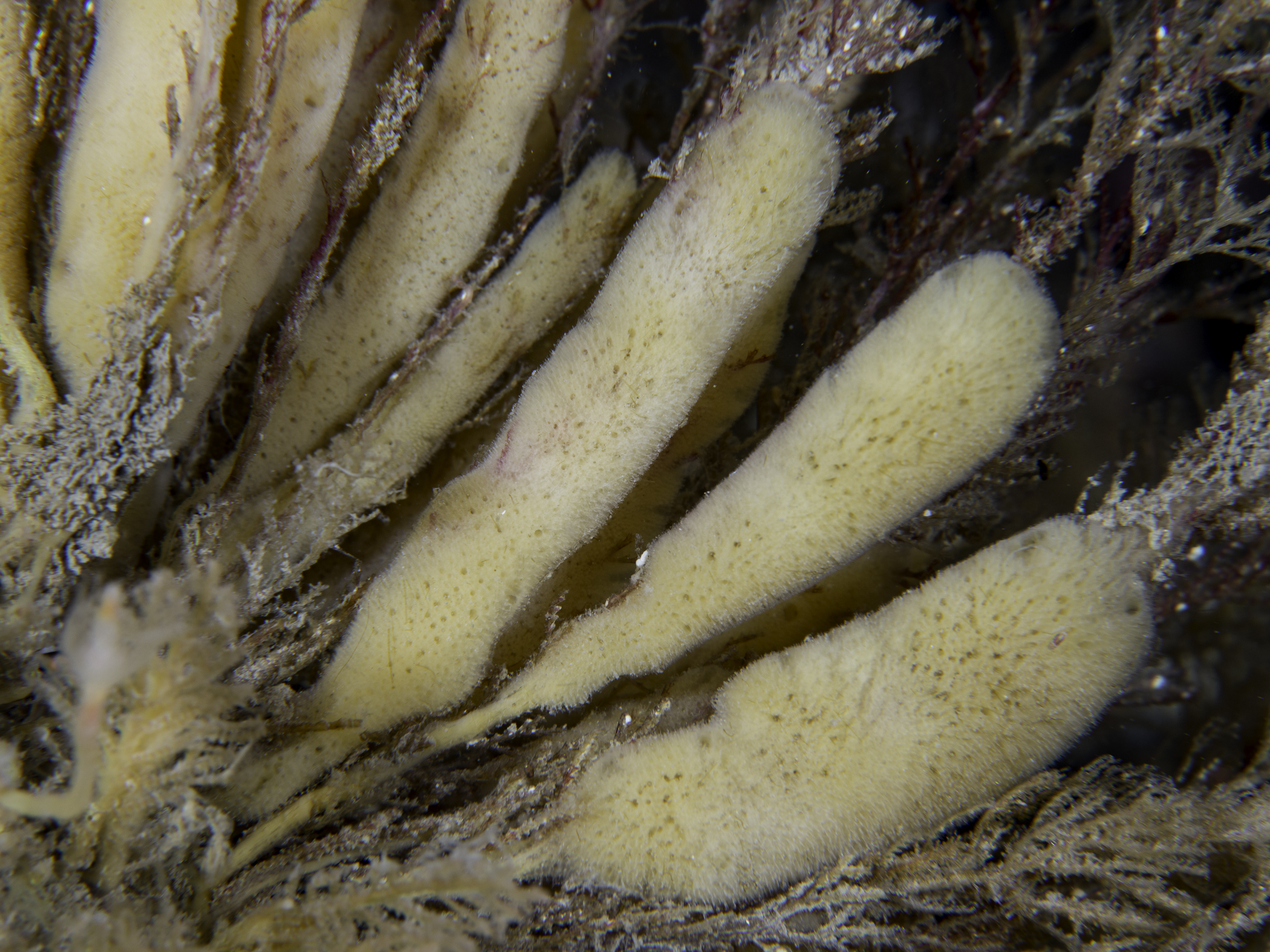
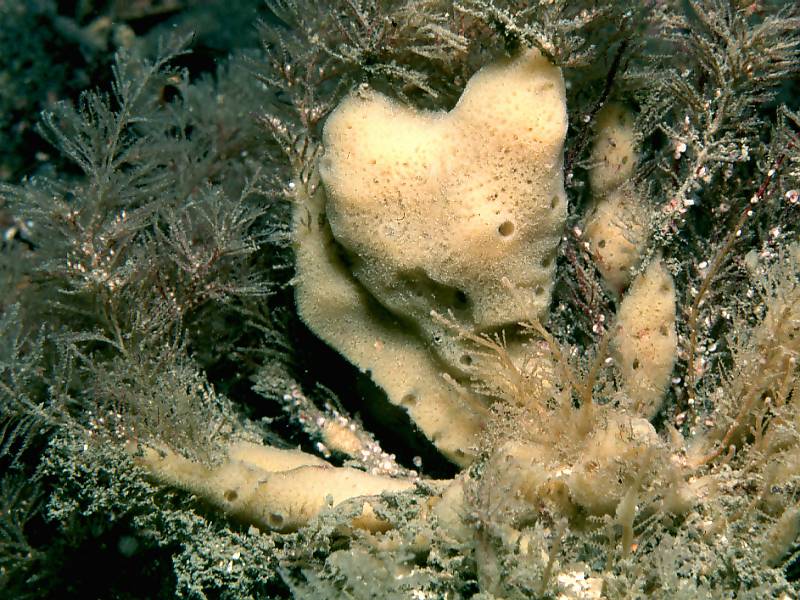
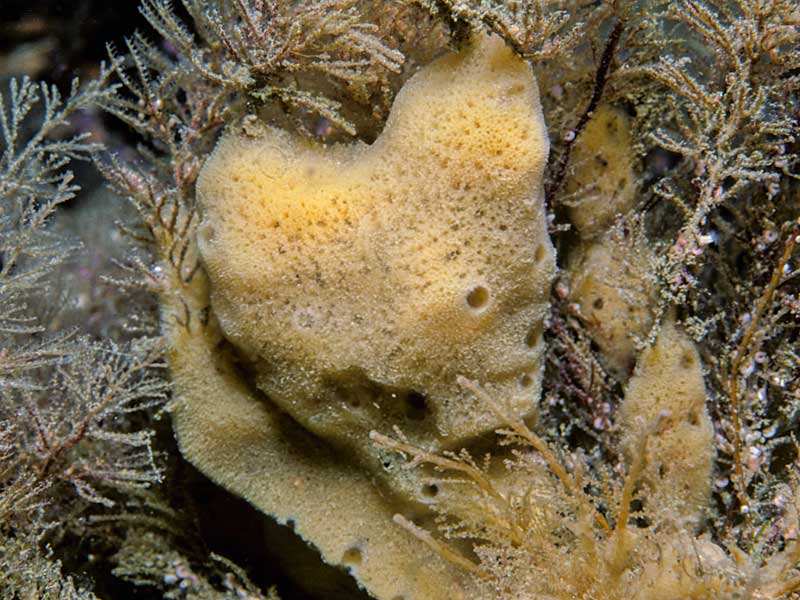
Form: 4-15mm round, egg-shaped, or flattened cushions growing on brown algae, hydroids or erect bryozoans. Larger specimens are cylindrical or rather irregular in shape as a result of growth along the branches of the substrate organism and coalescence of originally separate individuals.
Colour: Pale yellow, beige.
Smell: Strong, pungent: "Garlic", "Halichondria panicea".
Consistency: Slightly elastic, very soft.
Surface: Very finely hispid.
Apertures:
- On small cushions there is a single oscule, flush with the surface; larger specimens may have oscules in rows along a ridge, or somewhat scattered; Ostia in the dermal membrane.
Contraction:
- None noticeable.
 |
 |
[ More images ] |
Synonyms: Isodictya lobata Bowerbank, 1864: 139, Isodictya (Halichondria) clarkei Bowerbank, 1864: 330, Corybas lobata Gray, 1867: 537, Chalinula ovulum G. Schmidt, 1870: 38, Mycale ovulum Lundbeck, 1905: 34, Corybas ovulum Arndt, 1935: 50.
Internal characters
 |
Skeleton: Primary polyspicular bundles, cross-linked here and there by single spicules, run from the substratum to the surface. The arrangement may be somewhat confused basally, but becomes more uniform near the surface. In the primary bundles (in which 6-8 spicules may be closely set side by side) the spicules (curved styles) all have their pointed ends in the direction of the surface. The primary bundles may curve along their lengths. The transverse interlinking spicules are also styles. The dermal membrane is largely clear of styles, but contains scattered anisochelae. Spongin is not obviously abundant, and is colourless.
Spicules: Megascleres are more or less curved styles (a), the curvature occurring nearer to the rounded end of the spicule. They are slightly thicker in the middle region (fusiform) and slightly constricted just above the head. Lengths are 145-(190)-230 μm (up to 310 μm in some specimens), with widths of 2-4 and 7-10 μm (even 11 μm sometimes). Anisochelae (b) are variable in size, from 15-23 μm in length. They also vary greatly in the relative sizes of the chelate ends. "In some specimens the difference between the ends is so slight as to suggest isochelae", but usually the size difference is considerable. In some specimens considered to be the same species the anisochelae can be up to 45 μm in length.
 |  |  |  |
 |
Habitat: Almost always found on weed, hydroids, erect bryozoans, in low-lying littoral rock pools and in the infralittoral zone to 200m depth; usually in strong water movement. May be common coating the basal portion of the hydroids Hydrallmania falcata and Sertularia argentea in tidal streams of 3-7 knots. Often found in rias and sea loch entrances.
Distribution: North Atlantic: Devon, North Wales, Faroe Isles, Kattegat, Norway, Iceland, Greenland, Baltic Sea, White Sea. Common in the entrance to Carlingford Lough and the narrows of Strangford Lough, Co. Down, N. Ireland; and in Milford Haven and Daucleddau River, Pembrokeshire.
Identity: A spicule preparation or thin, cleared section of the sponge is required. The variable anisochelae and the smooth styles are diagnostic. There might be confusion with Amphilectus fucorum (q.v.), but in this species the microscleres are isochelae, the skeletal arrangement is more regular and usually the colour of the sponge is reddish-orange.
Distribution Map from NBN: Amphilectus ovulum at National Biodiversity Network mapping facility, data for UK.
iNaturalist: Amphilectus ovulum at iNaturalist World Species Observations database.
WoRMS: Amphilectus ovulum at World Register of Marine Species. Accepted name: Amphilectus ovulum (Schmidt, 1870). AphiaID: 1424119.
Classification: Biota; Animalia; Porifera; Demospongiae; Heteroscleromorpha; Poecilosclerida; Esperiopsidae; Amphilectus
Voucher: BELUM : Mc1838. Milford Haven, Pembroke, Wales.
Editors: D. Moss, B.E. Picton.
| Previous species | Next species |
| Picton, B.E. & Morrow, C.C. (2023). Amphilectus ovulum. (Schmidt, 1870). [In] Sponges of Britain and Ireland. https://www2.habitas.org.uk/marbiop-ni/sponges.php?item=C5450. Accessed on 2026-10-15 |