
| PORIFERA : Poecilosclerida : Mycalidae | SPONGES |
Mycale lingua (Bowerbank, 1866)
 |
| Mycale lingua |
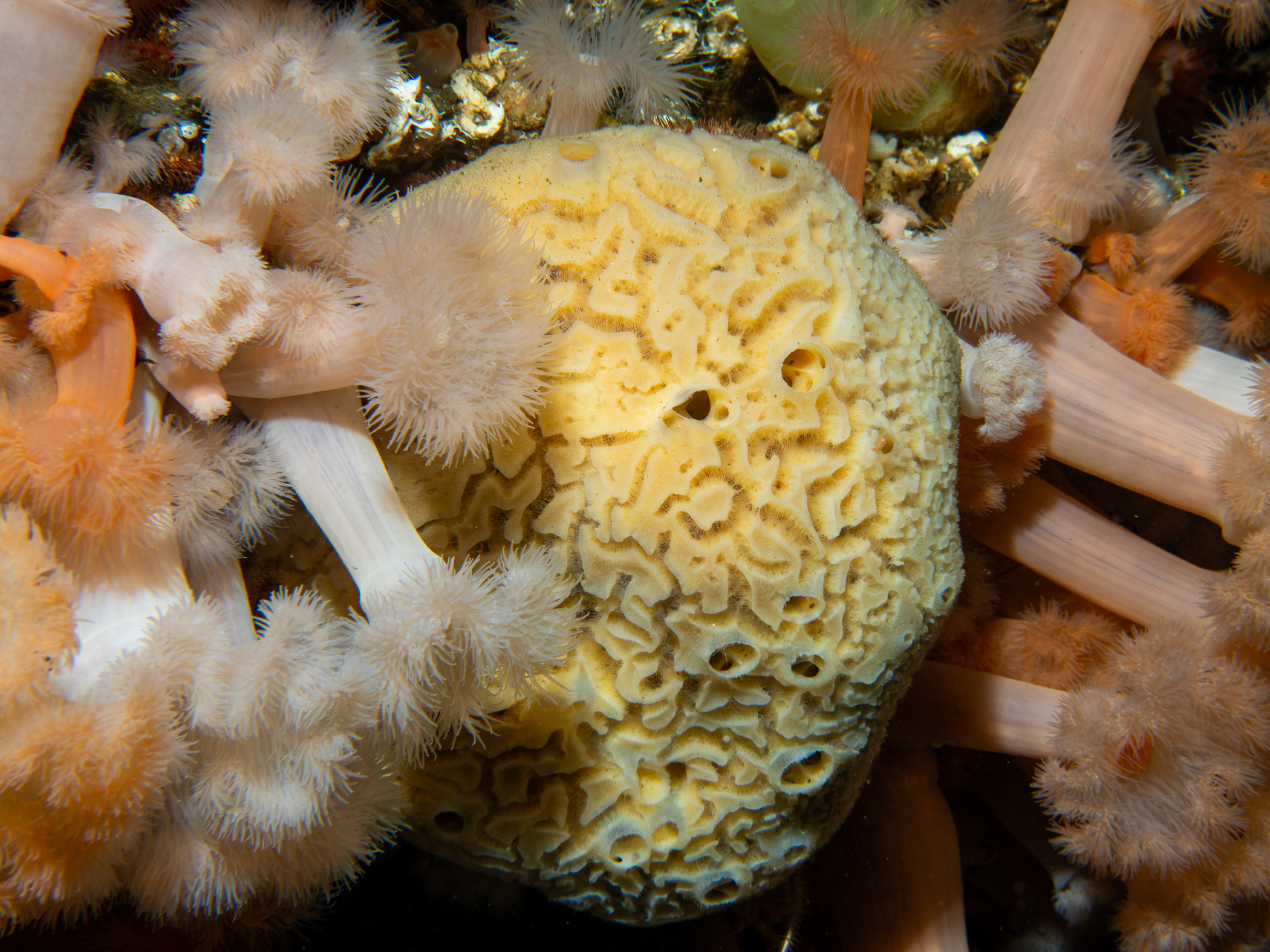
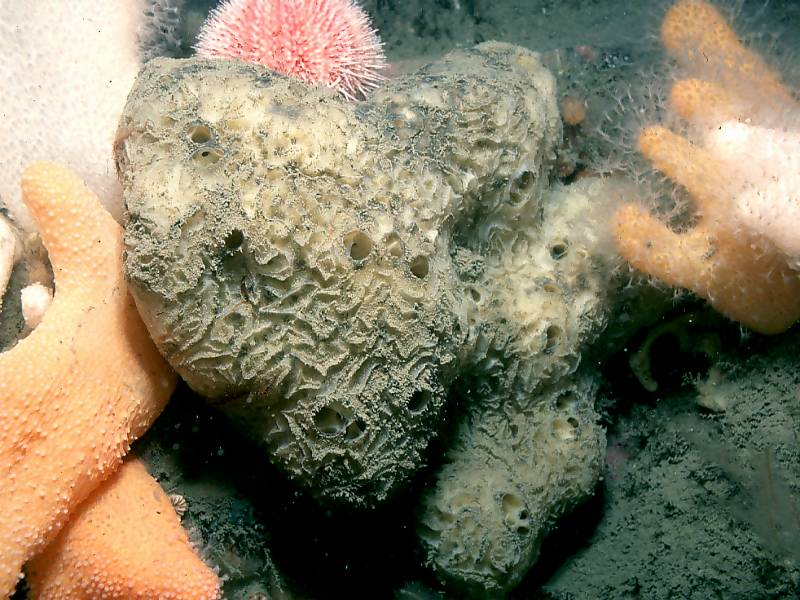
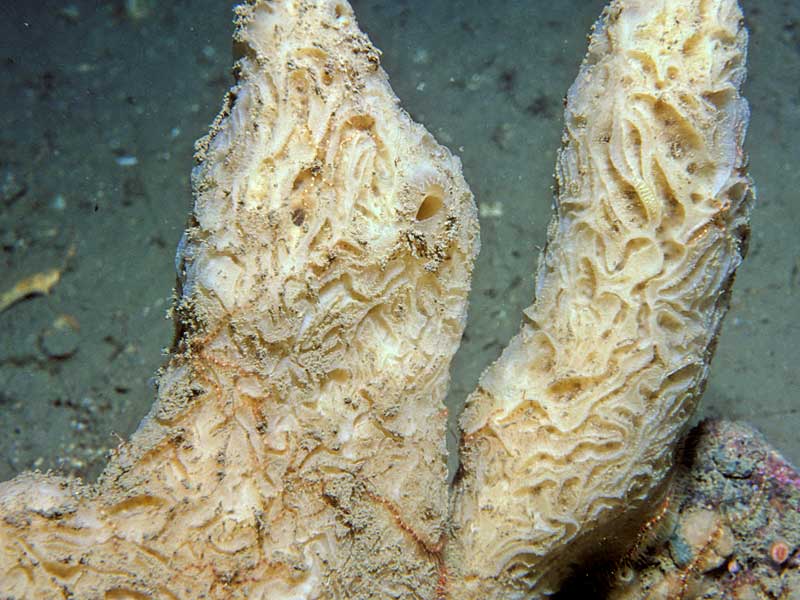
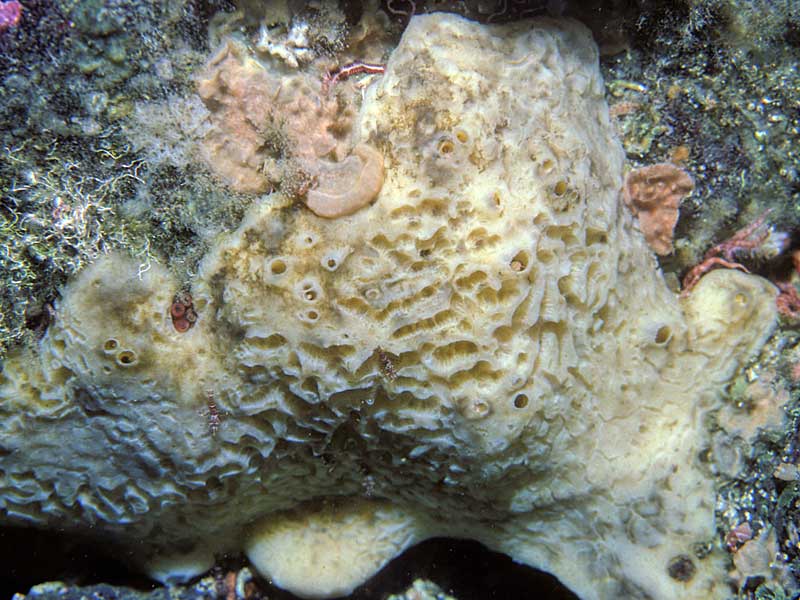
Form: Encrusting to massive-lobose to massive-fig. Variously described as being "roundish", "resembling the tongue of a sheep", or "an inverted triangular pyramid". It is apparent that some specimens tend to grow in an erect, flattened form, with the attached base narrower than the apex. Grows up to 30 cms in height, with variable width and depth.
Colour: Grey, pale buff. (In spirit, "pale yellow", "whitish yellow or gray". The specimen in GA's collection is dull greenish yellow in spirit).
Smell: None observed.
Consistency: Rather tough, very fibrous, but easily compressed.
Surface: Sulcate, the furrows forming an irregular reticulation over the surface. Within the furrows, the dermal membrane is smooth, elsewhere it is rather shaggy in appearance (like "sun-cracks upon a cake of mud").
Apertures:
- Oscules are borne on shallow, transparent cones of height 2-3mm, and have a diameter of 4-10mm. The inhalent pores lie along the surface of the furrows, and can only be seen with the aid of a microscope in preserved material but are obvious in living specimens.
Contraction:
- The sulcate cracks close on collection.
 |
 |
 |
| [ More images ] |
Synonyms: Esperia placoides Carter, 1876: 316, Esperella murrayi Ridley & Dendy, 1886: 338.
Internal characters
 |
Skeleton: Plumoreticulate, of ascending multispicular fibres of styles, with small amounts of spongin binding the fibres. Towards the surface, some fibres run parallel to the surface, and some become splayed like a brush and penetrate the surface.
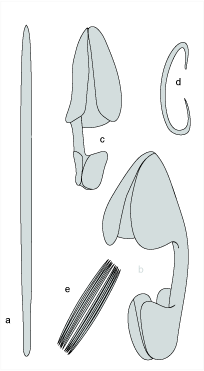
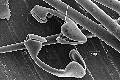
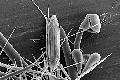
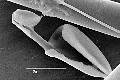
Spicules: Megascleres are styles (a), usually straight, occasionally slightly curved, 460-(510)-560 [530-1150] x 13-20 μm. Their ends are variable in shape. The head may be that of a typical style, or may tend to that of a subtylostyle, or may be constricted like a handle. The points may be abrupt or long. Microscleres are palmate anisochelae (b,c), sigmata (d) and trichodragmata, (e). The anisochelae fall into two distinct size classes, ca. 35 μm and 70 μm, the larger ones (b) being found in rosettes, mainly near the dermal membrane. Sigmata are ca. 16-32 μm in length. Trichodragmata are ca. 42-78 μm long and 11-14 μm thick.
 |  |  |
Habitat: Found at depths between 30m and 2460m.
Distribution: Widely distributed over the north Atlantic, from the Azores to Spitzbergen. Also known from the Mediterranean, north west coast of America and Australia. At depths accessible by SCUBA, the distribution of this essentially deep water species is probably localised into discrete areas. Known recently from Ushant, Brittany; Rathlin Is; Loch Sunart, Insh Is. and Bach Is, Firth of Lorne; Faeroes.
Identity: The furrowed grooves on the surface of the sponge are highly characteristic.
Distribution Map from NBN: Mycale lingua at National Biodiversity Network mapping facility, data for UK.
iNaturalist: Mycale lingua at iNaturalist World Species Observations database.
WoRMS: Mycale lingua at World Register of Marine Species. Accepted name: Mycale (Mycale) lingua (Bowerbank, 1866). AphiaID: 168640.
Classification: Biota; Animalia; Porifera; Demospongiae; Heteroscleromorpha; Poecilosclerida; Mycalidae; Mycale
Voucher: BELUM : Mc1345. Brittany, France.
Editors: D. Moss, B.E. Picton.
| Previous species | Next species |
| Picton, B.E. & Morrow, C.C. (2023). Mycale lingua. (Bowerbank, 1866). [In] Sponges of Britain and Ireland. https://www2.habitas.org.uk/marbiop-ni/sponges.php?item=C5440. Accessed on 2026-10-16 |