
| PORIFERA : Bubarida : Dictyonellidae | SPONGES |
Tethyspira spinosa (Bowerbank, 1874)
 |
| Tethyspira spinosa |
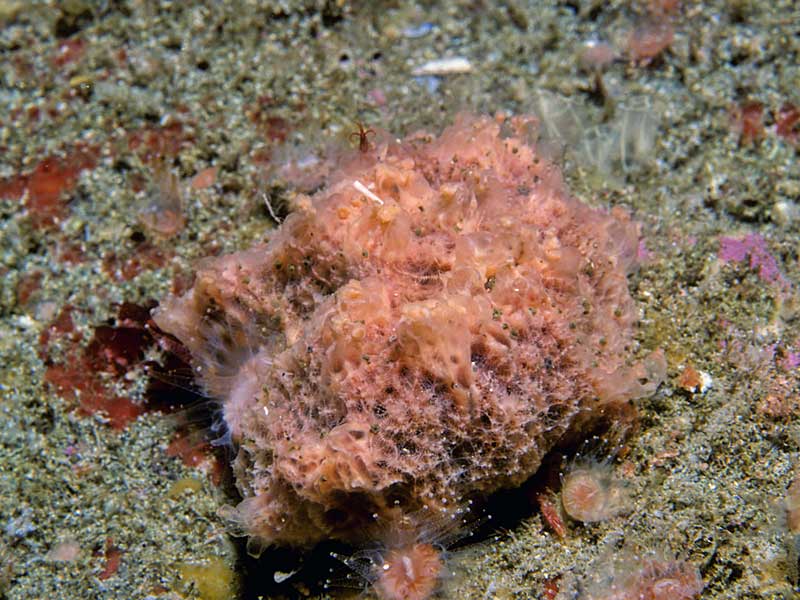
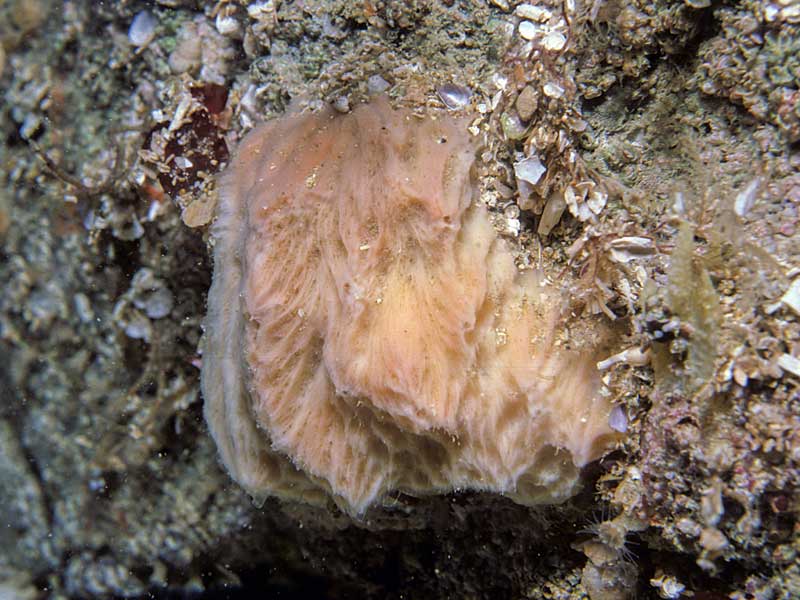
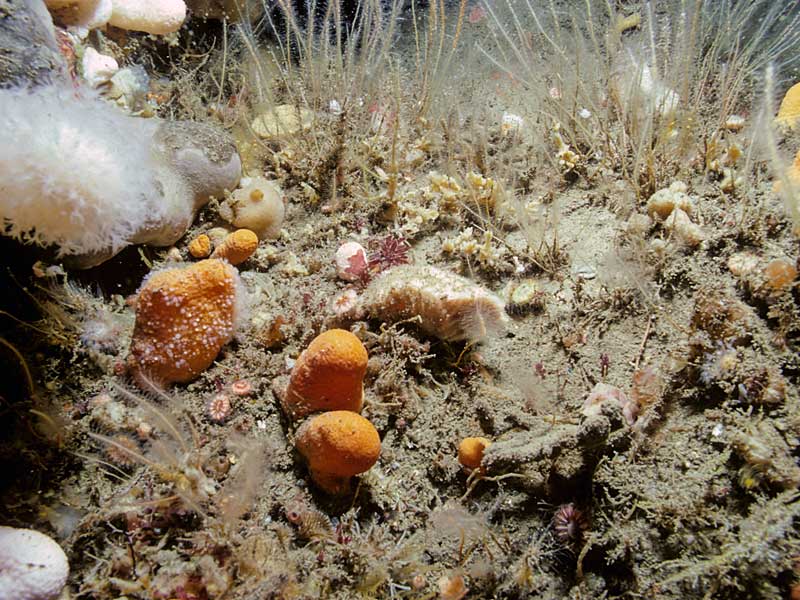
Form: Low cushion with tall sides and rugose upper surface. Larger specimens may become massive-globose, to ca. 15cm across, and are often angular with ridges and crests. (Cushion forms are also described in the literature, and Arndt (1933) refers to a crust-like form).
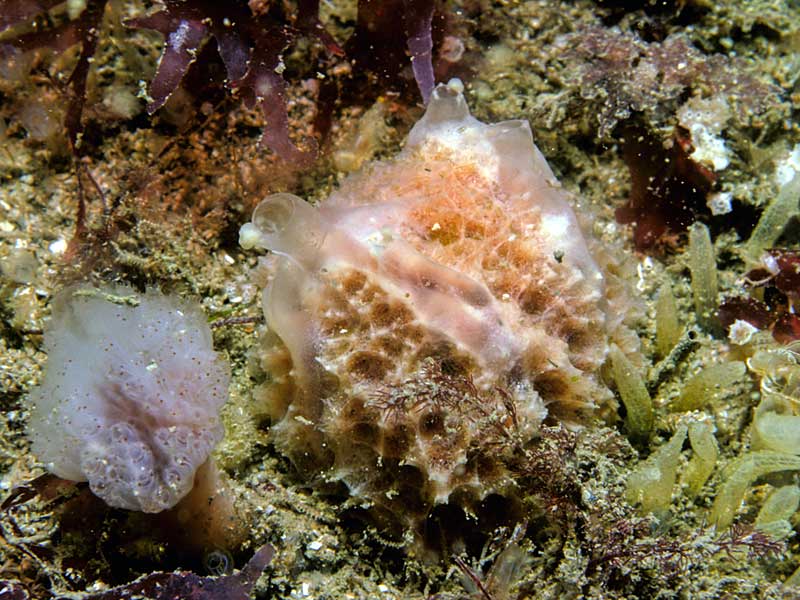
Colour: Greyish-white, through orangeish, to almost rose-red. The colour can vary within a single specimen, because of the variable combination of a translucent whitish ectosome and light brown choanosome.
Smell: None reported. Slime : None, although surface is somewhat slippery.
Consistency: Firm; slightly compressible, elastic.
Surface: Slippery. Conulate, rather 'spiky' in appearance, due to ends of spicule bundles raising and sometimes penetrating the surface. "Sticky" appearance: subsurface channels sometimes visible in photographs.
Apertures:
- In situ, oscules are usually borne on long, white, translucent, almost vermiform chimneys. These are not always present, but there may be two or three per sponge. They are fragile and collapse on collection, leaving whitish patches.
Contraction:
- Noticeable but slight, with contraction of the ectosomal layer being more marked than that of the choanosome.
 |
 |
 |
 |
[ More images ] |
Synonyms: Tethea spinosa (Bowerbank, 1874: 279).
Internal characters
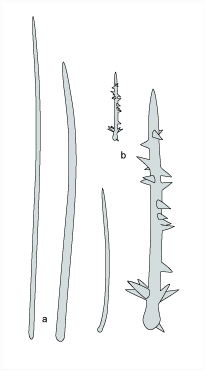 |
Skeleton: Parallel fibres of long styles (sometimes subtylostyles) are present; these are less closely distributed near the surface, where they become separated by spongin. Some spicules penetrate the surface. There is a scattered basal layer of small acanthostyles of characteristic shape, with long spines. These are easily missed as the basal layer of massive sponges is not always collected or sectioned.
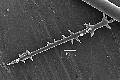
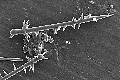
Spicules: The main structural megascleres are straight or somewhat curved styles or subtylostyles (a), up to 1-2mm long x 3-12 μm thick. Long-spined microtylostyles (b), ca. 70-120 x 4-6 μm, are also present in a basal layer, but may be scarce and hard to find.
 |  |
Habitat: On wave exposed circalittoral rock (often where horizontal when in the "open"), to at least ca. 60m.
Distribution: A south-western species in the British Isles. Known recently from Salcombe (Prawle Point), Lundy, Skomer, Sherkin Is., Calf of Man, Rathlin Is. (The record of Rhaphidostyla incisa reported by R.W.B. van Soest from Sherkin Is. (Irish Nat. J. 20, (1), p. 1-15), was found on re-examination to be Tethyspira spinosa (R.W.B van Soest, pers. comm.)). Reported from Fowey Harbour by Bowerbank. "Continental Channel coast", ?Brittany. Records from other sites in the British Isles would be of very great interest. Do not over collect.
Identity: At a casual glance the surface is rather reminiscent of Dysidea fragilis (q.v., the skeleton is, of course, completely different). The translucent, waxy appearance is somewhat like that of Haliclona fistulosa (q.v.), but the latter has a brittle ectosome, produces fistules and has a quite dissimilar spiculation. With experience, this is an easily recognisable species. The identity may be confirmed by the skeleton and especially by the shape of the basal acanthostyles.
Distribution Map from NBN: Tethyspira spinosa at National Biodiversity Network mapping facility, data for UK.
iNaturalist: Tethyspira spinosa at iNaturalist World Species Observations database.
WoRMS: Tethyspira spinosa at World Register of Marine Species. Accepted name: Tethyspira spinosa (Bowerbank, 1874). AphiaID: 132558.
Classification: Biota; Animalia; Porifera; Demospongiae; Heteroscleromorpha; Bubarida; Dictyonellidae; Tethyspira
Voucher: BELUM : Mc1581. Rathlin Is. Antrim.
Editors: D. Moss,B.E. Picton.
| Previous species | Next species |
| Picton, B.E. & Morrow, C.C. (2023). Tethyspira spinosa. (Bowerbank, 1874). [In] Sponges of Britain and Ireland. https://www2.habitas.org.uk/marbiop-ni/sponges.php?item=C4450. Accessed on 2026-10-15 |