
| PORIFERA : Polymastiida : Polymastiidae | SPONGES |
Polymastia boletiformis (Lamarck, 1815)
 |
| Polymastia boletiformis |
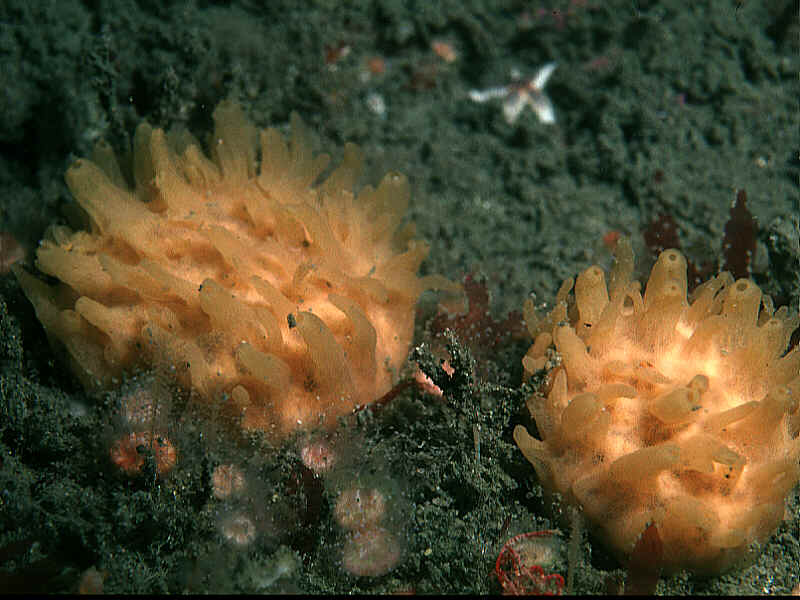
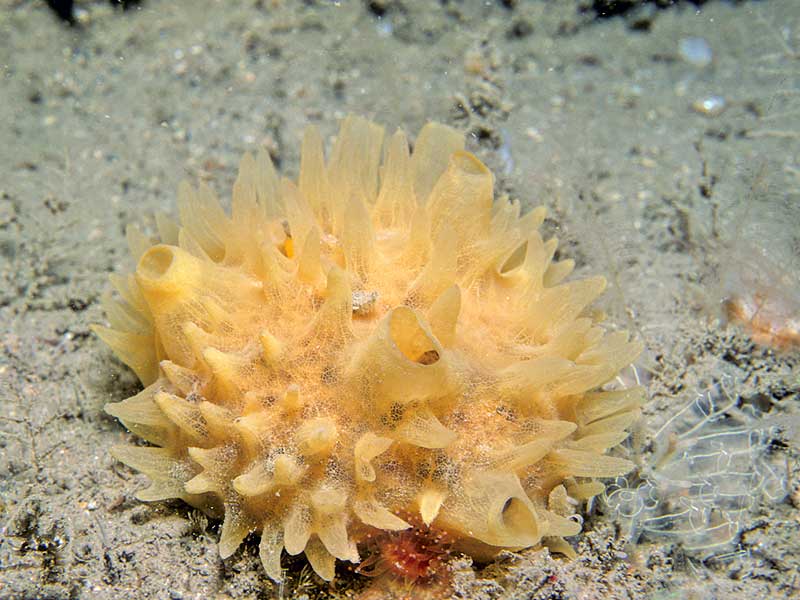
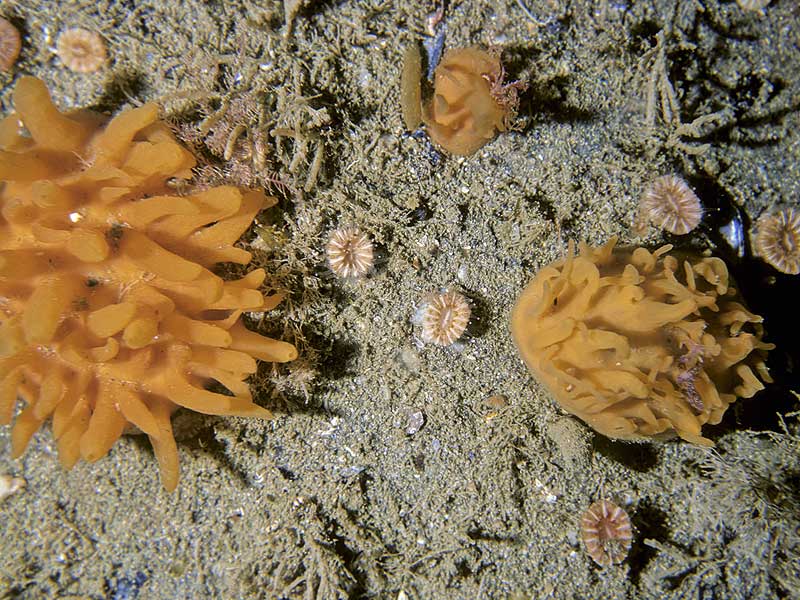
Form: Massive - globose. A thick, bulbous sponge, with the upper surface covered by vertical, tapering, contractile papillae. The hollow papillae are approximately the same length, but vary in number from individual to individual. Typically the papillae are simple, but occasionally two adjacent papillae fuse along their length, resulting in figure '8'-like oscular openings (more rarely, three papillae may fuse). The sponge is firmly attached by a broad base.
Colour: Varying shades of orange or yellow, depending on density. The body and papillae are similar.
Smell: None.
Consistency: The body is soft; the papillae are firm but flexible.
Surface: Clean, smooth and slightly velvety. The surfaces of the body and the papillae are similar.
Apertures:
- The oscules and pores are carried on conical papillae. There are usually a few papillae with terminal oscules gaping wide open. Pores cover the surface of the papillae and are visible in situ, but become invisible on collection.
Contraction:
- The body contracts slightly when collected and preserved. The papillae are contractile, and may reduce to small button-like bumps over the surface of the body. Rarely, papillae may collapse to lie fully extended over the surface, resembling floppy straps. This is a condition typical of preserved specimens, but can occur when an individual is stressed. Confirmation is needed. The oscules can be induced to close slowly when touched.
 |
 |
 |
| [ More images ] |
Synonyms: Polymastia robusta Bowerbank, 1862:751; Bowerbank, 1866:62.
Internal characters
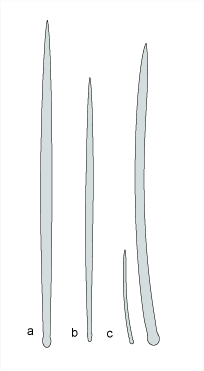 |
Skeleton: Radiate to sub-radiate, with the radial arrangement being most apparent near to the surface, where there is a well organised ectosome. The skeleton of the papillae is a continuation of the main body skeleton. There is a single category of spicule (tylostyle), divided into two size groups. The larger are the main structural megascleres, forming loose, multispicular tracts (10-12 spicules thick), which wander up through the body and on into the papillae, but do not pierce the surface. Loose spicules lie scattered between the tracts. Megascleres of the same size form a tangential layer of inter-crossing spicules, just below the surface (2 - 4 spicules thick), which supports a single layer of smaller tylostyles. These are arranged perpendicular to the surface, grouped into plumose brushes, but becoming more tightly packed in mature sponges to form a palisade. The inhalent and exhalent canal systems fill the centres of the papillae, supported by the multispicular tracts. At the surface of the papillae, the ectosomal skeleton is exactly as that of the body.
Spicules: The megascleres are tylostyles of two size groups: the spicules of the tracts (a,b) and tangential layer are 500-(590)-700 μm, stout, fusiform, with swellings at or just above the head; the spicules of the surface brushes (c) are 125-(166)-190 μm in length, curved, parallel-sided, with virtually no swelling at the head. There are no microscleres.
Habitat: Most commonly found on sediment covered, upward facing, rock or boulder tops in the lower infralittoral and circalittoral zones, associated with a bryozoan/hydroid 'turf'. Found in conditions varying from quite rapidly flowing water to those in which silt falls out of suspension. "From tidal pools to 2300m" .
Distribution: "Arctic; Atlantic coasts of Europe and N. America; never found in the Mediterranean."(?) Recently known from St. Abbs; many sites on the western and southern coasts of the British Isles.
Identity: The other common, papillate sponges in British waters which might be confused with Polymastia boletiformis by appearance are Ciocalypta penicillus(q.v.) and Polymastia mamillaris (q.v.). Apart from other differences, Polymastia boletiformis sits proud on the rock surface, whereas Polymastia mamillaris often occupies small, shallow hollows. Polymastia boletiformis is one of the most commonly seen sponges on rock below the kelp in the west and south west of the British Isles. Several other, less conspicuous, Polymastia species are known to occur around the British Isles, but are more likely to be confused with Polymastia mamillaris.
Distribution Map from NBN: Polymastia boletiformis at National Biodiversity Network mapping facility, data for UK.
iNaturalist: Polymastia boletiformis at iNaturalist World Species Observations database.
WoRMS: Polymastia boletiformis at World Register of Marine Species. Accepted name: Polymastia boletiformis (Lamarck, 1815). AphiaID: 134194.
Classification: Biota; Animalia; Porifera; Demospongiae; Heteroscleromorpha; Polymastiida; Polymastiidae; Polymastia
Voucher: BELUM : Mc214. Strangford Lough, Down.
Editors: J.D. Guiterman, D.Moss, B.E. Picton.
| Previous species | Next species |
| Picton, B.E. & Morrow, C.C. (2023). Polymastia boletiformis. (Lamarck, 1815). [In] Sponges of Britain and Ireland. https://www2.habitas.org.uk/marbiop-ni/sponges.php?item=C2580. Accessed on 2026-10-15 |