
| PORIFERA : Tetractinellida : Tetillidae | SPONGES |
Craniella zetlandica (Carter, 1872)
 |
| Craniella zetlandica |
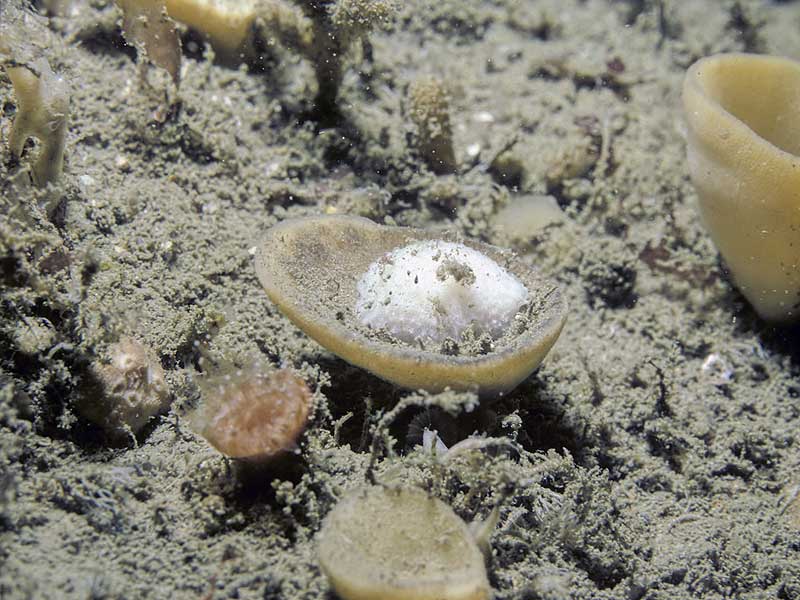
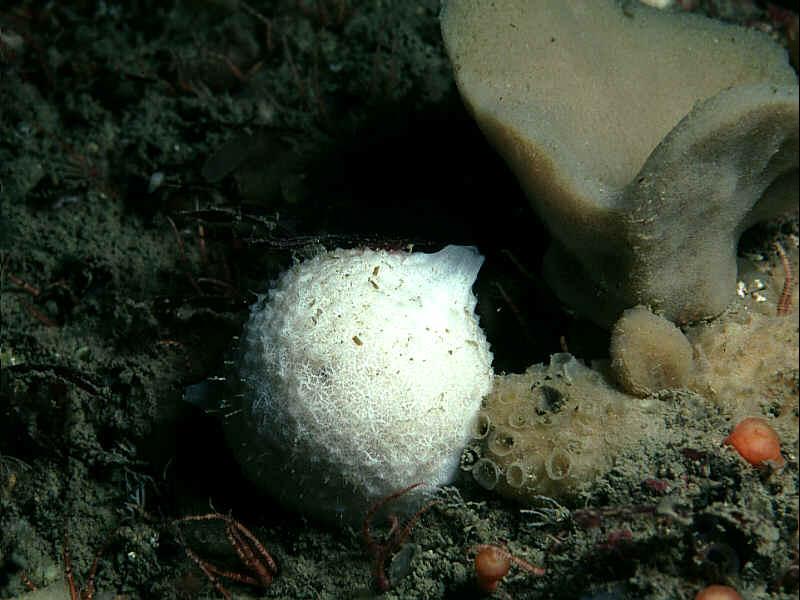
Form: Massive-globose, being spherical to hemispherical, slightly flattened at the base. Up to 6cms in diameter.
Colour: White, "brown, yellow". Recent observations of living specimens indicate that they are white when alive, but Tetilla cranium is brown or yellow. (Tetilla cranium is described as "yellowish white in spirit").
Smell: ? (T. cranium is described as having an "offensive, ammoniacal odour" when fresh). Slime : None
Consistency: Firm, incompressible.
Surface: Even, conulate, spinose (the hairs projecting through the conules), with a rough texture exhibiting high friction.
Apertures:
- Typically, a single oscule at the apex (??).
Contraction:
- None.
 |
[ More images ] |
Synonyms: Tethya zetlandica (Carter, 1872: 417), Craniella zetlandica (Carter, 1872: 417), Tethyopsilla zetlandica (Carter, 1872: 417).
Internal characters
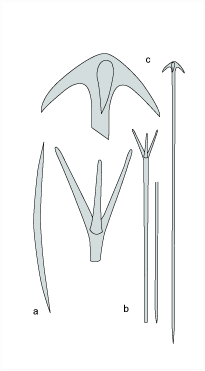 |
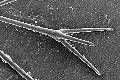
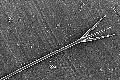
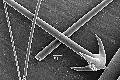
Skeleton: Choristid, with a well developed cortex. The thick radially arranged tracts of megascleres, which can be seen with the unaided eye in torn specimens, run perpendicular to the surface. The cortical skeleton is a dense palisade of the smaller oxea (see below) supporting bundles of protriaenes, which project from the surface at their clad (i.e. rayed) ends.
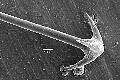
Spicules: There are four types of megascleres. Cortical oxea are 800-1400 μm long, by 50 μm wide. Choanosomal oxea are ca. 2560-4600 μm long, by 60 μm wide, and are longitudinally asymmetrical. The trianes are long shafted, with relatively small rayed ends. The protriaenes are 3490-7100 μm long, by 18 μm wide. The anatriaenes are ca. 5300-8570 μm long, by 25 μm, diminishing to 13 μm wide. There are no microscleres.
 |  |  |  |
Habitat: Seated in cup shaped sponges (Axinella infundibuliformis/Phakellia ventilabrum), or attached to stones at depths of 15-680metres (recent observations by divers are from ca. 40m).
Distribution: Shetland. Also generally reported from the Arctic, Atlantic, Indian and Pacific Oceans. Known recently from the Aran Islands, Galway Bay and Western Scotland.
Identity: Tethya citrina (q.v.) is similar in shape and size, but is usually orange, not as firm and "coarse" as T. zetlandica, and typically found in shallower water. The spiculation of these two sponges is quite different. T. zetlandica is a northern, deeper water sponge, only likely to be encountered occasionally by scuba divers. T. cranium (Muller, 1776: 255) is reported to be identical to T. zetlandica in external appearance, but possesses distorted 'S' shaped microscleres called sigmaspires. The similarity between these two sponges has resulted in some authors synonymising T. zetlandica under T. cranium, or making it a variety thereof.
iNaturalist: Craniella zetlandica at iNaturalist World Species Observations database.
WoRMS: Craniella zetlandica at World Register of Marine Species. Accepted name: Craniella zetlandica (Carter, 1872). AphiaID: 171358.
Classification: Biota; Animalia; Porifera; Demospongiae; Heteroscleromorpha; Tetractinellida; Spirophorina; Tetillidae; Craniella
Voucher: BELUM : Mc695. Aran Islands, Galway.
Editors: D. Moss.
| Previous species | Next species |
| Picton, B.E. & Morrow, C.C. (2023). Craniella zetlandica. (Carter, 1872). [In] Sponges of Britain and Ireland. https://www2.habitas.org.uk/marbiop-ni/sponges.php?item=C1930. Accessed on 2026-06-11 |