
| MOLLUSCA : Venerida : Veneridae | SNAILS, SLUGS, ETC. |
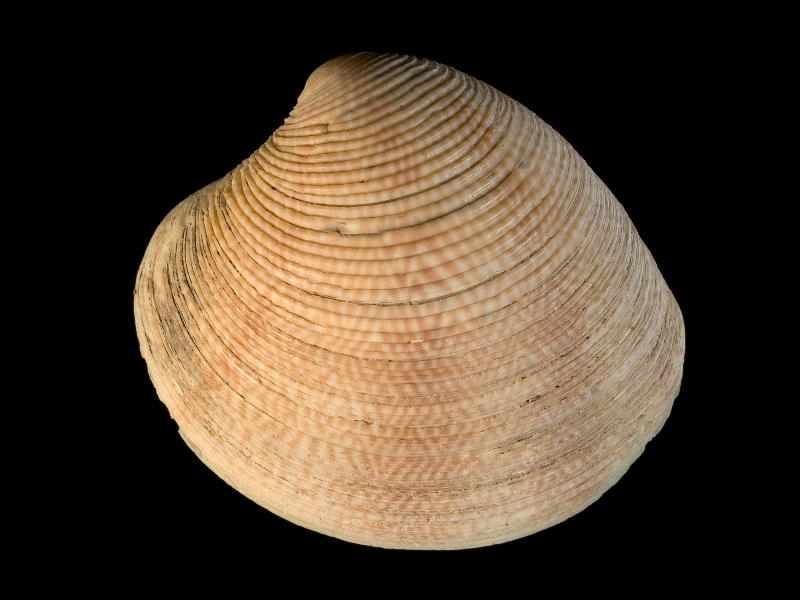
Chamelea striatula (da Costa, 1778)
Striped venus
 |
| Chamelea striatula |
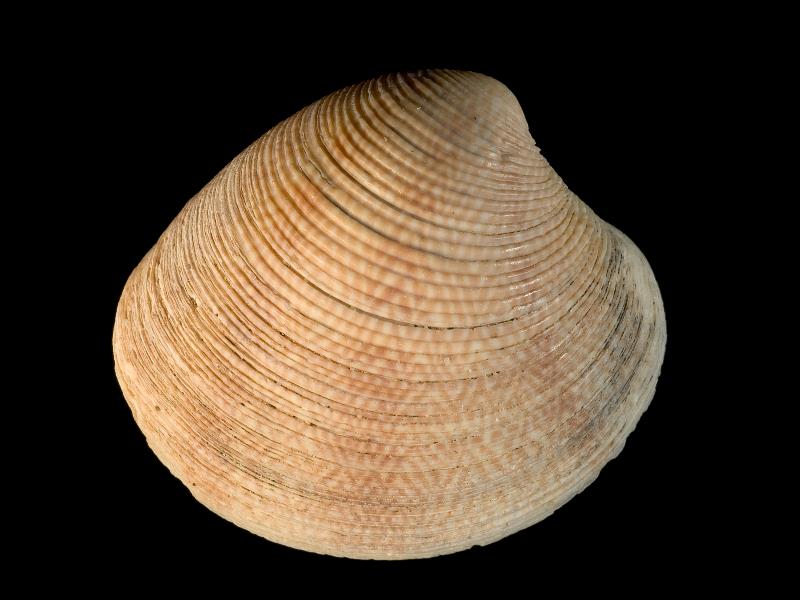
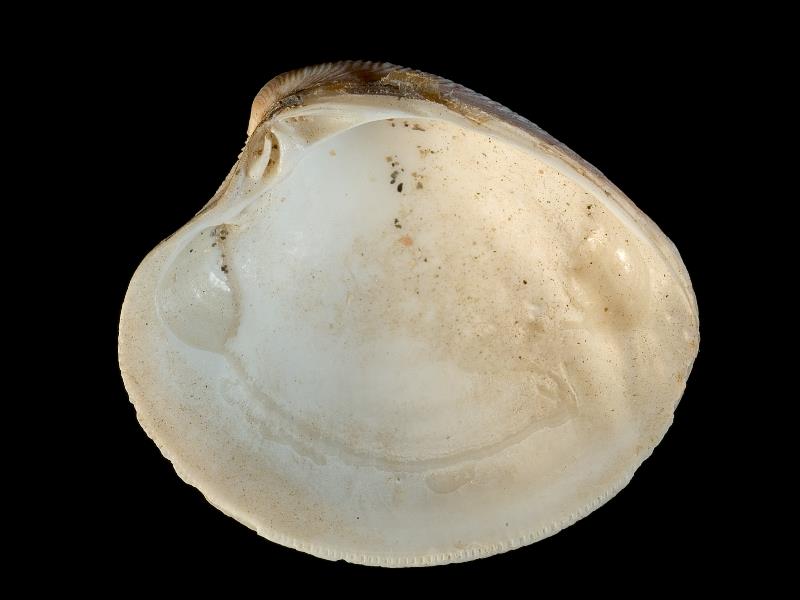
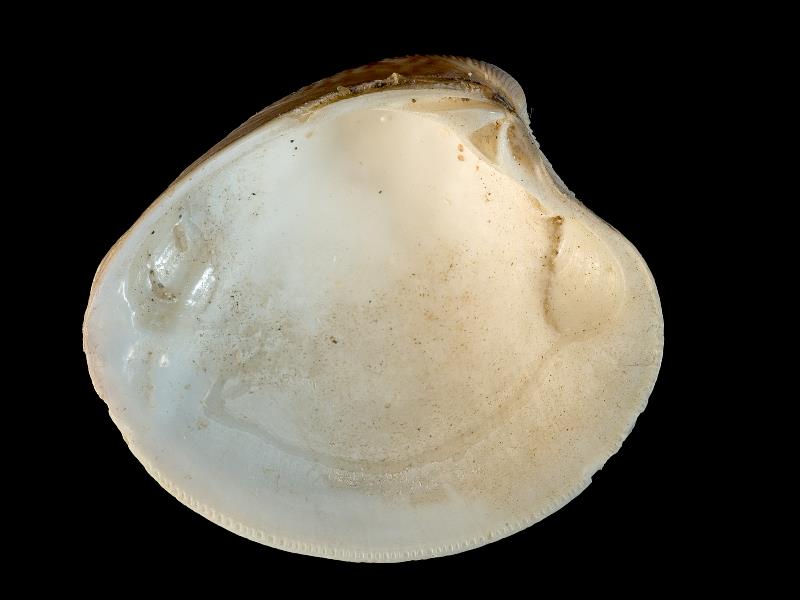
Description: A thick set bivalve with strong concentric ridges, that can reach up to 4.5 cm. It has an broadly triangular outline, with a rounded lower edge. It is a dirty white to pale yellow in colour, usually with 3 red-brown rays radiating from the top of the valve which may merge to form linear patterning. It can sometimes be polished, but often has some of the thin periostracum on the outside of the valves. In each valve there are 3 cardinal teeth and no lateral teeth.
Habitat: Clean sand or muddy sand from low water mark to around 60 m.
Distribution: Found on all coasts around Britain and Ireland.
Similar Species: Could be confused with some other superficially similar bivalves, especially some of the Venus species.
Key Identification Features:
- Thick set bivalve with strong ridges.
- Usually has 3 red-brown rays.
Distribution Map from NBN: Chamelea striatula at National Biodiversity Network mapping facility, data for UK.
iNaturalist: Chamelea striatula at iNaturalist World Species Observations database.
GBIF data for Chamelea striatula
WoRMS: Chamelea striatula at World Register of Marine Species. Accepted name: Chamelea striatula (da Costa, 1778). AphiaID: 141908.
Classification: Biota; Animalia; Mollusca; Bivalvia; Autobranchia; Heteroconchia; Euheterodonta; Imparidentia; Venerida; Veneroidea; Veneridae; Venerinae; Chamelea
| Previous species | Next species |
| Picton, B.E., Keatley, L. & Morrow, C.C. (2025). Chamelea striatula. (da Costa, 1778). [In] Encyclopedia of Marine Life of Britain and Ireland. https://www2.habitas.org.uk/marbiop-ni/speciesaccounts.php?item=W21890. Accessed on 2026-07-16 |