
| MOLLUSCA : Carditida : Astartidae | SNAILS, SLUGS, ETC. |
Tridonta borealis Schumacher, 1817
 |
| Tridonta borealis |
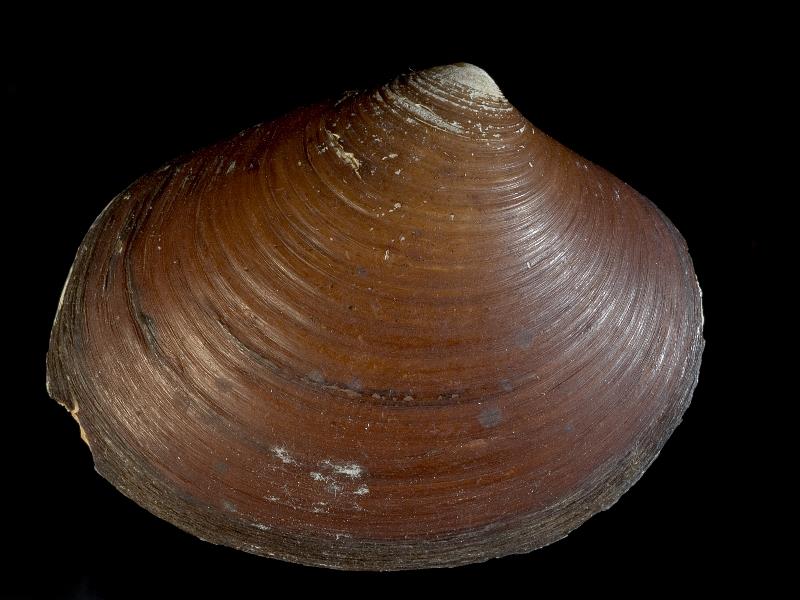
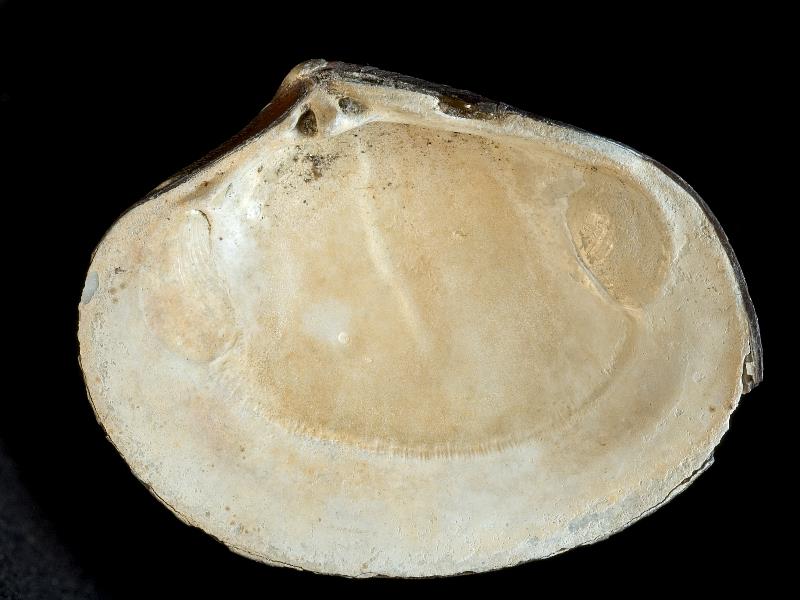
Description: A solid bivalve with 2 equal valves and a circular to oval outline. It reaches around 4.5 cm in length and is white with a very thick dark brown to black periostracum, which has ridges at the margin. Periostracum may be a light brown in juvenile animals. The outer surface of the shell is covered in fine concentric lines and these may form ridges near the umbones. 2 cardinal teeth in right valve, anterior one is broad while posterior is thin; 3 cardinal teeth in left valve, posterior of which is very small.
Habitat: Muddy sand or gravel.
Distribution: Seems to be a northern species with some scattered records from north and NE Britain and Ireland. Recorded from just outside Belfast Lough.
Similar Species: Could be confused with Tridonta elliptica.
Key Identification Features:
- 2 equal valves and circular to oval in shape.
- Very thick dark brown to black persiostracum.
- 2 cardinal teeth in right valve (anterior broad, posterior thin).
- 3 cardinal teeth in left valve (posterior very small).
Distribution Map from NBN: Tridonta borealis at National Biodiversity Network mapping facility, data for UK.
iNaturalist: Tridonta borealis at iNaturalist World Species Observations database.
GBIF data for Tridonta borealis
WoRMS: Tridonta borealis at World Register of Marine Species. Accepted name: Tridonta borealis Schumacher, 1817. AphiaID: 152398.
Classification: Biota; Animalia; Mollusca; Bivalvia; Autobranchia; Heteroconchia; Archiheterodonta; Carditida; Crassatelloidea; Astartidae; Tridonta
| Previous species | Next species |
| Picton, B.E., Keatley, L. & Morrow, C.C. (2025). Tridonta borealis. Schumacher, 1817. [In] Encyclopedia of Marine Life of Britain and Ireland. https://www2.habitas.org.uk/marbiop-ni/speciesaccounts.php?item=W19580. Accessed on 2026-09-28 |