
| MOLLUSCA : Mytilida : Modiolidae | SNAILS, SLUGS, ETC. |
Modiolus modiolus (Linnaeus, 1758)
Horse mussel
 |
| Modiolus modiolus |
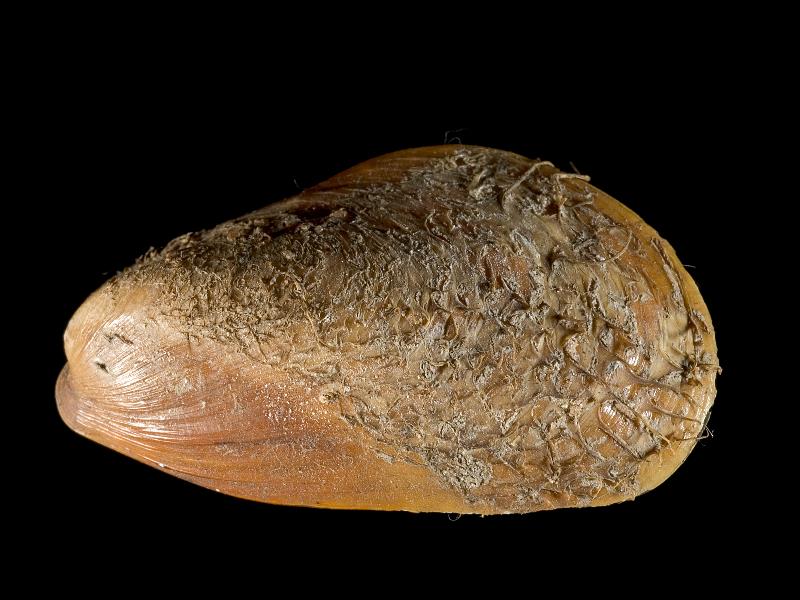
Description: Large mussel with a solid, swollen oblong shell reaching up to 22 cm, although more typically around 12 cm. Main shell colouration is dark blue to purple, however the periostracum (thin outermost layer) can give a glossy yellow or chestnut to dark brown appearance, usually with a lighter strip along umbonal ridges. Juveniles may be more blue in colour, and their periostracum is in thin lines rather than covering a lot of the shell. Young shells have multiple long and smooth periostracal spines, which can wear away as the animal ages, smaller individuals confined to rockpools and lower shore may keep these spines. Fine, concentric growth rings are visible on the shell. The interior of the shell is white.
Considered a northern species, they may be retreating from southern part of its range due to climate change, and may no longer occur in more southern locations where they were once present.
Habitat: Lower shore on exposed coasts, and in algal holdfasts, down to depths of 150 m. Smaller individuals may be found in rockpools and the lower shore, larger individuals can be found in the subtidal and can form dense beds or reefs in the right conditions.
Distribution: Widely distributed around Britain and Ireland as the smaller individuals, but dense sublittoral reefs made up of larger individuals are much more rare, and are only known from relatively few locations. In Northern Ireland, Strangford Lough was once a stronghold for Modiolus modiolus reef, but after extensive bottom fishing and unfavourable conditions the populations crashed. Bottom fishing was banned in 2003 and some efforts have been made with restoration of the Modiolus reefs, but their current status in the lough is uncertain.
Similar Species: Could be confused with Mytilus edulis when juvenile. Could also be confused with Modiolus barbatus but M. barbatus has well-defined serrated spines on the periostracum whereas in M. modiolus any spines present are smooth. There are no confirmed records of M. barbatus from Northern Ireland and comparatively few from around Britain and Ireland.
Could also be potentially confused with Modiolus adriaticus, Modiolula phaseolina, Musculus subpictus and Musculus discors when juvenile.
Key Identification Features:
- Large mussel with a solid, swollen oblong shell.
- Dark blue to purple shell colour, with periostracum giving an overall yellow-chestnut or dark brown appearance.
- Large size when mature is helpful in discounting other confusion species.
- Any periostracal spines present are smooth.
Distribution Map from NBN: Modiolus modiolus at National Biodiversity Network mapping facility, data for UK.
iNaturalist: Modiolus modiolus at iNaturalist World Species Observations database.
GBIF data for Modiolus modiolus
WoRMS: Modiolus modiolus at World Register of Marine Species. Accepted name: Modiolus modiolus (Linnaeus, 1758). AphiaID: 140467.
Classification: Biota; Animalia; Mollusca; Bivalvia; Autobranchia; Pteriomorphia; Mytilida; Mytiloidea; Modiolidae; Modiolinae; Modiolus
| Previous species | Next species |
| Picton, B.E., Keatley, L. & Morrow, C.C. (2025). Modiolus modiolus. (Linnaeus, 1758). [In] Encyclopedia of Marine Life of Britain and Ireland. https://www2.habitas.org.uk/marbiop-ni/speciesaccounts.php?item=W16750. Accessed on 2026-09-13 |