
| CHELICERATA : Pantopoda : Nymphonidae | SEA SPIDERS |
Nymphon subtile Loman, 1923
Sea spider
 |
| Nymphon subtile |
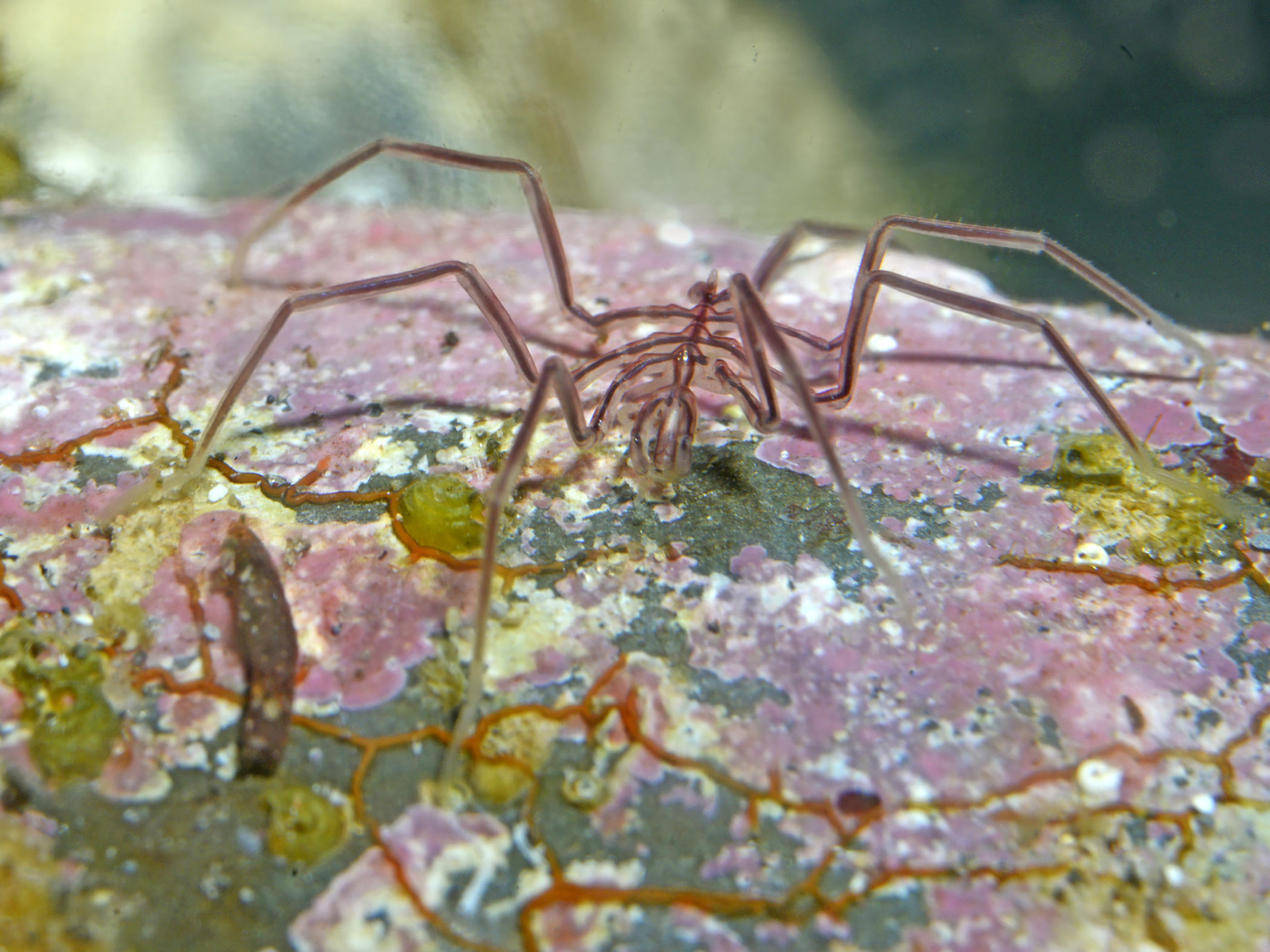
Description: This sea spider has a smooth body up to 1 cm in length, with 8 elongated limbs that are 3-4 times the length of the body. Body segments are longer than they are wide. There are chelifores, with well-developed chelae and a prominent row of teeth, and palps present on this species. The palps have five segments, and the last two segments are equal in length. The propodus (last section of leg) has some spines with three larger spines about halfway along. The body is usually translucent, but the alimentary canal gives the animal a red to dark pink colouration. Ovigers (egg carrying legs) are found on both males and females, and when not carrying eggs they are used to keep the body clean. Occasionally when males are carrying eggs, they are unable to keep up this cleaning maintenance and develop a crust of algae or hydroids etc.
Habitat: Lower shore and shallow sublittoral. Can often be found higher up the shore during summer months, moving offshore in winter.
Distribution: Found all around Britain and Ireland.
Similar Species: There are other Nymphon species found in Britain and Ireland which could be confused with Nymphon gracile. Careful inspection of palps required. Five segmented palps identifies to genus Nymphon, relative length of the segments distinguishes the various species.
Key Identification Features:
- Red-pink coloured sea spider up to 1 cm in length.
- 8 elongate legs (3-4 times the length of the body).
- Palps have five segments; the last two segments are equal in length.
- Propodus has numerous spines with three larger spines about halfway along.
Distribution Map from NBN: Nymphon subtile at National Biodiversity Network mapping facility, data for UK.
iNaturalist: Nymphon subtile at iNaturalist World Species Observations database.
GBIF data for Nymphon subtile
WoRMS: Nymphon subtile at World Register of Marine Species. Accepted name: Nymphon subtile Loman, 1923. AphiaID: 240326.
Classification: Biota; Animalia; Arthropoda; Chelicerata; Pycnogonida; Pantopoda; Eupantopodida; Nymphonoidea; Nymphonidae; Nymphon
| Previous species | Next species |
| Picton, B.E., Keatley, L. & Morrow, C.C. (2025). Nymphon subtile. Loman, 1923. [In] Encyclopedia of Marine Life of Britain and Ireland. https://www2.habitas.org.uk/marbiop-ni/speciesaccounts.php?item=Q60. Accessed on 2026-10-16 |