
| ANNELIDA : : Arenicolidae | ANNELID WORMS |
Arenicola marina (Linnaeus, 1758)
Blow logworm
 |
| Arenicola marina |
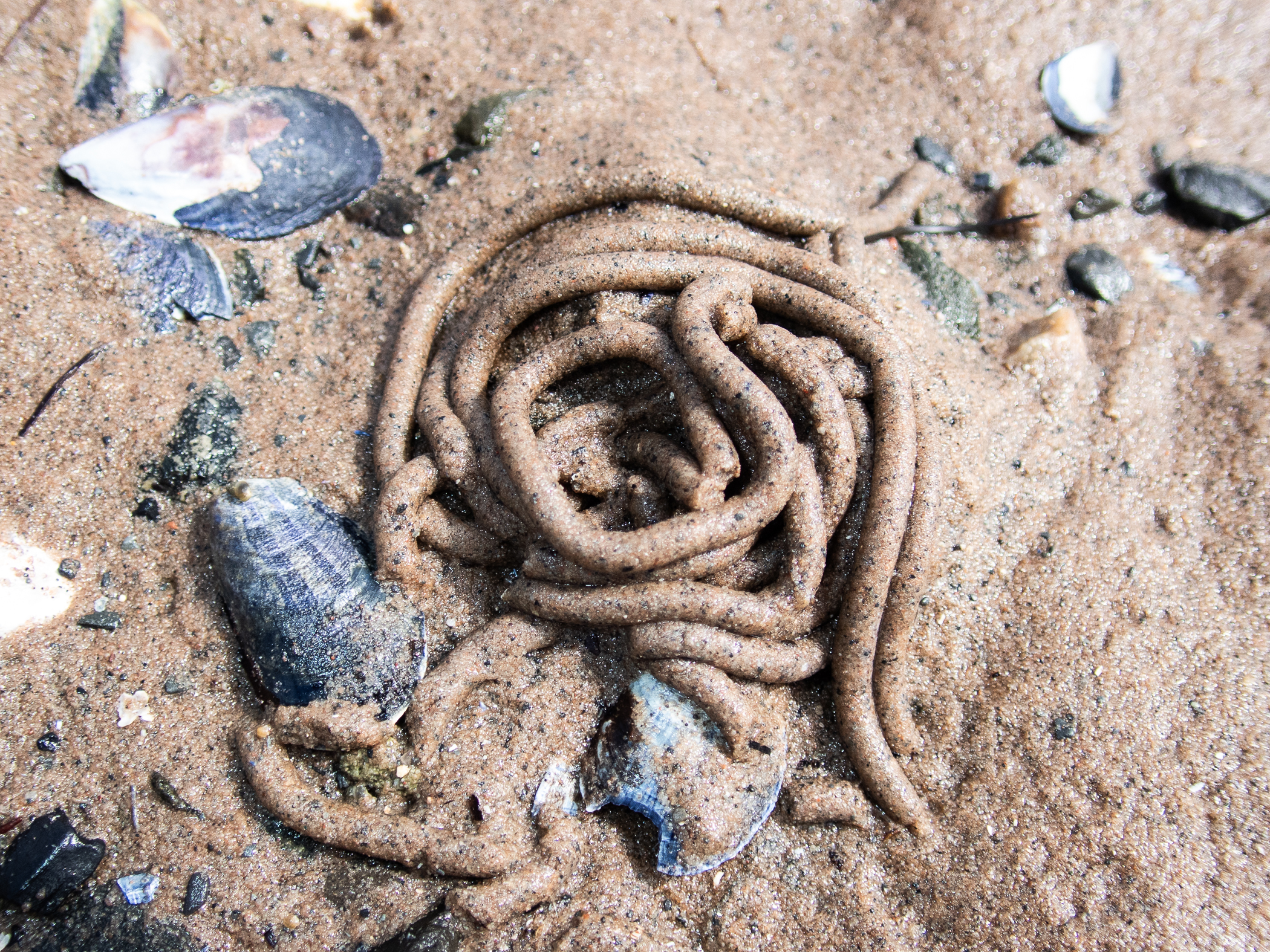
Description: This lugworm is usually seen through presence of its distinctive burrows in sand. They form J- or U-shaped burrows which have a 'blow hole' at the front, in the form of a noticeable depression in the sand, and a slightly messy worm cast at the rear which has the appearance of a piled up string of clean sand which is excreted by the worm as it burrows. The worm itself has a firm cylindrical body 12-20 cm in length, and is usually pink to red in colour. but may sometimes be dark green to black. There are branching dorsal gills on segments 7-19. The head is small and blunt and lacks appendages aside from a rough proboscis. The number of body rings on the first three chaetigers is an important characteristic for this genus, this species has the formula of 2-2-3 body rings on the first three chaetigers.
Habitat: In a J- or U-shaped burrow in sand or muddy sand. Found intertidally, from high water mark to lower shore.
Distribution: Widespread around all coats of Britain and Ireland.
Similar Species: Potentially confused with black lugworm, Arenicola defodiens, which is much darker in colour and burrows much more deeply. It also doesn't usually form a 'blow hole.' Body ring formula helps distinguish (2-2-3 A. marina or 2-2-4 Arenicola defodiens.
Key Identification Features:
- Distinctive burrows with blow hole and casts.
- Firm, cylindrical body.
- Small, blunt head.
- Branching dorsal gills on segments 7-19.
- Usually pink to red in colour.
- Body ring formula of 2-2-3 on first 3 chaetigers.
Distribution Map from NBN: Arenicola marina at National Biodiversity Network mapping facility, data for UK.
iNaturalist: Arenicola marina at iNaturalist World Species Observations database.
GBIF data for Arenicola marina
WoRMS: Arenicola marina at World Register of Marine Species. Accepted name: Arenicola marina (Linnaeus, 1758). AphiaID: 129868.
Classification: Biota; Animalia; Annelida; Polychaeta; Sedentaria; Scolecida; Arenicolidae; Arenicola
| Previous species | Next species |
| Picton, B.E., Keatley, L. & Morrow, C.C. (2025). Arenicola marina. (Linnaeus, 1758). [In] Encyclopedia of Marine Life of Britain and Ireland. https://www2.habitas.org.uk/marbiop-ni/speciesaccounts.php?item=P15760. Accessed on 2026-09-21 |