
Northern Ireland Priority species (NIPS)
| MOLLUSCA : Mytilida : Modiolidae | SNAILS, SLUGS, ETC. |
Modiolus modiolus (Linnaeus, 1758)
Horse mussel
 |
| Modiolus modiolus |
This widespread and common bivalve mollusc can form dense beds or reefs in depths of more than 5 m, and historically these were found throughout the mid- and northern part of Strangford Lough. These reefs have been heavily damaged by bottom fishing, and based on the available survey data are currently showing little to no signs of recovery.
In brief
- The species is found around all Northern Ireland coasts, but usually as the small form in rock pools on the shore, throughout the year.
- The large form is found as species rich beds or reefs, normally in the sublittoral, which can bee seen by diving.
- The Northern Ireland population, which is a significant proportion of the all Ireland population, is in decline.
- The beds in Strangford Lough have been heavily damaged.
- The main threat is thought to be commercial fishing gear.
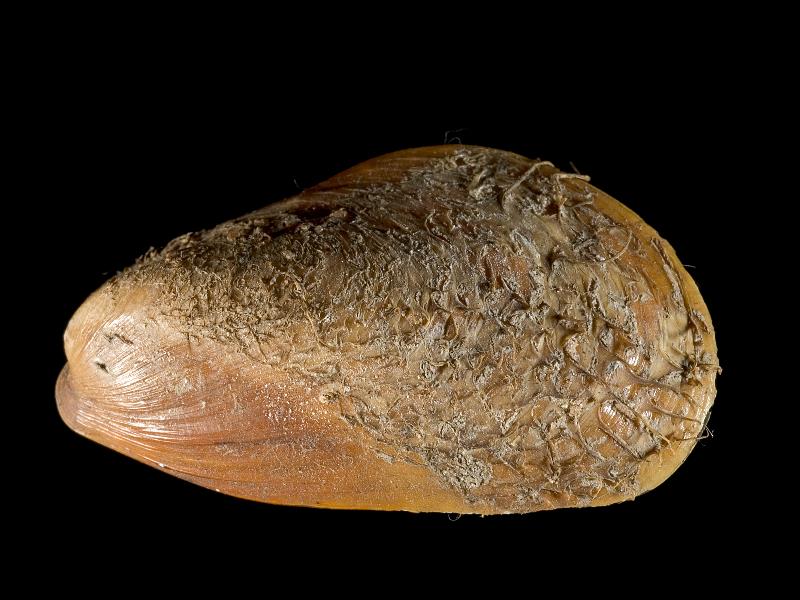
Species description: The shell is solid, irregularly oval or rhomboidal, swollen and equivalve, with well-developed anterior umbonal (beaks) ridges which are subterminal, with the anterior margin projecting beyond. It is bluish-white to slate blue, darkening in older specimens with a very glossy periostracum, a light horn colour to mahogany or dark brown in old shells, usually with a lighter yellow-brown strip along the umbonal ridges. Young shells have numerous long, smooth, spines which wear away in the adult. The interior of the shell is white. The shells reach 10 cm long by 12-18 years, but can be up to 22 cm.
Life cycle: This species matures at over four years of age in Strangford Lough, after a period of rapid growth to a size which is relatively immune to predation. It lives up to 25 years normally, with a maximum of about 50 years. Spawning occurs throughout the year, with larvae settling preferentially where adults are present, which act as a refuge.
Similar species: There are many similar species: Mytilus edulis; Modiolus barbatus, Modiolus adriaticus, Modiolula phaseolina, Modiolarca tumida and Musculus discors. All these species are very difficult to distinguish when juvenile. Modiolus barbatus has serrations on its spines, and has not been found in Northern Ireland waters; Modiolarca tumida and Musculus discors have raised ribs on their shells; the umbones (or beaks) are blunter in Modiolus modiolus than Mytilus edulis, and are not quite anterior due to extension of the shell margin; Modiolus adriaticus is light-yellow in colour with prominent reddish rays or zigzags. It can be reasonably assumed that any specimen of mussel longer than approximately 12cm in Northern Ireland is likely to be Modiolus modiolus.
How to see this species: It is possible to see the small cryptic form of the horse mussel on the lower shore, in exposed or moderately exposed rock pools or in kelp holdfasts around most of the coast of Northern Ireland. The animals live on or around boulders, in crevices and under ledges. Specimens from this habitat often keep their shaggy spines. In offshore waters, principally Strangford Lough, on coarse or muddy sediment with some current, the species may occur in very large communities, which can only be seen by diving. The species is extremely gregarious, with large clumps living partially buried in sediment, and attached to each other by byssus threads.
Current status: Declining. In Northern Ireland, there were formerly extensive mature beds or reefs in Strangford Lough (1970s, 1980s). Most of these beds have now been damaged extensively. Beds have also been found in Carlingford Lough, inside the Skerries and off Millisle/Ballywalter on a variety of sedimentary habitats. There has been a rapid decline in the extent and loss of integrity of the horse mussel reefs, such that both the species and its community are now considered scarce in Northern Ireland. Similar reefs of horse mussel are absent from the rest of the island of Ireland, and only exist in a few areas in Britain such as the Isle of Man, off the Welsh coast, and the west coast of Scotland, to more than 200 m. Elsewhere the species is distributed from the Arctic to France down to 2000 m.
Why is this species a priority in Northern Ireland?
- Criterion 2: Decline based on available data and expert judgement.
Threats: The horse mussel community is one of the most diverse in Strangford Lough and has been identified as being of major importance to the Lough's conservation interest. The community is dependent on the survival of mature, long-lived mussels living together in closely knit clumps to provide a substrate for attachment of epifauna and protection for infauna. The viability of the population itself is dependent on slow but continuous recruitment provided by the present population, and on the physical structure of the community to provide secure sites for larval settlement and growth, so that some individuals at least escape predation. This species has a high sensitivity to substratum loss; smothering; desiccation; increase in emergence routine; changes in water flow; increase in temperature or wave exposure; abrasion and physical disturbance; decrease in salinity; synthetic compound contamination; extraction of the species or other species. There is low recoverability to all these physical factors.
The commercial species the queen scallop Aequipecten opercularis is closely associated with the horse mussel reefs. Juvenile A. opercularis may attach to horse mussels prior to becoming free-living adults. They are therefore important nursery grounds, but are also therefore a target fishery. Diving and remote studies using side-scan sonar confirmed that certain areas of Strangford Lough have been heavily impacted by trawling, in particular that part occupied by the horse mussel/variegated scallop community. The horse mussel is also considered to be a northern species, which may therefore already be under stress due to climate change (global warming).
Action: Records of new sites for this species, with details of habitat and population are always valuable. Observations with a photograph can be recorded using iNaturalist, find the MBDP-NI iNaturalist project here.
Alternatively, records can be sent to CEDaR, National Museums Northern Ireland, 153 Bangor Road, Cultra, Holywood, County Down, BT18 0EU. Tel 028 9039 5257, e-mail cedar.records@nationalmuseumsni.org, or via the online portal.
Objectives:
- Increase the number of viable populations of the species.
- Increase the range of the species.
- Establish appropriate management on appropriate historic sites.
Conservation:
- Strangford Lough is a Marine Protected Area with multiple designations.
- The reefs in Strangford Lough are one of the designated features in this Special Area of Conservation, and this includes the biogenic reefs formed by Modiolus modiolus.
- Implementation of the Northern Ireland and UK Biodiversity Action Plans for the habitat Modiolus modiolus beds.
Distribution Map from NBN: Modiolus modiolus at National Biodiversity Network mapping facility, data for UK.
iNaturalist: Modiolus modiolus at iNaturalist World Species Observations database.
WoRMS: Modiolus modiolus at World Register of Marine Species. Accepted name: Modiolus modiolus (Linnaeus, 1758). AphiaID: 140467.
Classification: Biota; Animalia; Mollusca; Bivalvia; Autobranchia; Pteriomorphia; Mytilida; Mytiloidea; Modiolidae; Modiolinae; Modiolus
| Previous species | Next species |
| Adapted from text by Dr Julia Nunn (2026). Modiolus modiolus. (Linnaeus, 1758). [In] Priority species, Marine Biodiversity Portal NI. https://www2.habitas.org.uk/marbiop-ni/priorityaccounts.php?item=W16750. Accessed on 2026-09-13 |